Hash use turns into addiction when a substance that changes the brain’s reward circuits meets a person with a predisposition and an environment that makes repetition easy. Not everyone who tries hash becomes addicted to it, but among the clearest causes of hash addiction are starting before the age of eighteen, daily smoking, high-potency types, and having anxiety, depression or insomnia the person is trying to calm with the joint. In Egypt, the culture of the “gathering” and considering hash a mood rather than a drug add a special factor that makes repetition easy and acceptable. This article explains the causes and risk factors, and why one person falls while another escapes from the same company.
How does hash turn trying into dependence?
The active substance in hash raises dopamine release in the reward circuits, to a lesser degree than cocaine or heroin but enough for the brain to remember the experience and ask for it. With repetition two things happen at the same time: the brain learns that the joint is the fastest way to relax, sleep or laugh, and receptor sensitivity decreases so it needs a larger amount. When the person tries to stop, insomnia and irritability appear, so they go back to the joint to get rid of them, not to enjoy it. Here dependence has taken root. Data from the US Centers for Disease Control and Prevention indicate that roughly three in every ten cannabis users meet the criteria for the disorder.
From the first session to the morning joint
Rarely does anyone decide to become an addict. The most repeated story goes through gradual stages: a joint at a wedding or a summer trip out of curiosity, then weekend sessions with friends, then a joint every night “so I can sleep”, then a joint before going out in the morning to face the day. Each stage looks to its owner like a natural extension of the previous one, which is why they don’t notice they have crossed the line until they try to stop and fail. Moving from one stage to another may take months or years, and speeds up with the following risk factors.
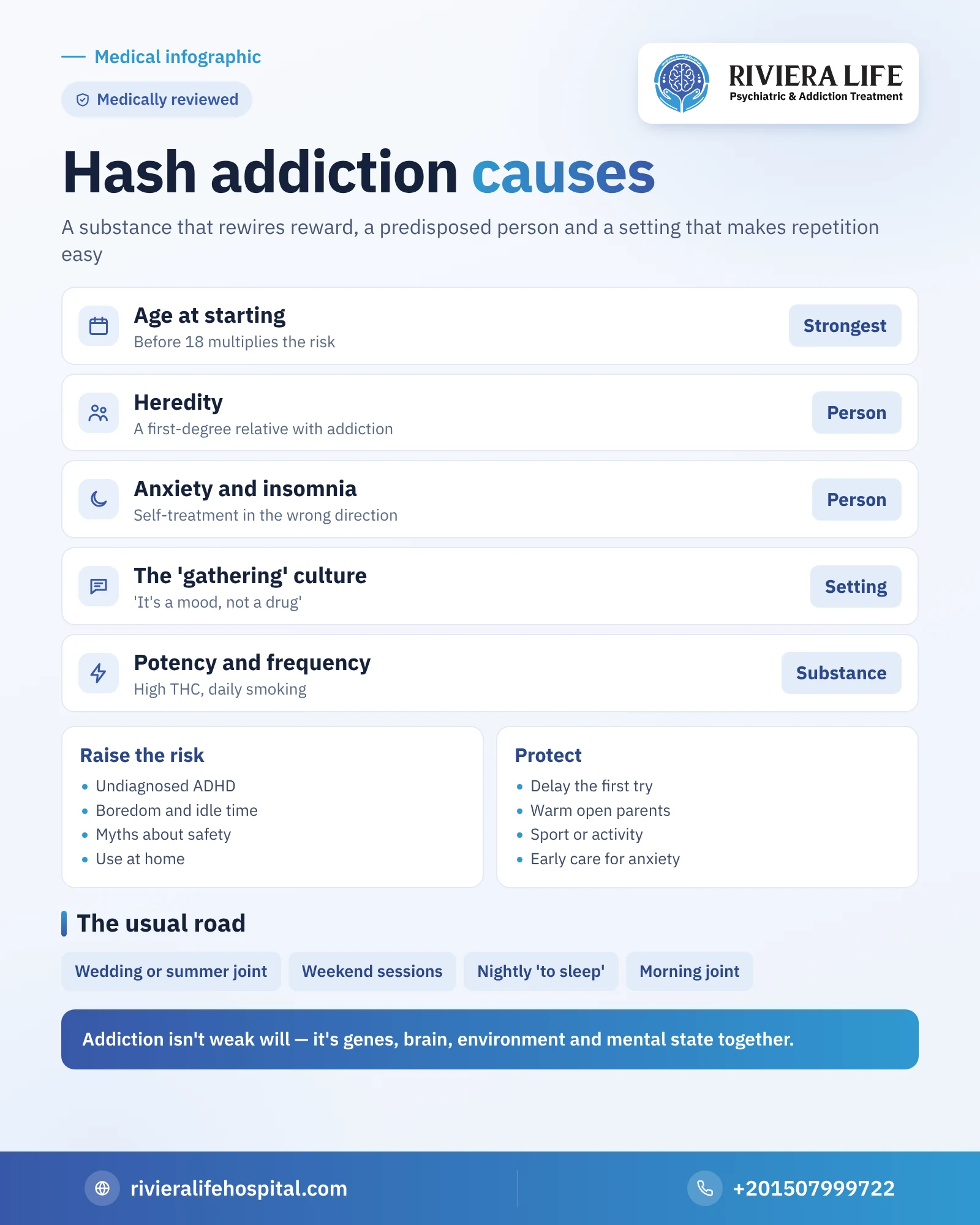
Age at starting: the most dangerous factor
If there is one factor worth the family memorizing, it is age. The brain continues to mature until the mid-twenties, and the last to complete are the areas responsible for controlling impulsivity and judging consequences. The teenager who starts hash at fourteen or fifteen exposes a brain still under construction to a substance that reshapes the reward circuits, which is why research estimates that his risk of addiction is several times higher than someone who starts after adulthood. Delay alone, even if it doesn’t completely prevent trying, reduces the risk.
Heredity and biological predisposition
Genes play a considerable role in addiction in general, and in cannabis addiction too. Having a father, brother or first-degree relative who suffered from addiction, whether to hash, another substance or alcohol, raises the likelihood. People also differ in the way they respond to the first experience: some feel anxiety and dizziness so don’t repeat it, while others feel great relief so are drawn to it. Heredity isn’t an inevitable fate, but it is an extra reason for someone with a family history of addiction to be more cautious.
Anxiety, insomnia and depression: self-treatment in the wrong direction
Among the sentences doctors hear most: “I smoke to calm down” or “without it I can’t sleep”. Many hash addicts started with social anxiety, constant tension or undiagnosed sadness, and found quick relief in the joint. The problem is that this relief is temporary, and that repeated use increases anxiety and insomnia over time, so the person needs more joints to soothe what increased because of the joint itself. This circle is among the strongest causes of addiction and the hardest to break unless the original disorder is treated. We explain hash’s reverse effect on mood in the article on the harms of hash.
Attention-deficit/hyperactivity disorder
Young people with undiagnosed attention-deficit/hyperactivity disorder are more prone to trying hash and continuing with it. They are looking for calm for a mind that doesn’t stop, and tend towards impulsivity and sensation-seeking. Many of them only had their disorder discovered after coming for addiction treatment. Treating this disorder properly is an essential part of both prevention and treatment.
Company and the “gathering” culture in Egypt
Hash in Egypt usually isn’t a substance used in secret, but part of social rituals: a late night on the roof, a summer trip, a popular wedding, or a gathering with work friends. These rituals carry hidden messages that make repetition easy: “everyone smokes”, “this isn’t drugs”, “this is lighter than cigarettes”. And with its frequent appearance in films and songs as a symbol of fun and manhood, refusing becomes the strange behavior, not using. The young man whose whole circle of friends is built on this gathering finds stopping almost impossible, because he would lose his whole social life with it.
Idle time, pressures and the absence of alternatives
Boredom is among the strongest triggers users mention. Periods of unemployment after graduation, long holidays, exhausting night work, and the pressures of money and marriage are all situations in which a person looks for a quick escape. And when alternatives such as sport, a hobby or meaningful work aren’t available, the joint fills the gap.
The potency of the active substance and the way of use
Hash itself, being the concentrated resin of the plant, usually carries a higher proportion of the active substance than bango, and this proportion has risen globally in recent decades. The higher the potency, the faster the dependence and the more likely the psychological symptoms. Daily smoking, or more than once a day, is also linked to addiction much more than intermittent use.
Myths that pave the road to addiction
A large part of hash’s spread in Egypt is caused by ideas people repeat without checking. “It’s a plant God created”, “no one has died from hash”, “it opens the mind and makes you think better”, “I smoke when I feel like it and stop whenever I want”. Each of these sentences lowers caution a step, and makes the second and third joint easier. The truth is that a substance being herbal doesn’t make it safe, and that the absence of direct death doesn’t mean the absence of addiction, psychosis and lost years. When a young man believes that what he is doing isn’t drugs at all, he won’t see the early signs in himself, and won’t ask for help until late.
The home and the family
The family can be a risk factor or a protective factor. Constant disagreements, separation, the father’s absence from following up the children, or the opposite of suffocating control without dialogue, all raise the risk. So does having a member of the household who smokes hash openly, so the young learn that it is normal. Some families implicitly allow it, thinking it is less harmful than others, and this is a message the children pick up early.
Factors that protect against hash addiction
On the other side there are factors that clearly reduce the risk:
- Delaying the first try until after adolescence.
- A warm relationship with the parents and open dialogue without threats.
- Friends whose time doesn’t revolve around using.
- Regular sport or activity that gives a sense of achievement.
- Early diagnosis and treatment of anxiety, depression and ADHD.
- Correct information about hash instead of circulating myths.
Is hash addiction a weakness of will?
No. Addiction is a medical condition in which genes, the brain, the environment and the psychological state intertwine, and will is part of the picture, not all of it. Knowing the causes doesn’t mean releasing the person from responsibility, but it explains why sermons and threats don’t work, and why many need organized treatment that targets these same causes, as we explain in the article on hash addiction treatment. And if you are still trying to confirm the problem exists at all, start with the article on hash addiction symptoms, and for how to open the conversation without a clash see how to deal with a hash addict.
More from the hash guide
Questions many people ask
Addiction doesn't usually happen from one time; it forms with repetition. But the first experience may be the start of the road, especially in teenagers and those with a genetic or psychological predisposition.
People differ in genes, age at starting, psychological state and the surrounding environment. Several risk factors meeting in the same person is what raises the likelihood of addiction.
Anxiety and insomnia are among the best-known motives for continuing, because the joint calms them temporarily. But repeated use increases them in the longer term, forming a circle that is hard to break without treatment.
Each has a different pattern of dependence, and both may cause addiction. And in Egypt hash is usually mixed with tobacco, so the user combines two risks.
Open dialogue, delaying any experiment until after adolescence, knowing his friends, encouraging sport and activity, and treating anxiety or ADHD early are among the most important protective factors.