Hashish withdrawal symptoms usually begin within one to three days of the last joint, peak roughly between the second and sixth day, then mostly settle within one to two weeks. The most prominent are insomnia, irritability, anxiety, loss of appetite and disturbing dreams, and sleep problems may continue for weeks afterwards. These symptoms don’t threaten life in most cases, but they are the number one reason attempts to stop fail. Withdrawal becomes dangerous when it comes with severe depression, thoughts of self-harm or psychotic symptoms, or when hashish has been mixed with other substances whose withdrawal is more dangerous.
Why do withdrawal symptoms appear when quitting hashish?
For years it was commonly said that hashish “has no withdrawal”, and that isn’t true. Its active substance activates a network in the brain that regulates sleep, appetite, mood and stress. With daily smoking, the brain adapts by reducing the number of receptors that respond to it, as if turning the volume down to cope with the noise. When hashish stops suddenly, the volume stays low, so sleep is disturbed, eating drops and tension rises, until the receptors gradually return to normal over weeks. That is why psychiatry today recognizes cannabis withdrawal as a separate diagnosis with clear criteria.
When do hashish withdrawal symptoms start?
Because the active substance is stored in fat and released from it slowly, withdrawal is slightly delayed compared with short-acting drugs. Most users notice the first symptoms on the first or second day, usually beginning with irritability and difficulty sleeping on the first night. The heavier and longer the use, the clearer the onset and the more severe the symptoms. Someone who smoked only occasionally may feel hardly any withdrawal.
The timeline of hashish withdrawal
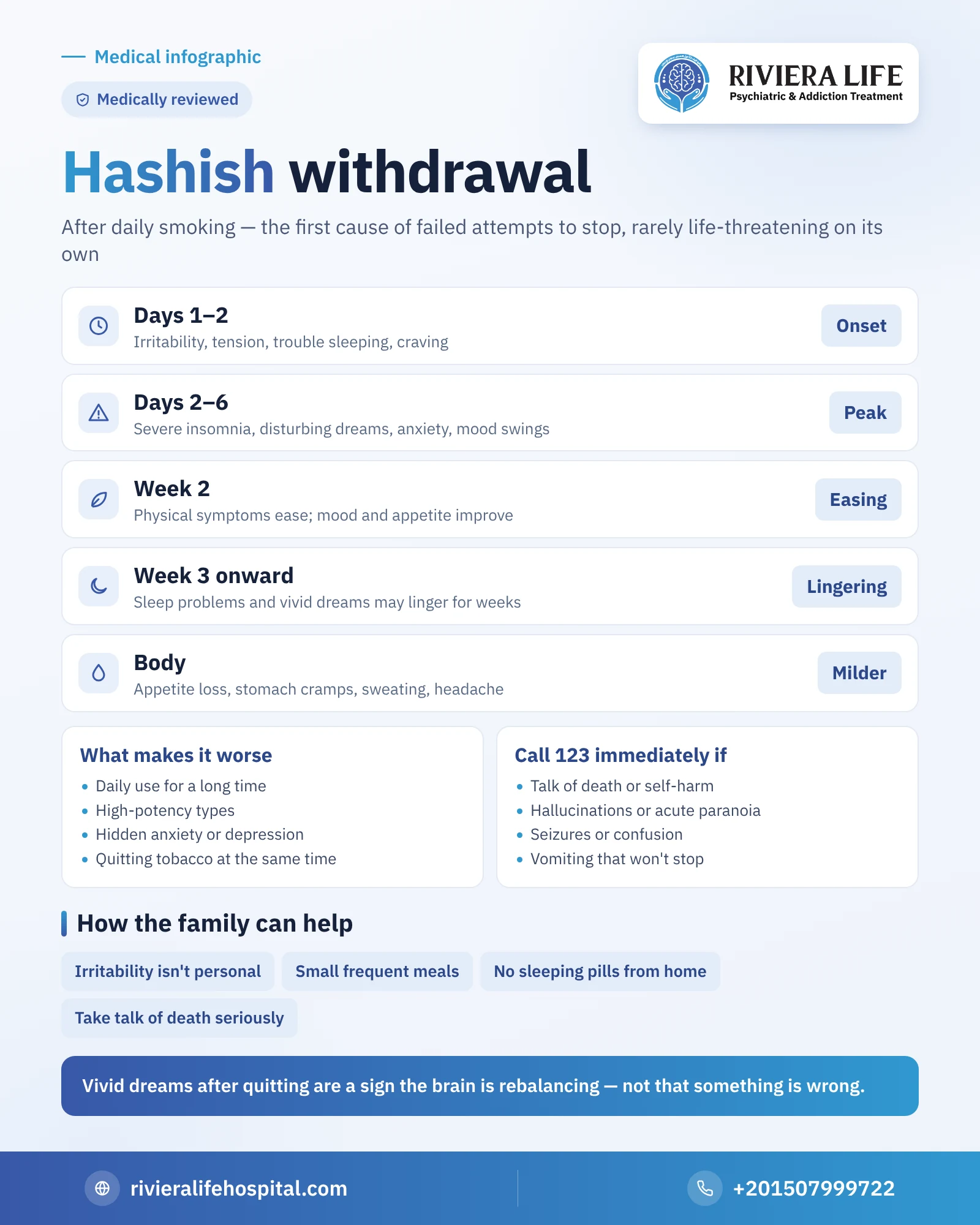
This is an approximate picture of what happens in someone who smoked daily, and it differs from person to person:
| Period | What usually happens |
|---|---|
| Days one and two | Irritability and tension, difficulty sleeping, the start of appetite loss, and a clear urge to smoke. |
| Day two to day six | The peak: severe insomnia and disturbing dreams, anxiety and distress, mood swings, and sometimes sweating, tremor, headache and stomach pain. |
| The second week | Most physical symptoms gradually settle, and mood and appetite improve, while the urge remains at certain moments. |
| The third week and beyond | Sleep problems and vivid dreams may continue for weeks, and the urge appears with old triggers. |
The psychological symptoms of withdrawal
The psychological side is the heaviest part of hashish withdrawal. Many describe the first days as feeling “suffocated” for no reason. Common symptoms include:
- Irritability and quick anger over trivial things, which may reach outbursts.
- Anxiety, inner tension and being unable to sit still.
- Low mood and loss of enjoyment.
- A pressing urge to smoke, stronger at times linked to it, such as after dinner or before sleep.
- Poor concentration and scattered attention.
Physical symptoms
The physical symptoms are usually milder and shorter, and don’t appear in everyone:
- Loss of appetite and sometimes weight loss in the first weeks.
- Abdominal pain or cramps, and nausea.
- Sweating, especially at night, and a mild tremor.
- Headache, and feeling hot or shivery.
Insomnia and disturbing dreams
Sleep deserves special attention, because it is the last thing to improve and the thing that most drives relapse. Many people addicted to hashish haven’t slept without a joint for years, so the first nights are long and broken. With stopping, the dream sleep that hashish was suppressing returns, coming intensely with vivid and sometimes disturbing dreams. This is a sign that the brain is regaining its balance, not that something bad is happening. It improves gradually over weeks, helped by regular sleep and wake times, avoiding caffeine after the afternoon, and physical activity during the day. Sleeping pills are only taken on prescription, because some of them cause a new dependence.
What makes withdrawal more severe?
- Smoking daily, or several times a day, for a long period.
- High-potency types.
- Anxiety or depression before use, which hashish was covering.
- Quitting tobacco at the same time, so nicotine withdrawal symptoms combine with those of hashish.
- Mixing hashish with tramadol, pregabalin or alcohol.
- An environment full of triggers: the same friends and the same places.
When do hashish withdrawal symptoms become dangerous?
Hashish withdrawal alone doesn’t cause seizures or directly threaten life. The danger comes through three doors: a severe drop in mood that may reach suicidal thoughts; suspicion and hallucinations appearing in someone predisposed to psychosis; or withdrawal from other substances the person was mixing with hashish without the family knowing. Suddenly stopping alcohol, sedatives or pregabalin can cause seizures and dangerous confusion.
Call an ambulance immediately on 123 if you see
These signs during stopping aren't treated at home.
- Talk of death or self-harm, or an actual attempt
- Hallucinations or acute paranoia with aggressive behavior or loss of touch with reality
- Seizures, or confusion and not knowing the place and time
- Persistent vomiting that won’t stop, with signs of dehydration
Withdrawal, or a hidden mental illness?
Sometimes symptoms continue with the same force after two or three weeks: sadness that doesn’t lift, constant anxiety, or growing suspicion. Here it should be considered that withdrawal has ended and uncovered what lay beneath it, such as depression, an anxiety disorder or a psychotic disorder. Telling the two apart is the psychiatrist’s job, and it matters because the treatment differs. You will find an explanation of hashish-related suspicion in our article on hashish addiction and suspicion.
Stopping suddenly or cutting down gradually?
Many ask whether it is better to stop all at once or cut down day by day. With hashish alone, stopping suddenly poses no physical danger, and most patients choose it under follow-up, because cutting down on your own often turns into endless postponement: one joint fewer today, then back to the same rate on the first hard day.
But someone who mixes hashish with sedatives, pregabalin or alcohol shouldn’t stop those substances suddenly without a doctor, because withdrawal from them can be dangerous. The decision here is made after an assessment, with a written plan that the patient and family know, not with repeated solo attempts that end each time in fresh disappointment.
How are hashish withdrawal symptoms managed medically?
There is no approved medicine specifically for hashish withdrawal, but the doctor has ways to ease the symptoms: short-term treatment for insomnia, for anxiety if it is severe, or for nausea and stomach pain. More important than medicine is psychological support in these days, and explaining to the patient what is happening so they don’t interpret every bad night as proof that they “can’t do it”. In simple cases an outpatient program with close follow-up is enough, while with mixed substances or severe depression admission is safer. Withdrawal is only the beginning; what comes after it is explained in our article on hashish addiction treatment.
What can the family do during withdrawal?
Know that irritability is part of the symptoms and isn’t aimed at you, so don’t get into battles over every word. Provide frequent light meals instead of large ones, and encourage them to walk or exercise. Don’t offer them a sleeping pill from your own cupboard, and don’t ask them to “pull themselves together” as if it were only a matter of willpower. Watch their mood calmly, and if you hear talk of death, take it seriously. To learn about the stages of the body and mind recovering after withdrawal ends, see our article on when the body returns to normal after quitting hashish.
More from our hashish guide
- Hashish: the complete guide
- Hashish addiction symptoms
- How long hashish stays in your system
- Hashish addiction treatment
Questions many people ask
Most symptoms settle within one to two weeks, but disturbed sleep and vivid dreams may continue for several weeks in those who smoked daily for a long time.
Hashish withdrawal alone doesn't usually cause seizures. Their appearance usually points to withdrawal from another substance such as alcohol, sedatives or pregabalin, and calls for the emergency department.
Because the brain had grown used to the substance in regulating sleep, and needs weeks to regain its balance. The insomnia is temporary and improves with regular sleep times and daytime activity; sleeping pills are only taken on prescription.
A dip in mood can happen during withdrawal. If it continues after two or three weeks, or comes with thoughts of death, it needs an urgent psychiatric assessment.
Most cases are managed with an outpatient program, but admission is better with mixed substances, severe depression, psychotic symptoms or failed previous attempts.