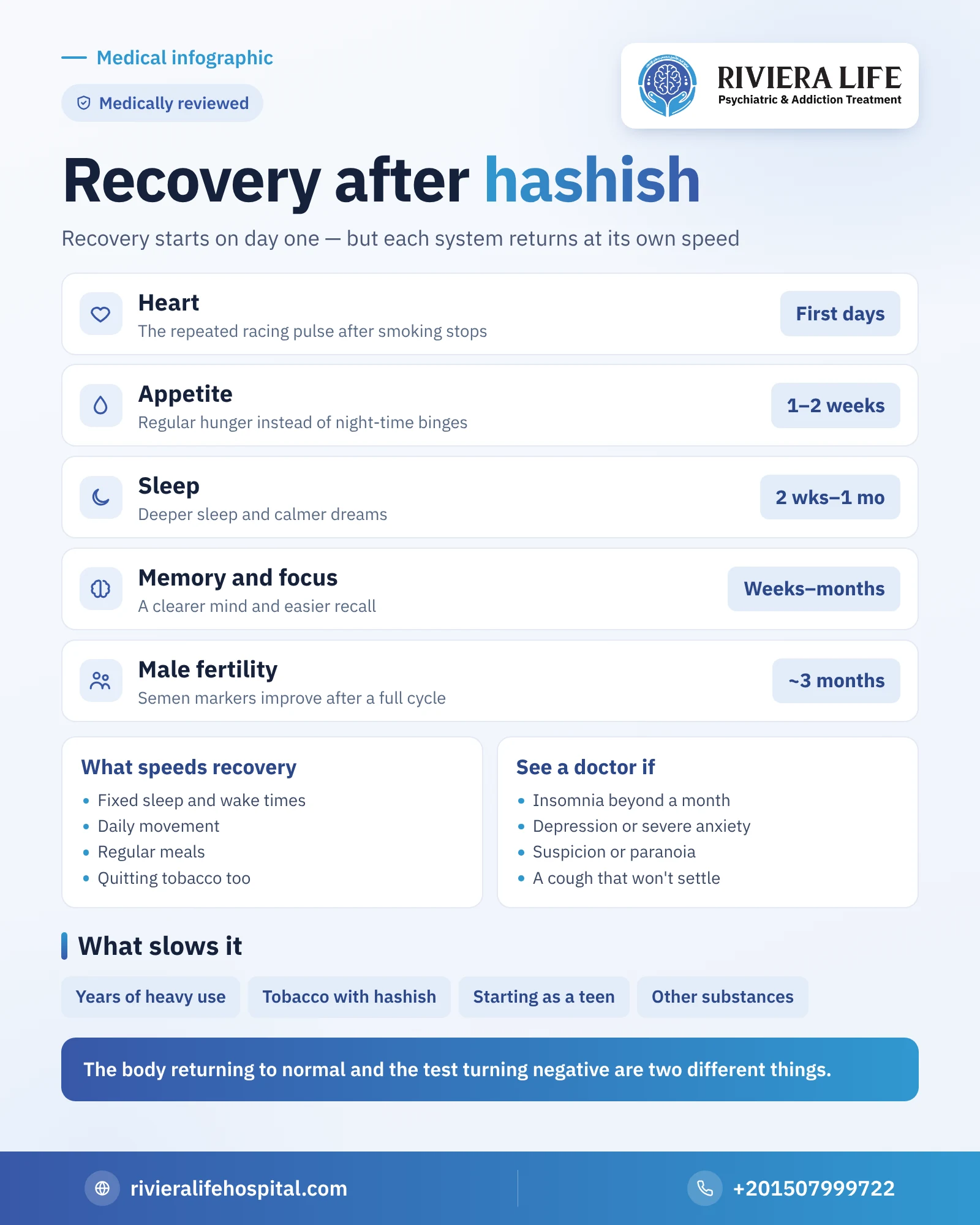
When does the body return to normal after quitting hashish? Recovery begins from the first day of stopping, but each system returns at its own speed. Appetite usually improves within one to two weeks, sleep usually needs about two weeks to a month to settle, cough and phlegm decrease within weeks, while memory, concentration and motivation need weeks or months, and a semen analysis needs about three months to reflect the improvement. These durations are approximate, and they are longer for those who used for many years, in large amounts, or mixed hashish with tobacco. This article maps the improvement system by system, what speeds it up, and when a delay is a reason to see a doctor.
What determines how fast the body recovers?
There is no single clock that applies to everyone. Someone who smoked at weekends for a few months differs from someone who has smoked daily for ten years. The most important factors include:
This article is specifically about hashish. If you use more than one substance, or another substance, the general picture for all types is in when the body returns to normal after quitting drugs.
- The length and amount of use: the longer the period and the larger the amount, the longer the brain needs to regain its balance.
- Tobacco: in Egypt hashish is usually rolled with tobacco, so if smoking continues after quitting hashish, the benefit to the lungs and heart is slower.
- Age at the start: those who started in adolescence may need longer for concentration and memory to improve.
- Other substances: tramadol, pills or alcohol add complications of their own.
- Mental health: anxiety or depression that hashish was covering may appear after stopping and need separate treatment.
The first weeks: the crossing stage
The first days after stopping are the hardest, dominated by insomnia, irritability, anxiety and poor appetite; they usually peak during the first week and then begin to recede. This stage isn’t the subject of this article, and its details are in our article on hashish withdrawal symptoms. What matters here is knowing that this discomfort is itself a sign that the brain has begun to reset itself, and that what comes after it is the stage of real improvement that we follow below.
Sleep: when does it return to normal?
Sleep is what worries people in recovery most, because many of them used to smoke to be able to sleep. At first it is hard to fall asleep and waking is frequent, and unusually vivid, strange dreams appear. The reason for these dreams is that hashish reduced the stage of sleep in which dreams happen, so when it stops, that stage returns strongly for a while. Sleep quality usually starts to improve after the second week, and settles for most people within about a month; some disturbing dreams or difficulty sleeping may continue for additional weeks in those who used for a long time. And the final result is worth the patience: normal sleep that doesn’t depend on a substance, and lighter waking in the morning.
Appetite, weight and the stomach
After days of poor appetite, the desire for food returns gradually within one to two weeks, but in a more regular way than the night-time hunger bouts that accompanied use. Weight may change slightly in the first month, up or down, then settle. As for those who suffered repeated bouts of vomiting with abdominal pain and found relief in hot showers, this is a recognized condition that affects some chronic users; it usually improves within days to weeks of stopping completely, and continuing to use “to calm the stomach” doesn’t help.
The lungs and breathing
Hashish smoke irritates the airways, which is why many regular smokers have a morning cough, phlegm and sometimes wheezing. After stopping, the cough and phlegm decrease gradually over weeks, and breathlessness when climbing stairs or exercising improves. The cough may increase slightly in the first days because the airways have begun to clear themselves.
But the full benefit depends on quitting tobacco too: someone who quits hashish and keeps smoking cigarettes retains a large part of the harm. And if the cough lasts more than a few weeks, if blood appears in the phlegm, or breathlessness doesn’t improve, a medical examination is needed. For anyone who wants to get rid of cigarettes as well, our article on nicotine addiction and how to quit explains the tried steps.
The heart and physical energy
Hashish raises the heart rate immediately after smoking, and with stopping this repeated effect disappears. Many notice during the first month that their physical energy is better, and that the sluggishness they had considered part of their nature has begun to ease. The ability to exercise returns gradually, especially if stopping is combined with regular physical activity, even something simple like a daily walk.
Memory and concentration
This is what students and employees ask about more than anything else. Hashish weakens short-term memory and attention during regular use, and research indicates that a large part of this weakness improves after stopping, with noticeable improvement within the first weeks. The person in recovery feels their mind is clearer, and that they remember appointments and what they have read more easily. But those who started at an early age or used heavily for years may need longer, and some difficulties may remain that improve with mental training and regular study or work. The full picture of hashish’s effect on the brain is in our article on the harmful effects of hashish.
Mood and motivation
In the first weeks, the person in recovery may go through mood swings, anxiety and obvious boredom, because the brain has lost its easy source of pleasure and hasn’t yet returned to enjoying natural sources. Then motivation begins to return gradually: a wish to go out, to plan, and to get done what has been put off for a long time. Families often notice this change before the person does. But if sadness or loss of interest continues for more than about two weeks after the withdrawal stage is over, or thoughts of hopelessness appear, there may be depression that needs treatment, and waiting isn’t enough.
Hormones and fertility
In men, the cycle of sperm production takes about three months, so a semen analysis isn’t expected to improve before then. In women, the menstrual cycle may become regular gradually during the first months. Desire and sexual performance return in most cases as sleep and mood improve, and the details are in our article on hashish and sex.
The recovery map in brief
| System | Roughly when improvement starts | What you notice |
|---|---|---|
| Heart | From the first days | The repeated racing pulse disappears |
| Appetite | One to two weeks | Regular hunger instead of night-time eating bouts |
| Sleep | Two weeks to a month | Deeper sleep and calmer dreams |
| Lungs | Weeks to months | Less cough and phlegm, and longer breath |
| Memory and concentration | Weeks to months | A clearer mind and easier recall |
| Mood and motivation | Weeks to months | Interest, and a return to activities |
| Male fertility | About three months | Improved semen markers |
And note that the body returning to normal is one thing, and the substance clearing from a test is another. In a heavy user, the test may remain positive for weeks despite stopping, as our article on how long hashish stays in your system explains.
What speeds up recovery?
- Fixed sleep times: and waking at the same time every day, with fewer screens and less caffeine in the evening.
- Daily movement: walking or exercise improves sleep, mood and breathing together.
- Regular food: three meals and enough fluids, even before appetite fully returns.
- Quitting tobacco: or at least cutting down with a plan, so the lungs get the full benefit.
- No substitution: no sleeping pills without a prescription, no alcohol and no substitute pills.
- Psychological support: cognitive behavioral therapy helps with craving and boredom in the first months.
When do you need a doctor?
If insomnia continues for more than a month despite sticking to healthy habits, if depression or severe anxiety appears, or thoughts of suspicion and paranoia, a persistent cough, or if you have gone back to smoking more than once despite wanting to stop. At Riviera Life, a team of consultants in psychiatry and addiction treatment follows the post-stopping stage as part of a hashish addiction treatment plan, in complete confidentiality, with a follow-up program after discharge. The first consultation is free on +201507999722.
More from our hashish guide
- Hashish: the complete guide
- Hashish withdrawal symptoms and how long they last
- Hashish addiction treatment and relapse prevention
- How to deal with someone addicted to hashish
- When does the body return to normal after quitting drugs? A recovery map for the brain and body
Questions many people ask
Improvement usually starts after the second week and settles for most people within about a month, and it may take a little longer for those who used for years.
Because hashish reduced the stage of sleep in which dreams happen, so when it stops, that stage comes back strongly for a while and then calms down gradually.
Cough and phlegm decrease within weeks and breathing improves, but the full benefit requires quitting tobacco too, because it is usually mixed with hashish.
A large part of the weakness in memory and concentration improves within weeks to months, and those who started early or used heavily may need longer.
No, the two are different, and in a heavy user the test may stay positive for weeks despite stopping.