High cortisol symptoms come in two completely different types despite the similar name. The first type is common: a functional rise that accompanies chronic psychological stress and lack of sleep, appearing as insomnia, tension, cravings for sweets and fatigue. The second type is rare but a real disease called Cushing’s syndrome, with clear physical signs such as a full face, fat collecting in the belly with thin arms and legs, and wide purple skin streaks. In this article we explain how to tell them apart, when reviewing your lifestyle is enough, and when you must see an endocrinologist without delay.
Why does cortisol rise in the first place?
Cortisol is a hormone secreted by the adrenal gland on orders from the brain via the hypothalamus and pituitary axis, and its basic job is preparing the body for effort, as our guide to cortisol explains. A rise for hours after a difficult situation is completely normal. Concern begins when the rise remains for weeks and months, or when it comes from a source not subject to stress at all, such as a cortisone medicine or a tumor that secretes the hormone without stopping.
The sources of the rise can be summarized in three groups: continuous psychological and physical stress, conditions that mimic the disease without being it, and the real disease with its various causes. Each group has a different picture and a different way of dealing with it.
The first picture: a stress-related rise
Here the hormone isn’t at pathological levels, but the daily rhythm is disturbed; it doesn’t fall as it should at night, or it rises with every small stress. Imagine an employee who works long hours, takes their phone to bed and drinks coffee until the evening. This person may notice:
- Difficulty sleeping, or repeated waking around dawn with a busy mind.
- Tension, irritability and a constant feeling that something must be done.
- An increasing desire for sweets and fast food, and gradual weight gain.
- Morning fatigue despite hours of sleep, and scattered concentration.
- Frequent colds or slow healing of minor wounds.
- Tension headaches and digestive disturbances.
These signs are very general and shared by many conditions, including anxiety, depression, iron deficiency and an underactive thyroid. So it isn’t right to conclude from them alone that cortisol is the cause.
The second picture: Cushing’s syndrome
Cushing’s syndrome is the medical condition in which the body is exposed to excess amounts of cortisol for a long period. Its signs differ from the effect of stress in being tangible physical signs that develop gradually over months, the most important of which are:
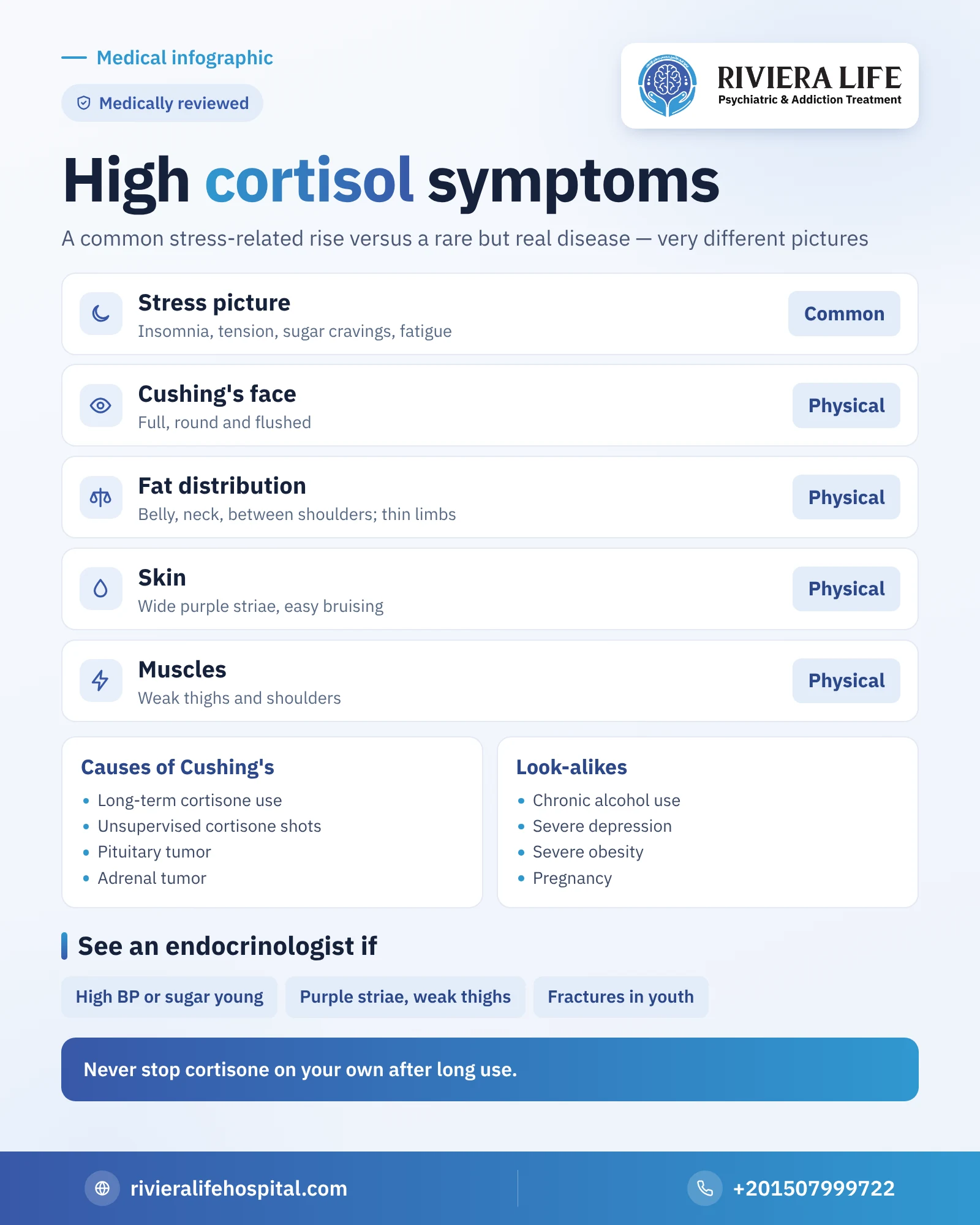
- A full, round and flushed face.
- Fat collecting in the belly, chest and behind the neck between the shoulders, with relatively thin arms and legs.
- Wide violet or purple streaks on the belly and thighs, wider than ordinary stretch marks.
- Thin skin that bruises easily, and wounds that heal slowly.
- Weakness in the thigh and shoulder muscles, which the patient notices when getting up from a chair or climbing stairs.
- High blood pressure and blood sugar, and osteoporosis.
- In women: menstrual disturbance and increased facial and body hair.
- Psychological changes such as depression, anxiety, mood swings and poor memory.
What causes Cushing’s syndrome?
The most common cause is cortisone that enters the body from outside: tablets or injections used for long periods to treat asthma, rheumatism, immune diseases and others. This doesn’t mean the treatment is wrong, but that it needs follow-up to reduce its effects. More dangerous is use without supervision, such as the cortisone injections some people in Egypt pass around to gain weight, open the appetite or ease joint pain.
Internal causes are much less common, the best known being a small benign tumor in the pituitary gland that secretes the hormone stimulating the adrenal gland, called “Cushing’s disease” in this case. They also include tumors in the adrenal gland itself, and rarely tumors in other organs that secrete the stimulating hormone.
Conditions that resemble Cushing’s but aren’t
There are conditions in which cortisol may rise genuinely in tests without a tumor or medicine, which doctors call “pseudo-Cushing’s”, the best known of which are:
- Chronic alcohol addiction, and the tests may improve after stopping for long enough; you will find the treatment plan in our article on alcohol addiction treatment.
- Severe depression and some anxiety disorders.
- Severe obesity and poor control of blood sugar.
- Pregnancy, in which cortisol rises naturally.
This point explains why the doctor sometimes asks for tests to be repeated after treating the cause, before judging that there is a glandular disease.
Quick comparison: stress or disease?
| Aspect | Stress-related rise | Cushing’s syndrome |
|---|---|---|
| Nature of the signs | Psychological and general: insomnia, tension, fatigue | Clearly physical: round face, purple streaks, muscle weakness |
| Weight distribution | General gradual gain, if any | Belly, neck and face with thin limbs |
| Skin | Usually normal | Thin, easy bruising, slow healing |
| Blood pressure and sugar | May be slightly affected | A clear rise, sometimes at a young age |
| Improvement with rest | Improves with sleep and less stress | Doesn’t improve without treating the cause |
| Who follows up | A general practitioner or psychiatrist | An endocrinologist |
When should you see an endocrinologist?
Ask for an appointment with an endocrinologist if you have two or more signs of Cushing’s, especially if they develop over months. Situations that deserve assessment include:
- High blood pressure or sugar appearing at a young age without a clear family history.
- Wide purple streaks with weakness in the thigh muscles.
- Osteoporosis or unexpected minor fractures in young people.
- Long-term use of cortisone, with or without a prescription, with a change in body shape.
- Rapid weight gain with general weakness, psychological changes and menstrual disturbance.
Your journey may start with a general practitioner or internist, who decides on referral to an endocrinologist. It is important not to stop any cortisone medicine on a personal decision, because stopping suddenly after long use may cause a dangerous hormone deficiency.
How does the doctor confirm the diagnosis?
The diagnosis doesn’t rely on a single morning cortisol test. The doctor usually chooses two or more tests from among: measuring cortisol in saliva late at night, or in urine over a full day, or a suppression test in which the patient takes a medicine at night and cortisol is then measured in the morning. If the rise is confirmed, the stage of looking for its source comes with additional tests and scans. And because the tests are affected by medicines, contraceptives, staying up late and acute illness, reading them is the doctor’s job, not the job of search engines.
The psychological side: don’t ignore it
Many of those who search for high cortisol symptoms don’t have a glandular disease, but prolonged psychological stress, anxiety or depression that needs treatment in its own right. Doctors know that chronic anxiety comes with palpitations, tremor and muscle tension linked to the fast stress hormones, as our article on adrenaline and anxiety explains. And if these signs appear with persistent insomnia and loss of enjoyment of things, they may be closer to anxiety symptoms than to a hormonal disorder.
Some people try to calm themselves with sedatives, cannabis or alcohol, so tension rises further with each withdrawal, and the condition enters a cycle that is hard to escape alone.
What do you do if the cause is stress?
The good news is that a functional rise usually responds to realistic changes in sleep, movement and the way of dealing with stress. What chronic stress does to the body and mood we have detailed in our article on psychological stress: its signs and effect on the body. You don’t need expensive supplements or complicated diets. You will find practical steps ordered by strength of evidence in our article on how to lower cortisol, and if the symptoms don’t improve within weeks despite commitment, medical assessment is the next step.
How can Riviera Life help you?
If psychological stress, anxiety or substance use is what raises your tension and drains your sleep, the consultants in psychiatry and addiction treatment at Riviera Life assess your case in complete confidentiality, and refer you to an endocrinologist if signs appear that call for it. The first consultation is free on +201507999722.
More from our cortisol guide
- Cortisol: the complete guide to the stress hormone
- How to lower cortisol in proven ways
- Noradrenaline and psychological stress
- Melatonin and the body’s biological clock
- Psychological stress: its signs, its effect on the body and how to deal with it healthily
Questions many people ask
No. Stress changes the rhythm of cortisol, but doesn't usually reach the persistent pathological levels that cause Cushing's. The syndrome usually comes from cortisone medicines or tumors that secrete the hormone.
Not necessarily, as most cases of weight gain have other causes. What catches the doctor's eye is belly fat combined with thin limbs, purple stretch marks and muscle weakness.
An endocrinologist is the specialist, and you can start with an internist who decides on referral. If the symptoms are mostly psychological, a psychiatrist is suitable.
Using them without supervision may cause a chronic rise in cortisol with all its complications, then a dangerous deficiency when they are stopped. They are only used with a prescription and follow-up.
In many people with alcohol addiction who show Cushing-like signs, the tests and signs often improve after stopping for long enough, with medical follow-up.