Psychological stress is what a person feels when demands seem bigger than their ability to meet them: a manager asking for the impossible, prices rising faster than the salary, and a mother caring for her children and her sick father at the same time. It isn’t an illness, but a natural response that can be useful when it is short, because it sharpens attention and pushes to act.
But when it lasts without breaks, it starts showing on the body, mood, sleep and relationships, and may pave the way for anxiety or depression. This article explains how you tell passing stress from chronic stress, how to read its signs, why it exhausts the body, which ways of dealing with it protect and which harm, and when you need specialist help.
What exactly is psychological stress?
The World Health Organization describes psychological stress as a state of worry or mental tension caused by a difficult situation. The key word here is “situation”: stress usually has an external source that can be named, and usually eases when it ends. This is what distinguishes it from anxiety disorders, in which fear and apprehension continue even in the absence of a clear threat.
And stress doesn’t come only from bad events. Marriage, moving to a new home, promotion and the arrival of a child are all happy events that carry real stress because they demand new adaptation.
Acute stress and chronic stress
Not all stress is equal. The most important difference is duration, and whether the body gets a chance to recover between one wave and another:
| Point of comparison | Acute stress | Chronic stress |
|---|---|---|
| Duration | Minutes to days | Weeks and months, sometimes years |
| Examples | A job interview, an exam, a minor road accident, a family disagreement | Endless exhausting work, accumulated debt, caring for a patient, a tense marriage |
| Its effect | Temporary alertness after which the body returns to balance | Alertness that doesn’t calm and drains energy and health |
| The danger | Usually limited | Linked to physical illnesses and psychological disorders |
Chronic stress is deceptive, because the person gets used to it until they think it is normal. One says: “I’ve always been like this, irritable and not sleeping well”, while he has been living for years in a silent state of emergency.
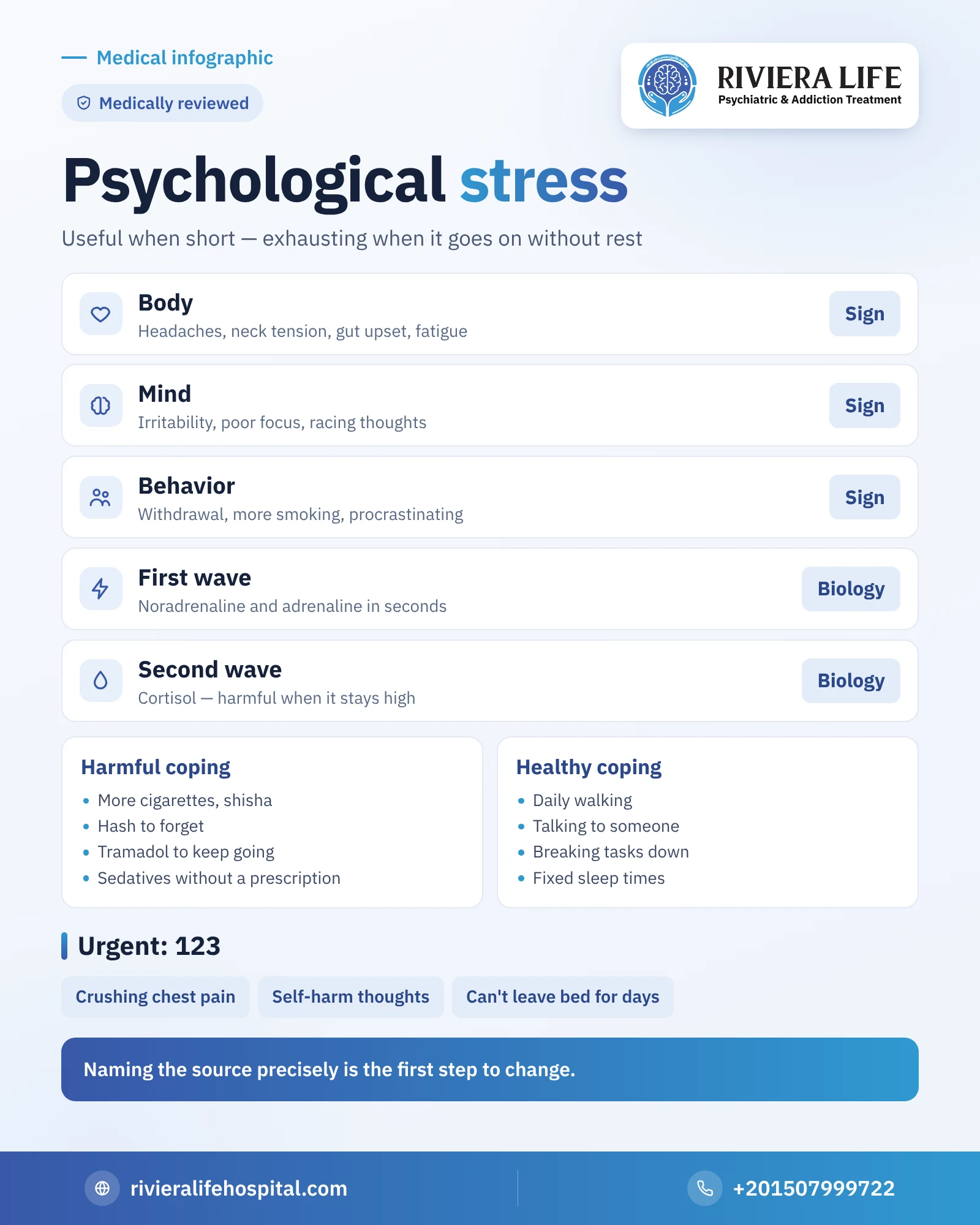
Signs of psychological stress in the body, mind and behavior
Stress shows in three overlapping circles, and family members often notice the change before the person does.
Physical signs
- Repeated headaches and tension in the neck and shoulders.
- Stomach and colon disturbance, or a change in appetite.
- Constant fatigue that doesn’t go away with rest.
- Sometimes palpitations, sweating, and difficulty sleeping or repeated waking.
- Repeated colds, and reduced sexual desire.
Psychological and mental signs
- Irritability and quick anger over small matters.
- Difficulty concentrating, forgetfulness and hesitation in decisions.
- A feeling of helplessness or that things are out of control.
- Thinking about problems that doesn’t stop, especially at night.
Behavioral signs
- Withdrawing from friends and neglecting hobbies.
- More smoking, eating or staying up on the phone.
- Postponing tasks and then completing them under greater pressure.
- Outbursts with the wife or children unlike the person’s usual self.
Cortisol: how does stress turn into physical symptoms?
When a person faces stress, the body releases two successive waves. The first is fast, led by noradrenaline and adrenaline, so the heart speeds up, the muscles tense and attention rises within seconds. The second is slower, led by cortisol, the adrenal hormone, which raises blood sugar to provide energy and rearranges the body’s priorities.
This design is excellent for facing a passing danger. But when cortisol stays high for weeks and months, its effect starts to show: broken sleep, a tendency to store fat around the belly, disturbed blood sugar and pressure, weak immunity, and mental exhaustion. It is important to distinguish this effect from real gland diseases, as the article on high cortisol symptoms explains, while the practical steps to lower it are in the article on how to lower cortisol.
Sources of stress in daily life in Egypt
The sources of stress are similar around the world, but each society has its details. In the Egyptian context certain pictures recur in clinics:
- Work: long hours, a second job after hours to cover expenses, commuting that takes two or three hours a day, and fear of losing the job.
- Family: caring for an elderly father or mother, marital disagreements, and the pressure of the Thanaweya Amma exams that the whole household lives through, not just the student.
- Money: rising prices, installments, debts, and the costs of education and marriage, among the most persistent sources of stress because they don’t end with the end of a day.
- Social expectations: comparing oneself with others, and relatives’ repeated questions about marriage, children and income.
Naming the source precisely isn’t a detail; it is the first step, because some of these sources can be changed, and some can’t be changed but the way of dealing with them can.
Healthy coping and harmful coping
Everyone looks for a way to calm down. The problem is that the fastest ways are usually the most harmful in the long term:
| Harmful coping that relieves temporarily | Healthy coping that protects in the long term |
|---|---|
| More cigarettes or shisha “to calm the nerves” | Walking or any regular physical activity |
| A hash cigarette at the end of the day to forget | Talking with a trusted friend or relative |
| A tramadol tablet to get through long work | Breaking tasks down and setting clear limits on work |
| Pregabalin or a sedative without a prescription | Breathing and relaxation exercises |
| Energy drinks and staying up | Fixed sleep times |
| Isolation and emotional eating | Prayer, meditation or a hobby that clears the mind |
Harmful ways don’t remove stress, but postpone it and add a new problem to it. The substance that calms you tonight may, after months, become a physical, financial and family burden greater than the original stress, and sometimes ends in an addiction that needs separate treatment.
When does stress turn into anxiety or depression?
Chronic stress is one of the most important factors that pave the way for psychological disorders in those predisposed. Pay attention if you notice that tension continues even after the problem is solved, or that fear has become general without a clear cause; here it may have turned into an anxiety disorder. And if heavy sadness, loss of pleasure in everything and a feeling of worthlessness replace the tension for more than two weeks, it may be depression. And someone who was exposed to a traumatic event such as an accident or violence, and whose memories keep intruding while they avoid everything that reminds them of it, may need an assessment for post-traumatic stress disorder.
There is also burnout: complete exhaustion, numbness towards work and a feeling of no achievement, appearing after years of work stress without recovery. It isn’t weakness, but a sign that the way of working itself needs to change.
Practical steps to relieve psychological stress
- Write a list of the sources: separate what you can change from what you can’t, and start with a small step on the first.
- Break big tasks down: one huge task paralyzes, while five small steps get done.
- Protect your sleep: a fixed wake-up time, the phone out of bed, and less coffee after noon.
- Move daily: about half an hour of walking clearly lowers tension for many people.
- Breathe slowly: a few minutes of long, calm breathing out is enough to calm the alert system.
- Cut down news and comparisons: set a time for following news and social media instead of open-ended browsing.
- Say “no” sometimes: clear limits at work and in the family aren’t selfishness, but prevention.
- Don’t carry it alone: sharing the burden with someone close eases its weight even if it doesn’t solve the problem.
When should you seek help?
Seek a specialist assessment if the signs of stress continue for weeks and start disrupting your work, sleep or relationships, or if you find yourself avoiding places and people, or relying on more cigarettes, hash or tablets to bear your day. Psychotherapy, especially cognitive behavioral therapy, teaches you practical tools to manage stress, and some people may need medicine if anxiety or depression appears.
Seek urgent help immediately if you have
Call an ambulance on 123 or go to the nearest emergency department.
- Pressing chest pain or pain spreading to the arm or jaw
- Thoughts of self-harm or that life isn’t worth it
- Complete inability to eat, sleep or leave bed for several days
At Riviera Life, the consultant psychiatrists assess whether what you are living through is stress that needs coping tools, a disorder that needs treatment, or dependence on a substance that began as a way to cope. The first consultation is free and confidential.
More from the anxiety guide
- Anxiety: the complete guide
- Panic attacks
- Noradrenaline and stress
- The causes of anxiety
- Burnout: its dimensions, signs, difference from depression and ways to recover
- Nervous breakdown: its medical meaning, what to do in the moment and when it is an emergency
- Adjustment disorder: when does the reaction to a crisis become a disorder?
- Anxiety vs stress: a comparison table and signs that it needs treatment
- Tension headache: its signs, the difference from migraine and when it is serious
- Psychogenic urticaria: when stress triggers a rash and how it is treated
- Depression and diabetes: a two-way relationship and how to break the cycle
- The psychological stress test: instant result
Questions many people ask
Stress is a reaction to a specific situation that usually eases when it ends, while pathological anxiety continues even without a clear threat. Long stress may turn into an anxiety disorder in those predisposed.
Chronic stress is linked to headaches, digestive disorders, insomnia, high blood pressure and weak immunity. This doesn't mean every symptom has a psychological cause, so persistent symptoms need a medical examination.
It seems so because it relieves withdrawal symptoms of nicotine itself, but it doesn't treat the source of stress. Research indicates that stress levels usually improve after quitting, not before.
Stress alone is usually treated by changing its sources, learning coping tools and psychotherapy. But if it develops into anxiety or depression, the psychiatrist may suggest a suitable medicine.
Its signs include constant exhaustion, numbness or cynicism towards work, and feeling your effort is worthless, despite rest and holidays. These signs continuing deserves a talk with a specialist.