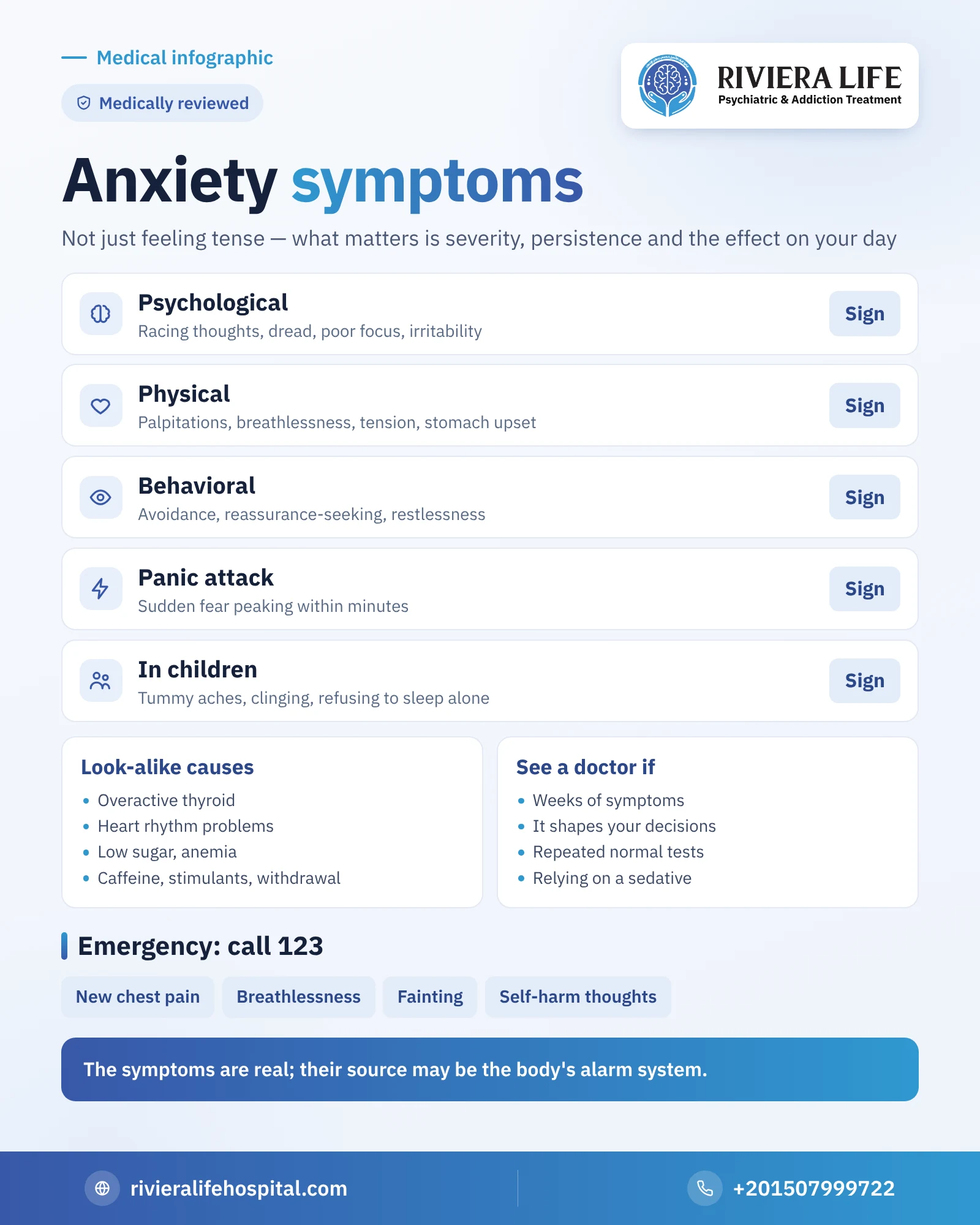
Anxiety symptoms aren’t limited to feeling tense; they appear in thoughts, body and behavior together, and often begin with a physical complaint such as palpitations or stomach upset before the person notices that the source is psychological. The distinguishing sign isn’t the presence of the symptom, since we all worry sometimes, but its severity, persistence and effect on your day. In this article you will find the psychological, physical and behavioral signs, what a panic attack looks like, how anxiety appears in children, and questions that help you assess your condition without diagnosing yourself, then when you need a doctor and when you need the emergency department.
Psychological symptoms: what happens inside the head
Many patients describe their mind as one that “doesn’t stop”. The thought starts small, a son late coming home for example, then within minutes swells into an accident and a hospital. Among the best-known psychological signs:
- Constant inner tension and a feeling that something bad is about to happen.
- Repeated preoccupation with the future and bad possibilities that is hard to stop by willpower.
- Difficulty concentrating, or a feeling that the mind suddenly goes blank.
- Quick irritability and impatience over small things.
- Excessive sensitivity to uncertainty, and a need to know everything in advance.
- Sometimes a strange feeling of detachment from oneself or that the place isn’t real, especially at the peak of tension.
Physical symptoms of anxiety
When the brain senses danger, the body releases stress hormones such as adrenaline, and prepares to flee or fight. This readiness is useful in the face of real danger, but when it recurs without reason it leaves tangible effects:
- Palpitations or a racing heartbeat.
- Shortness of breath or a feeling of being unable to take a deep breath.
- Tension in the neck and shoulder muscles, and tension headache.
- Sweating, trembling hands and cold extremities.
- Nausea, bloating, cramps, and diarrhea or constipation.
- Dizziness and tingling around the mouth or in the fingers.
- Insomnia, especially difficulty falling asleep because of thoughts, and daytime tiredness despite no exertion.
Behavioral symptoms: what those around notice
The family may not see what goes on in the patient’s head, but they see their behavior. Avoidance is the clearest sign: repeatedly excusing oneself from occasions, refusing to ride the metro, or putting off an important call for a whole week. There is also repeated reassurance-seeking, such as a husband asking his wife ten times whether she turned off the gas, or searching online for every physical symptom he feels. Other signs include excessive planning and preparation, long hesitation over simple decisions, and restlessness and being unable to sit calmly.
Signs of a panic attack
A panic attack is a wave of intense fear that starts suddenly, peaks within minutes, and may happen even during sleep or in a calm moment. Several symptoms usually come together in it:
- Strong palpitations and chest pain or pressure.
- A feeling of choking or that there isn’t enough air.
- Trembling, sweating, and hot flushes or chills.
- Severe dizziness and a feeling of being about to faint.
- Fear of losing control, going mad or dying.
Many go to the emergency department with their first attack believing it is a heart attack, and that is the right thing to do the first time. A single attack doesn’t mean a disorder, but its recurrence with constant fear of the next attack may point to panic disorder, one of the types we explain in the article on types of anxiety.
Anxiety symptoms in children and teenagers
A child rarely says “I’m anxious”. Instead they complain of a tummy ache on school mornings, cry and cling to their mother at the school gate, or refuse to sleep alone. Anxiety may also appear as tantrums, repeated questions about safety, or complete silence in class although they are chatty at home. A teenager may hide their anxiety behind isolation, staying up on the phone, or refusing group activities, and sometimes behind trying substances they think will calm them. Notice the repeated patterns, not the single situation.
Anxiety at night and on waking
Many patients notice that their symptoms intensify at particular times. At night, when the house quiets and distractions disappear, the thoughts come to the fore, so the person tosses and turns for an hour or more before sleeping. They may wake suddenly with their heart pounding, which is sometimes a nocturnal panic attack. In the morning some wake with a knot in the stomach and a sense of dread about the day before it begins. In older people anxiety may appear as insomnia, multiple physical complaints and fear of going out, and is wrongly attributed to ageing.
When anxiety disguises itself as a physical illness
In Egyptian clinics there is a familiar story: a man in his thirties who had an ECG four times in a year and visited a gastroenterologist because of “the colon”, and all the results were normal. The symptoms are completely real and the pain isn’t imaginary, but its source is the body’s alarm system. Ruling out organic causes is a necessary step, but repeating tests after normal results without a psychological assessment prolongs the suffering. If your story resembles this one, psychological assessment may be the step you haven’t tried yet.
Questions to help you assess your condition
These questions aren’t a diagnostic test, since diagnosis needs a doctor or psychologist. But they help you notice what is happening to you:
- Have you worried most days for several weeks or months, about different things?
- Do you find it genuinely difficult to stop your worrying thoughts when you want to?
- Have you started avoiding places, situations or people because of fear?
- Does anxiety affect your sleep, work, study or relationships?
- Do you need repeated reassurance from others or constant searching about your symptoms?
- Have you started using a sedative, a substance or alcohol to calm down?
If your answer is yes to more than one question, that is reason enough to book a consultation.
Symptoms that resemble anxiety but have another cause
Not every palpitation is anxiety. An overactive thyroid, heart rhythm disorders, low blood sugar and anemia may cause very similar symptoms. So may too much coffee and energy drinks, some cold and asthma medicines, stimulant use, and withdrawal from alcohol or sedatives. That is why the doctor usually starts with questions and simple tests before judging. You will find the details of these factors and their role in the article on the causes of anxiety.
When anxiety and depression come together
Anxiety and depression coexist in many patients, to the point that it is sometimes hard to separate them. Watch out if constant tension turns into loss of pleasure, persistent sadness, a feeling of hopelessness, or withdrawal from everything. These signs call for a quicker assessment, and you can review the depression page to learn its signs.
When do you need to consult a psychiatrist?
Ask for an assessment if the symptoms continue for more than a few weeks, start to shape your daily decisions, you have had repeated tests with no result, or you notice you rely on a sedative to get through your day. Postponing gives avoidance time to deepen, while early intervention shortens the road. The good news is that anxiety responds well to treatment, which we explain in the article on anxiety treatment. At Riviera Life the journey starts with a free, confidential assessment session with a consultant psychiatrist who listens to your whole story before any decision.
When are the symptoms an emergency?
Seek urgent help immediately if you see
Call the ambulance on 123 or go to the nearest emergency department; these signs aren't attributed to anxiety before examination.
- New or crushing chest pain spreading to the arm, jaw or back
- Breathlessness that doesn’t settle, or blue lips
- Loss of consciousness, sudden weakness in one side of the body, or slurred speech
- Thoughts of self-harm or not wanting to live
More from the anxiety guide
- Anxiety: the complete guide
- The causes of anxiety
- Types of anxiety
- Anxiety treatment
- Panic attacks: how to tell them from a heart attack and what to do during an attack
- Psychological stress: its signs, its effect on the body and how to deal with it healthily
- Overthinking: the difference between rumination and worry, and practical techniques to stop it
- Illness anxiety: when worry about health becomes an endless circle
- Psychogenic breathlessness: how to tell it from physical causes and what to do
- Tension headache: its signs, how it differs from migraine and when it is serious
- Psychological IBS: how anxiety moves the bowel and what calms it
- Anxiety at bedtime: why it gets worse at night and how to calm your mind before sleep
- Exam anxiety: symptoms, a study routine and steps for exam day
- Misophonia: when chewing and breathing sounds provoke you and how to cope
- The GAD-7 anxiety test: instant result
Questions many people ask
Yes, muscle tension, a racing heart and fast breathing may cause pain or pressure in the chest. But any new chest pain needs a medical check first before it is attributed to anxiety.
An attack usually peaks within a few minutes, then calms gradually, and often doesn't exceed about half an hour, although exhaustion may remain for longer afterwards.
Anxiety directly affects bowel movement, so bloating, cramps, and diarrhea or constipation are common with it, and it overlaps a lot with irritable bowel syndrome. Treating anxiety eases these symptoms in many people.
Online tests may alert you to a problem, but they don't diagnose. Diagnosis needs an interview with a doctor or psychologist and ruling out organic causes.
Watch for repeated physical complaints before school, excessive clinging to parents, refusing to sleep alone, avoiding activities, and bouts of crying or anger linked to particular situations. These signs continuing for weeks deserve assessment.