How to deal with a captagon addict starts with understanding their rhythm: days of activity and sleeplessness that may stretch over two or three nights, then a heavy crash, long sleep and a black mood. What is right to say on a crash day may spark a fight on a sleepless night, and vice versa. That is why parents need a plan that takes these stages into account: when to talk, how to respond to suspicion and irritability without the house turning into a battlefield, and what protects them if the situation escalates. This guide is written for the family that knows or is almost sure, and is looking for practical steps to bring their son, husband or brother closer to treatment.
Why is dealing with a captagon addict different?
The captagon circulating today is a stimulant, and most pills on the market contain amphetamine, not the original medicine. Stimulants don’t make the user sleepy or lethargic as sedatives do; they charge them with energy, impulsiveness and excess confidence, then leave them exhausted. This means you won’t be dealing with one steady person, but with three states that alternate over days. The common mistake is for parents to choose the moment of anger, usually the moment they find the pills or when he comes home at dawn, to open the hardest conversation of their lives. If you are still not sure about use in the first place, first read captagon addiction symptoms and then come back here.
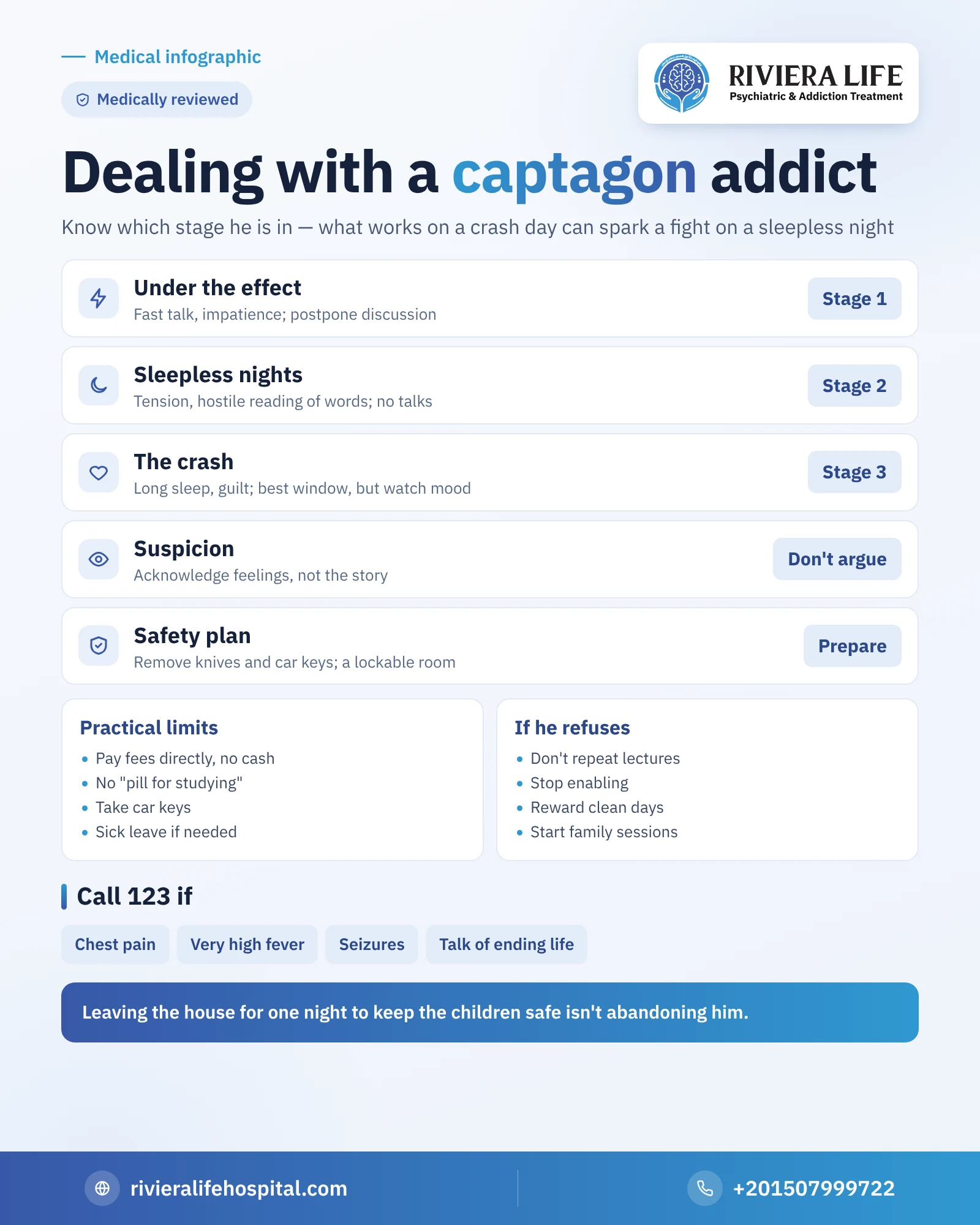
Know which stage he is in now
The effect stage
Fast talk, enthusiasm, impatience and no wish to eat. Here he is convinced he is at his best, and any criticism seems to him an attack. Stick to calm and postpone the discussion.
The continuous sleeplessness stage
After a night or more without sleep the picture changes: tension, a hostile interpretation of every word, and perhaps suspicion of others. This is the most dangerous stage for the safety of the household, and not a time for dialogue at all.
The crash stage
Sleeping for long hours, then hunger, exhaustion, sadness and guilt. In these days he is more broken and closer to hearing you, but also more vulnerable to depression and dark thoughts, so don’t exploit his weakness with reproach.
On sleepless nights: what do you do?
When he enters his second or third night without sleep, make your only goal that the night passes safely. Dim the lighting and noise in the house, offer him water and light food without insisting, and don’t raise the subject of pills, money or studies. Don’t try to force him to sleep and don’t give him sleeping pills or sedatives on your own, as mixing a stimulant with sedatives strains the heart and breathing in ways that are hard to predict. Stay close enough to notice any danger sign, and far enough not to provoke him. It helps for another family member to know what is happening, so you don’t bear the night alone.
Suspicion and paranoia: don’t argue and don’t agree
He may tell you that the neighbors are watching him, that his phone is hacked, or that a family member is plotting against him. Arguing at this moment doesn’t convince him, but puts you among the conspirators. Agreeing with him deepens the idea in his mind. The middle way is to acknowledge his feelings, not his story: “I understand you’re afraid, I’m here with you, and no one will hurt you in this house”.
Speak in a low voice and short sentences, leave him space and a way out of the room, and don’t stand between him and the door. If the paranoia recurs or is accompanied by voices only he hears, this is a sign of stimulant psychosis and needs an urgent psychiatric assessment. You can understand the nature of this symptom more in our article on paranoia.
Irritability and aggression: a safety plan before you need it
Not everyone who uses captagon is violent, but lack of sleep, suspicion and the crash make an explosion possible. Make your plan while you are calm, not in the middle of a crisis:
- Keep knives, sharp tools and car keys out of his reach on sleepless days.
- Agree with the rest of the family on a room that can be locked from inside, and on a person who calls for help.
- Keep a charged phone and the numbers of a trusted relative, the ambulance 123 and the police 122.
- If he raises his voice, don’t raise yours, and if he approaches threateningly, leave the place with the children immediately.
- Don’t try to search him or take something from his hand while he is under the effect.
The safety of the children, the mother and older people comes before any attempt to persuade him. Leaving the house for one night isn’t abandoning him.
Crash days: an opportunity and a danger at the same time
After sleeping and eating, many wake up feeling ashamed and distressed. This is the most suitable window for talking, provided he has rested and hasn’t gone back to the pills. But the crash also carries real depression that may reach despair. If he says life isn’t worth it, or talks about harming himself, take his words seriously, don’t leave him alone, and ask for medical help the same day; you can call the mental health hotline on 16328 or the ambulance on 123. Our article on captagon withdrawal symptoms explains how this stage extends and when it needs medical supervision.
How do you open the treatment conversation?
Choose a calm morning a day or two into the crash, in a private place, without an audience of relatives. Start with what you saw with your own eyes, not what you heard: “Three nights you haven’t slept, you’ve lost weight, and yesterday you broke your bedroom door. I’m worried about your heart and your future”. Then ask for something small and specific, such as one consultation, not a fateful decision to change his whole life. Many captagon users started looking for wakefulness to study or work, so they don’t see themselves as addicts. Don’t cling to the word; focus on what he is losing: sleep, concentration, money and the trust of those around him.
Phrases that bring closer and others that push away
| Instead of | Try saying |
|---|---|
| You’re an addict and you’ve ruined the house | I’ve noticed things that worry me and I want us to understand them together |
| Where are the pills? Bring them out now | When can we talk calmly about the last few days? |
| If you don’t stop you’re not my son | I’ll stay with you, but I won’t pay for the pills |
| Everyone knows about your scandal | This is between us, and the consultation is completely confidential |
The idea isn’t to memorize phrases, but to move from accusation to facts, and from threats to limits you can actually carry out.
If he refuses or denies
Refusal the first time is expected and isn’t the end of the road. Continue steadily without repeating the same lecture every day. Stop everything that unintentionally makes use easier: cash, paying his debts, and lying to the university or his work to cover his absence. Reward the days he spends clean with attention and shared time, and let the natural consequences of his choices fall on him. The family can start consultation alone before he agrees, and family sessions themselves raise the chances of him accepting treatment later. In cases where he becomes a danger to himself or others, there are specific legal and medical procedures explained in our article on compulsory addiction treatment.
Money, studying and driving: practical limits
Captagon’s link with staying awake calls for special limits. Pay study fees and needs directly instead of giving cash. Don’t buy him energy drinks in large quantities, and don’t accept the excuse “the pill is just for studying”. If he drives the family car, take the keys on sleepless and crash days in particular, as exhaustion after a stimulant makes drowsiness on the road sudden and dangerous. Someone who works as a driver or on night shifts may need temporary sick leave documented by the doctor instead of continuing under the influence.
From agreement to the first day of treatment
When he says “OK”, act the same day, because agreement with stimulants swings with mood. Prepare simple information for the doctor: how long he has been using, how many nights a week he stays up, whether he uses sedatives, tramadol or pregabalin to come down, and whether any hallucinations have appeared. Treatment usually starts with an assessment and detox under supervision that attends to sleep, nutrition and mood, then psychotherapy and rehabilitation. There is no medicine that cancels the craving for captagon on its own, so recovery rests mainly on behavioral therapy and family support. Full details are in our article on captagon addiction treatment.
When should you call an ambulance without hesitation?
Call an ambulance on 123 immediately if you see
These signs after using captagon may mean poisoning or an acute psychiatric crisis that can't wait.
- Chest pain, severe palpitations or shortness of breath
- A very high temperature with confusion, or heavy sweating then dryness
- Seizures or loss of consciousness
- Severe agitation or hallucinations with threats to harm himself or others
- Explicit talk of ending his life
You too need someone to lean on
The mother who stays awake to hear the door, the wife who hides it from everyone, and the father who blames himself are all slowly drained. You aren’t responsible for the decision to use, but you control how you respond. Talk to someone you trust, ask for a specialist family session, and look after your own sleep and work. An exhausted family can’t hold out until he accepts treatment.
At Riviera Life we often start with the family before the patient: a free, confidential session that sets a plan suited to his condition and stage, then a family program that accompanies you during and after treatment.
More from our captagon guide
- Captagon: the complete guide
- Captagon addiction symptoms
- Captagon addiction treatment
- The difference between captagon and shabu
Questions many people ask
It is better to postpone the confrontation until he is rested and out of the pill's effect and the sleepless nights. Confrontation in a moment of anger usually ends in denial or a fight.
Don't give him any sleeping pill or sedative without a doctor, as mixing stimulants with sedatives may strain the heart and breathing. Leave sleep regulation to the treating doctor.
Don't defend yourself by arguing; reassure him that he is safe and that you are by his side, and give him space. Repeated suspicion of this kind needs an urgent psychiatric assessment.
Some mild cases are followed in the outpatient clinic, but hallucinations, severe depression, mixing with other substances or failed previous attempts make a supervised stay safer.
Yes, and it is advisable. Family sessions help you change how you deal with him, which usually increases the chances of him accepting treatment.