Paranoia is a pattern of thinking in which a person reads others’ intentions as hostile without sufficient evidence: they think their colleagues are conspiring against them, that their phone is being monitored, or that a laugh in the street is aimed at them. It isn’t one diagnosis but a spectrum that starts with exaggerated caution and may end with a fixed persecutory delusion. It may be a chronic personality trait, a symptom of delusional disorder or schizophrenia, or a direct effect of hash and shabu. In this article we explain how to tell these pictures apart, the signs that call for assessment, and how to talk with a paranoid relative without losing them.
What is paranoia?
The word paranoia is used in everyday speech to describe anyone who is very suspicious, but in psychiatry it means something more precise: excessive mistrust and accusing others of harm, deception or targeting, beyond what the facts justify. Its essential feature is that the person doesn’t see themselves as suspicious, but sees themselves as alert, discovering what others miss, which is why they rarely ask for help themselves.
The theme of paranoia differs from other forms of doubt. It doesn’t revolve around fear of making a mistake or harming someone, but around fear of others: what are they plotting? What are they saying about me? Who wants to harm me?
The spectrum of suspicion: from caution to persecutory delusion
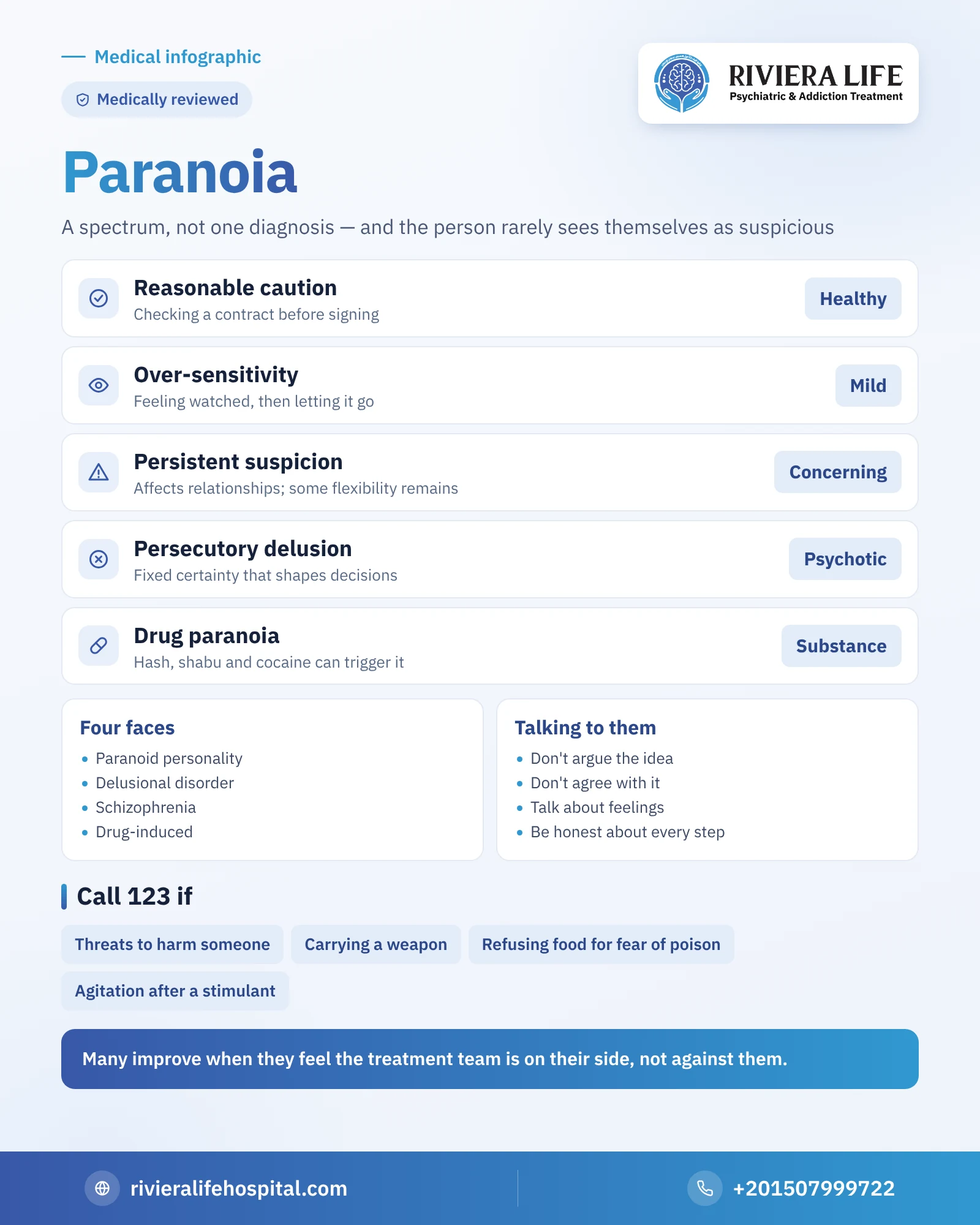
Researchers agree that paranoid thoughts are widespread to mild degrees among people, and that the difference between normal and pathological is a difference in intensity, fixity and impact on life. This spectrum can be pictured in four degrees:
- Reasonable caution: you are reserved with a stranger or review a contract before signing it. This is healthy behavior.
- Over-sensitivity: you feel that others are looking at you or talking about you in a crowded place, but you review the thought and move past it.
- Persistent suspicion: repeated doubt about intentions that affects relationships and work, while some flexibility remains; the person may accept the possibility that they are wrong.
- Persecutory delusion: a fixed certainty that some party is pursuing or conspiring against them, unshaken by evidence, on which they base their decisions, such as moving house or refusing food for fear of being poisoned.
The move from the third degree to the fourth is the line at which suspicion turns into a psychotic symptom that needs faster medical intervention.
Signs that suspicion has gone too far
- Interpreting neutral situations as an insult or a threat, such as taking a delayed reply to a message as proof of a conspiracy.
- Refusing to share any personal information for fear it will be used against them.
- Holding grudges for years and never forgetting a small offense.
- Repeatedly searching the phone or home for listening devices or cameras.
- Accusing a husband or wife of infidelity without real evidence.
- Growing isolation because “no one deserves trust”.
- Quick anger when someone tries to reassure or discuss with them.
One or two signs don’t mean a disorder; what matters is persistence, escalation and the impact on work and home.
Four faces of paranoia
Paranoid personality disorder
A stable pattern since early adulthood of mistrust of others that appears in most situations. The person usually works and marries, but lives in constant tension and repeated disputes, and sees offense where there is none. The thoughts here don’t usually reach the level of an outright delusion, and aren’t accompanied by hallucinations.
Delusional disorder
One fixed idea dominates for a month or more, such as the belief that some party is pursuing them, or that their partner is cheating on them, while the rest of their thinking and speech remains organized. The person may seem completely normal at work until the conversation approaches the subject of the delusion.
Paranoia in schizophrenia
Persecutory delusions here come within a wider picture: voices that comment or accuse, sometimes disjointed speech, and withdrawal and decline in self-care. Suspicion is often among the first things the family notices. Details are in our article on schizophrenia symptoms.
Drug-induced paranoia
Hash, especially high-potency types, may trigger suspicion during use that usually settles when the effect wears off, but it persists in some regular users. With shabu (ice) and cocaine, intense suspicion is common with repeated use, and may reach full psychosis with hallucinations and dangerous behavior. We explained the course of suspicion with hash step by step in hash addiction and suspicion, and the effect of shabu on the mind in the harms of ice.
A quick comparison of the forms of paranoia
| Form | Onset and duration | Degree of fixity | What accompanies it |
|---|---|---|---|
| Paranoid personality | Since youth and persistent | General mistrust, usually without an outright delusion | Disputes, grudges and isolation |
| Delusional disorder | A month or more | One fixed delusion | Organized thinking outside its subject |
| Schizophrenia | Six months or more | Usually multiple delusions | Hallucinations and negative symptoms |
| Drugs | Linked to use | From passing suspicion to psychosis | Signs of use and disturbed sleep |
What isn’t paranoia
Doubt in OCD revolves around the self: did I lock the door? Did I make a mistake? The person usually knows their doubt is exaggerated and suffers from it, a different picture we explained in OCD and doubt. Social anxiety may make a person feel that others are watching and criticizing them, but it is fear of negative judgment, not a belief that someone wants to harm them. There is also justified suspicion: someone who was really defrauded or betrayed may become cautious for a while, and this isn’t an illness.
Why does a paranoid person refuse treatment?
Because paranoia touches trust itself, the doctor and family may enter the circle of suspicion. They may think the family wants to admit them to hospital to get rid of them, or that the medicine is poison. It is made harder by the fact that they don’t see a problem in their thoughts. That is why direct confrontation doesn’t help; what helps is starting with what they acknowledge: insomnia, tension, or exhaustion from conflicts.
How do you talk to a relative with paranoia?
- Don’t argue about the idea: trying to prove the neighbors aren’t watching them increases their attachment to it, and may put you on the side of the “conspirators”.
- Don’t agree with it either: instead of “yes, they’re watching you” say “I can see this frightens you a lot”.
- Talk about their feelings: fear, exhaustion and lack of sleep are common ground that is easy to agree on.
- Be clear and honest: don’t hide an appointment or a medicine from them, as discovering deception confirms their suspicions.
- Suggest assessment as a way to feel better: “let’s ask a doctor about sleep and tension” is closer to acceptance than “you’re mentally ill”.
- Protect yourself: if threats or violence appear, your safety and the children’s safety come first.
Treating paranoia
Treatment depends on the picture the doctor determines after assessment. In psychosis and delusional disorder, antipsychotics are used to ease the intensity of delusions, with cognitive behavioral therapy that helps the patient test and gradually review their interpretations and reduce the anxiety linked to them. In drug-induced paranoia, treatment starts with completely stopping use under medical supervision, with temporary medicine when needed, then a relapse-prevention program. Paranoid personality relies on long-term psychotherapy built on trust, and the doctor may prescribe medicine for specific symptoms such as severe anxiety. In all cases many improve when they feel the treatment team is on their side, not against them.
When does paranoia become an emergency?
Seek urgent help immediately if you see
Call an ambulance on 123 or go to the nearest emergency department if suspicion is combined with real danger.
- Threats to harm someone they believe is conspiring against them
- Carrying a weapon or a sharp object claiming self-defense
- Complete refusal of food and drink for fear of poisoning
- Talk of self-harm or ending life
- Sudden intense suspicion after using a stimulant, with agitation or a high temperature
You can also ask for guidance from the hotline of the General Secretariat of Mental Health on 16328 or 0220816831.
How can Riviera Life help you?
Riviera Life’s consultant psychiatrists start with a calm assessment that determines the source of the suspicion, whether personality, psychosis or a drug, and involve the family in the communication plan, with complete confidentiality and a free first consultation on +201507999722. Because intense suspicion may be combined with ideas of grandeur, our article on delusions of grandeur may also help you.
More from our psychosis guide
- Psychosis: the complete guide
- Delusions of grandeur: causes, signs and treatment
- Schizophrenia symptoms and early signs
- Hash addiction and suspicion
- Causes of psychosis: genetics, drugs, trauma, sleep and protective factors
- Delusional disorder: types of delusions, the difference from schizophrenia and treatment
- Psychosis and marriage: when is it possible, and what about disclosure, pregnancy and children?
- Pathological jealousy: when does fear for a partner become suspicion that threatens the relationship?
Questions many people ask
Paranoia is a pattern of thinking that may be a personality trait or a symptom of delusional disorder or schizophrenia, or an effect of drugs; only a psychiatrist can determine its source after an assessment.
Paranoia is fear of others' intentions, and the person sees nothing wrong in their thoughts, while obsessive doubt revolves around the self and the person usually realizes it is exaggerated.
Yes, hash may trigger temporary suspicion during use, and in some regular users it may persist or develop into psychosis, especially with high-potency types.
Start with what they themselves acknowledge, such as insomnia or tension, and suggest the visit to ease it, and be honest with them at every step, because discovering any deception deepens their suspicion.
Many cases improve clearly, especially those caused by drugs or linked to a psychotic episode, while paranoid personality needs longer psychotherapy.