Treating an addict by force is a question asked by exhausted families who have tried everything: do we admit him to hospital against his will? The honest answer is that admission without consent is justified in specific cases decided by a psychiatrist after assessment, such as danger to oneself or others, psychosis or severe intoxication, and that when it happens in a licensed hospital and is followed by real treatment, refusal may turn over time into motivation. But abduction to unlicensed “centers” is a danger to the patient’s life and may expose the family itself to legal liability. This article sets out the medical, legal and ethical limits clearly, and explains the alternatives the family starts with before force.
Does treating an addict by force work?
The answer isn’t an absolute yes or an absolute no. Evidence in addiction research indicates that treatment doesn’t need to start with full willingness to be useful; many patients enter under pressure from family or work and then reach results close to those who entered voluntarily, provided they find good treatment that respects them. On the other hand, confinement without treatment doesn’t create recovery, and humiliation increases refusal and relapse.
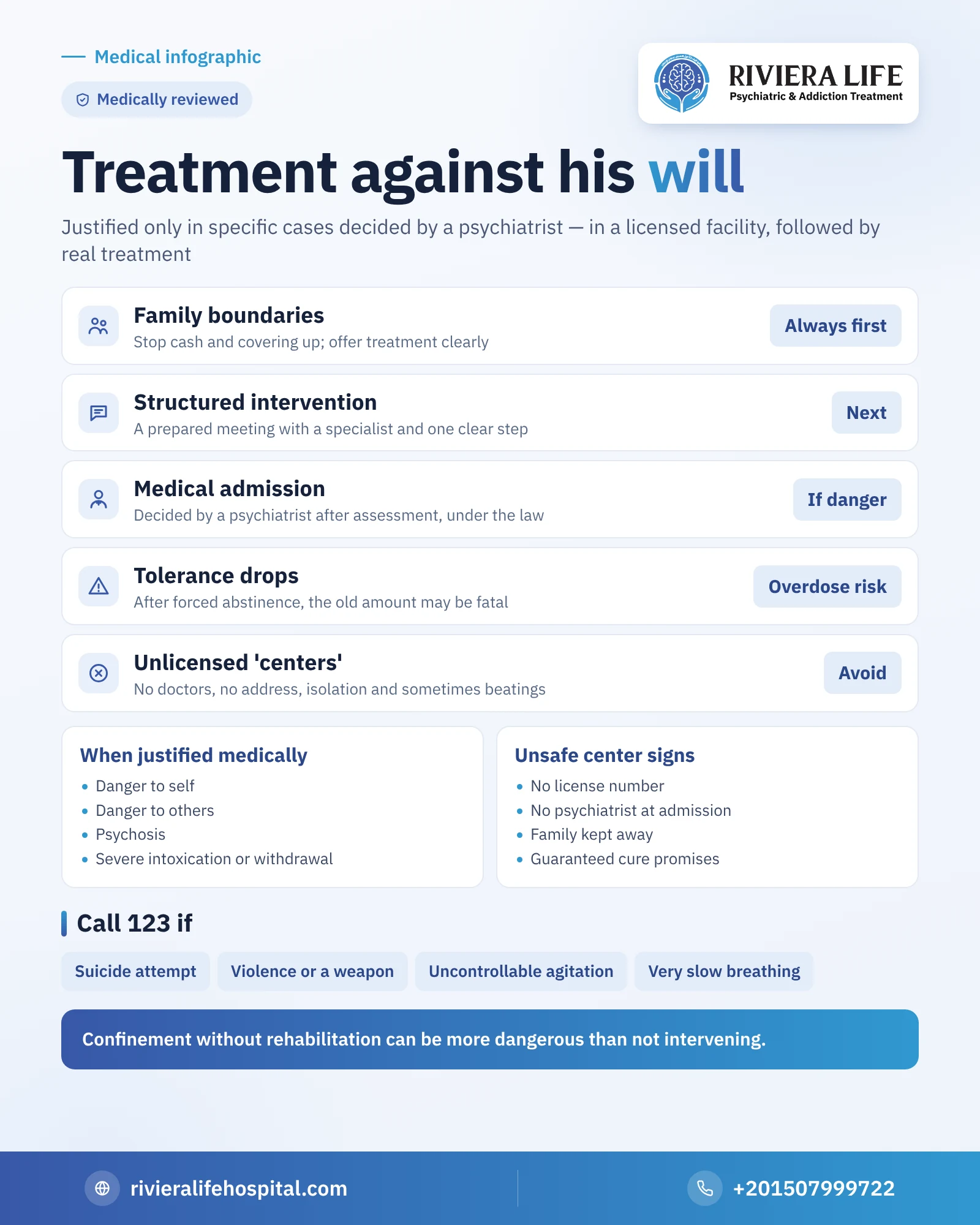
And there is a danger every family should know: after weeks of forced stopping, the body’s tolerance for the substance falls, so if the patient returns to the same old dose, especially with opioids, the chances of overdose rise greatly. That is why removing him from the substance without rehabilitation and follow-up may be more dangerous than not intervening.
Degrees of pressure: from boundaries to involuntary admission
| Degree | What is it? | When does it suit? |
|---|---|---|
| Family boundaries | Stopping cash and covering up, with a clear offer of treatment | Most cases, and it is always the start |
| Structured intervention | A prepared family meeting supervised by a specialist offering treatment and a specific step | When he refuses despite boundaries and there is no urgent danger |
| Admission by medical decision | Admission without consent decided by a psychiatrist after assessment according to the law | Serious danger to self or others, psychosis or severe deterioration |
When is admission without consent medically justified?
Addiction alone, however long, doesn’t automatically mean the patient has lost his right to decide. Involuntary intervention becomes a matter for medical discussion when one or more of the following appears:
- Danger to oneself: suicidal thoughts or attempts, or reckless use that threatens life.
- Danger to others: violence or serious threats to family members.
- Psychosis: hallucinations or pathological suspicion he acts on, as happens with ice, flakka and synthetic cannabis.
- Severe intoxication or withdrawal: a state in which he can’t make a decision and that needs urgent intervention.
- Inability to care for oneself: neglecting food, treatment and hygiene to a degree that threatens his health.
The decision remains with the psychiatrist after examining the patient, not with the family or any “agent” offering to move the patient.
Call an ambulance on 123 immediately if you see
These are emergencies that can't wait for persuasion or arranging admission.
- A suicide attempt or a serious threat of self-harm
- Violence or a threat with a weapon toward a family member
- Hallucinations or severe agitation that can’t be calmed
- Loss of consciousness or very slow breathing after using
- Seizures, chest pain or a very high temperature
What does the law in Egypt say?
Egypt’s mental health care law regulates involuntary admission to psychiatric facilities. In general, the law allows a patient to be admitted against his will in specific cases decided by a psychiatrist, when there is a serious psychiatric disorder linked to danger to the patient or others or to severe deterioration in his condition, provided this happens in a licensed facility and according to procedures that protect the patient’s rights and review of the decision. Applying this to a particular case of addiction is a matter determined by the medical assessment, and is usually linked to the presence of an accompanying psychiatric disorder or clear danger. For legal details specific to your case, consult a specialist lawyer.
Admission by medical decision or “abduction”?
Advertisements spread for “moving the addict from home” by force to places no one knows anything about. The difference between that and legal medical admission is great:
| Admission by medical decision | Abduction to an unlicensed center |
|---|---|
| A psychiatrist examines the patient and documents the reason for the decision | The decision is the family’s and whoever they pay |
| A licensed facility with a known address | An apartment or farm with no sign and no license |
| Round-the-clock medical and nursing supervision | Supervisors without medical qualifications |
| The patient’s right to review and contact according to the rules | Complete isolation and a ban on visits and calls |
| A therapeutic aim and a plan to turn it into voluntary admission | “Discipline”, punishment and sometimes beatings |
Signs of unsafe centers
- Refusing to give you the license number or a clear address you can visit yourself.
- No psychiatrist examining the patient on admission.
- Preventing the family from seeing or talking to the patient for long periods without a medical reason.
- Promises of a guaranteed cure or “discipline” that will keep him away from drugs forever.
- Offers to move the patient restrained without any prior medical assessment.
- Signs of beatings or deprivation of food and sleep that patients describe after leaving.
These places may cause the patient permanent psychological trauma, and he may be left in dangerous withdrawal without treatment.
Before force: how does the family build motivation?
In most cases where there is no urgent danger, the start is with the family itself. The family training approach known as CRAFT teaches parents to talk at the right moment, reward sober days, stop enabling, and ask for a small step such as one consultation. Studies have shown it increases the chances of the patient entering treatment compared with sharp confrontation. A “structured intervention” is a prepared meeting supervised by a specialist, in which family members express their concern with facts, not accusations. You will find practical steps in our articles on how to help a drug addict and how to deal with an addicted husband, and to understand his denial read how a drug addict thinks.
What happens after admission to turn refusal into motivation?
A patient who entered refusing doesn’t change through restraints, but through what he finds inside:
- Withdrawal that is safe and as comfortable as possible: easing withdrawal symptoms removes his biggest fears.
- Treatment that preserves dignity: explaining every step, hearing his opinion, and not using treatment as punishment.
- Motivational interviewing: sessions that help him see the distance between his current life and what he himself wants.
- Family sessions: repairing what was broken, and agreeing on boundaries for after discharge.
- Reassessment: continuous review of the admission status, and moving to voluntary consent when his condition allows.
Many patients say later that the first days were the hardest, and then staying became their own decision.
The safe and legal path, step by step
- Ask for a consultation for the family first, and explain the case in detail.
- Try boundaries, dialogue and offering a small step if there is no urgent danger.
- In urgent danger call an ambulance on 123 or go to the nearest emergency department.
- If the doctor sees admission is necessary, make sure the facility is licensed and the assessment documented.
- Ask for a written treatment plan that includes rehabilitation and aftercare, not withdrawal alone.
And if the patient is refusing and the family needs to move him safely, the arrangement steps and what happens on the day of the transfer are explained in transporting an addiction patient to hospital.
The right hospital to admit an addict safely and legally: how to choose
The right hospital for treating a refusing addict is one that puts medical assessment, the law and the patient’s dignity before the family’s wish for a quick solution. Ask:
- Is the facility licensed, and can you visit it and know its address before any decision?
- Does a psychiatrist examine the patient and decide on the need for admission and its type?
- Is round-the-clock medical supervision available for intoxication, withdrawal and psychosis?
- Does the team work to build motivation through psychotherapy, not punishment?
- Does the family take part in a treatment program and communicate with the patient according to clear rules?
- Is there aftercare that reduces the risk of relapse and overdose after discharge?
And stay away from any place that promises you a guaranteed cure or a final result in days.
How Riviera Life meets these standards
These criteria are what Riviera Life provides, in detail:
- Official license: a hospital licensed by the Ministry of Health, working within the regulated framework of psychiatric care.
- Specialist assessment: psychiatry and addiction consultants assess the case and determine the appropriate level of care.
- Continuous supervision: round-the-clock medical follow-up for intoxication, withdrawal and psychotic symptoms.
- A family program: helps parents build motivation before, during and after admission.
- Long experience: fourteen years of work and thousands of recovered cases.
- Complete confidentiality: the data of the patient and family don’t leave without permission.
- Aftercare: follow-up after discharge that protects against relapse in the most dangerous period.
The first consultation is free, and the family can start with it before the patient agrees. Contact us around the clock on +201507999722; our center is in Sheikh Zayed, Giza.
The safe path always passes through an addiction treatment hospital licensed by the Ministry of Health that assesses the case medically, not through parties that promise treatment by force without supervision.
Read also
- How do I help a drug addict and persuade him to get treatment?
- Can a drug addict quit on his own?
- The full residential addiction treatment program
- How to choose an addiction treatment hospital
- The law and addicts in Egypt: criminalization, voluntary treatment, confidentiality and workplace tests
- Fear of addiction treatment: eight common fears and how to deal with them
- Admitting a psychiatric patient without consent: what the law says
Questions many people ask
Egypt's mental health care law regulates involuntary admission in specific cases decided by a psychiatrist after assessment, such as serious danger to oneself or others, and only in a licensed facility.
He may recover if he finds real treatment that respects him and builds his motivation gradually, while confinement without rehabilitation doesn't create recovery and may increase the risk of relapse.
Many are unlicensed and without doctors, and the patient may be abused there or go through dangerous withdrawal without treatment, and the family itself may face legal liability.
Start by training the family in dialogue, setting boundaries and stopping enabling, ask for a family consultation, and offer him a small step at the right moment.
Look for a licensed facility you can visit, a psychiatrist who examines and documents the decision, round-the-clock medical supervision, a family program and aftercare. Riviera Life in Sheikh Zayed meets these criteria, with a free first consultation for the family.