Insomnia isn’t just a long night spent scrolling through your phone. It is a repeated difficulty starting or staying asleep, or early waking after which sleep doesn’t return, even though the time and place are right, followed by a heavy day for which the person pays in concentration, mood and patience.
It may pass within days as its cause goes away, or it may settle for months until it becomes a habit in which its owner fears the bed itself. The good news is that chronic insomnia is treated effectively without the sleeping pill being the first solution. In this guide we explain the types of insomnia and its causes, including withdrawal from drugs and sedatives, how it is diagnosed and treated, and when asking for help becomes necessary.
What is insomnia, and when is it considered a disorder?
Doctors describe insomnia in three main forms that may come together: the person stays awake for a long time before falling asleep, wakes many times and finds it hard to go back to sleep, or wakes hours before their time and stays awake. The important condition is that the opportunity to sleep is available; someone who works night shifts and sleeps four hours because of their circumstances suffers from sleep deprivation, not insomnia in the medical sense.
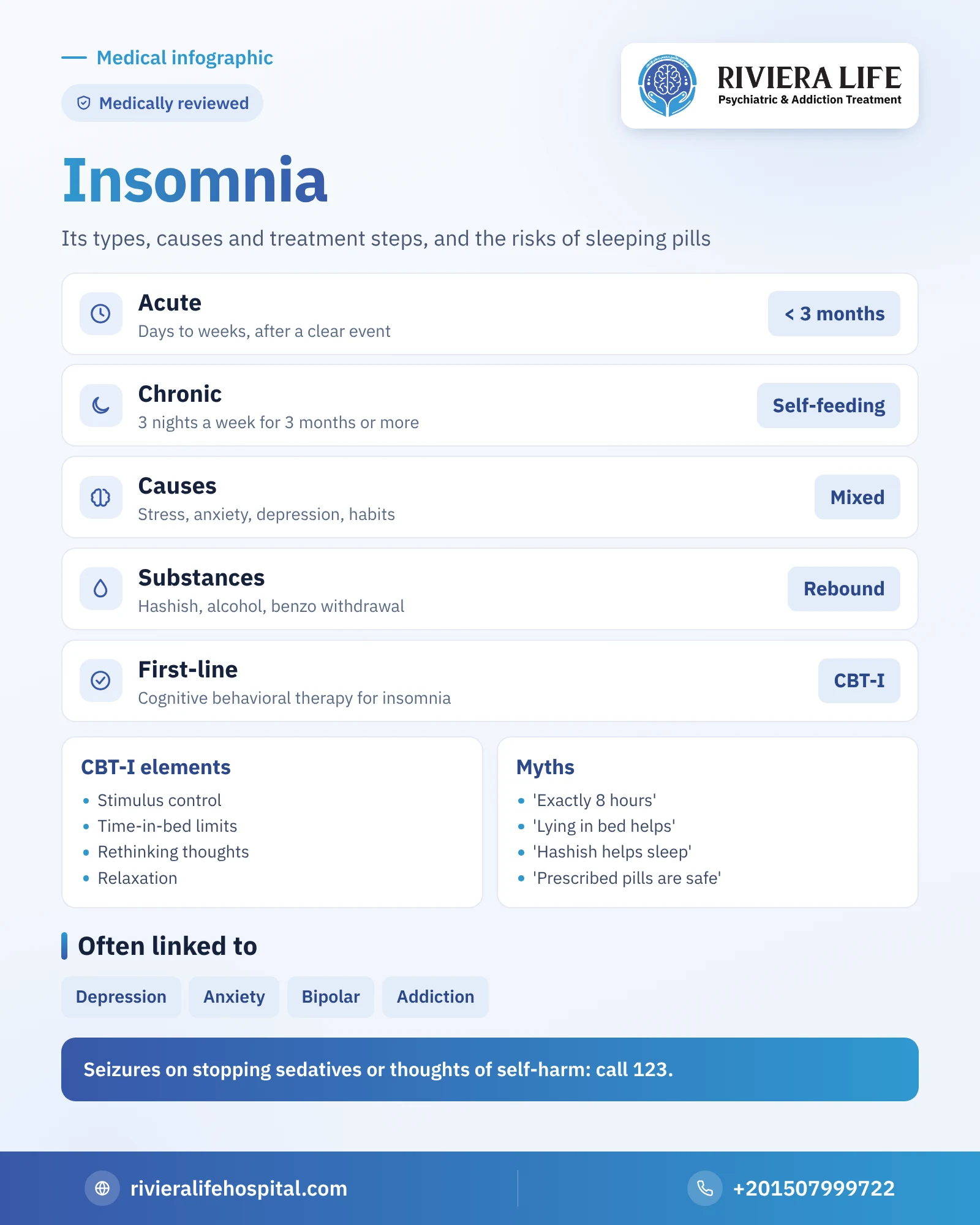
Insomnia turns into a disorder that deserves a diagnosis when it leaves a clear effect on the day: exhaustion, irritability, weakened memory and attention, and mistakes at work or while driving. Modern medical classifications adopt an approximate criterion for chronic insomnia: at least three nights a week, for three months or more.
How common is insomnia?
There is hardly anyone who hasn’t gone through nights of insomnia. Broad estimates indicate that about a third of adults suffer its symptoms at some point in the year, while the criteria for chronic insomnia apply to a smaller proportion, close to roughly a tenth of adults. Its prevalence increases with age, in women, especially around pregnancy and menopause, and in those who suffer from psychiatric illness, chronic pain or use drugs. In Egypt, insomnia is often linked to late social nights and late working hours, so it goes on for years without anyone noticing that it has become a medical problem.
Acute and chronic insomnia: what’s the difference?
Distinguishing between the two types changes the whole way of dealing with it, because the first is usually a temporary reaction, and the second is a cycle that feeds itself:
| Point of comparison | Acute insomnia | Chronic insomnia |
|---|---|---|
| Duration | Days to weeks, and less than three months | Three months or more, at least three nights a week |
| Usual cause | A clear event: an exam, a disagreement, travel, a relative’s death, illness | Starts with a cause, then continues after it goes away because of habits and anxiety about sleep |
| Course | Usually improves on its own as the stress goes away | Rarely disappears without organized intervention |
| Management | Healthy sleep rules and patience, and seeing the doctor if it lasts | Cognitive behavioral therapy for insomnia and treatment of any accompanying disorder |
The dangerous stage is the transition between the two. A young man loses sleep for a week because of a problem at work, so he starts going to bed early “to make up for it”, drinks coffee in the morning to keep going, and watches the clock at night counting how many hours he has left. The problem ends, but these habits remain and create chronic insomnia without an apparent cause.
Causes of insomnia
Insomnia rarely has a single cause. Usually a personal predisposition, such as an anxious temperament or an easily aroused nervous system, comes together with a cause that ignites the problem, then habits that make it continue.
Psychological causes
Psychological stress is the best-known trigger of insomnia; the body’s alert system remains active even in bed, and the article on noradrenaline and stress explains this mechanism. Anxiety makes the mind replay the scenes of the day and anticipate tomorrow’s problems. Depression is strongly linked to insomnia, especially very early waking, and insomnia sometimes precedes an episode of depression by weeks.
Daily habits
- Caffeine in coffee, tea, soft drinks and energy drinks, especially after the afternoon, because its effect may extend for long hours.
- Screens in bed: the light and the stimulating content delay the feeling of sleepiness and prolong staying up without noticing.
- Variable sleep times between workdays and days off, and a long nap late in the day.
- Smoking before sleep, because nicotine is a stimulant, and heavy meals late at night.
Drugs and their withdrawal
This is precisely where many fall into a trap. Hashish may help with drowsiness at first, but it changes the structure of sleep, and on stopping it insomnia and disturbing dreams appear that may last for weeks, so the person goes back to it “to be able to sleep”. Alcohol shortens the time to fall asleep but fragments sleep in the second half of the night. As for benzodiazepines, stopping them suddenly after long use causes rebound insomnia more severe than the original, and may carry greater risks. Stimulants such as captagon and ice cause staying awake for days, followed by a crash and disturbed sleep.
Medical causes and medicines
Insomnia may be a symptom of a physical problem: an overactive thyroid, chronic pain, acid reflux, frequent urination at night, sleep apnea, or restless legs syndrome. Some medicines, such as cortisone and some asthma and blood pressure medicines, may affect sleep. That is why an assessment of insomnia isn’t complete without asking about general health and the list of medicines.
How does insomnia affect the body and mind?
A single bad night makes the next day heavier, but chronic insomnia has a cumulative effect. Psychologically it is linked to irritability, low tolerance and an increased risk of depression and anxiety, and studies indicate that treating it may ease the symptoms of accompanying depression. Mentally, concentration, memory and reaction speed weaken, which raises the risk of accidents, especially while driving. Physically, chronic lack of sleep is linked to raised blood pressure, disturbed blood sugar, weight gain and weak immunity, though the relationship is intertwined with other factors. And for someone recovering from addiction, insomnia is among the best-known causes of relapse, because the long night brings back the craving for the substance.
How is insomnia diagnosed?
The diagnosis of insomnia is mainly clinical, that is, it relies on a detailed conversation with the doctor more than on devices. The doctor asks about the times of sleeping and waking, what happens in bed, naps, caffeine, substances and medicines, and the effect of insomnia on the day. They often ask for a sleep diary for two weeks, in which the patient writes when they went to bed, roughly when they fell asleep and when they woke, because memory alone exaggerates or minimizes the picture.
The doctor also looks for depression, anxiety or bipolar disorder, and for substance use. A sleep study in the laboratory isn’t requested for every case, but when another disorder is suspected, such as sleep apnea with heavy snoring and daytime sleepiness, or abnormal movements during sleep.
The insomnia test helps distinguish between passing bad nights and insomnia that deserves treatment, through eight questions about sleep and its effect on the day.
Cognitive behavioral therapy for insomnia: the first line
Medical guidelines recommend that the treatment of chronic insomnia begin with cognitive behavioral therapy designed for insomnia, before medicines, because its effect continues after the sessions end, unlike a sleeping pill, whose effect ends when it is stopped. It is a relatively short program, usually lasting a few weeks, and consists of elements that complement each other:
- Stimulus control: making the bed linked to sleep only again; if wakefulness lasts long, you leave it and only return with sleepiness.
- Restricting time in bed: temporarily reducing the time you spend in bed to bring it closer to your actual sleep time, then gradually increasing it as sleep improves, and this is done with a plan alongside the therapist.
- Adjusting thoughts: reviewing thoughts such as “if I don’t sleep eight hours, my tomorrow is ruined”, because they increase tension in bed.
- Relaxation: breathing and muscle-relaxation exercises that lower the level of arousal before sleep.
- Sleep education: understanding how the body’s rhythm works, and what spoils it.
Some patients find the first two weeks difficult, but improvement usually appears after them and holds. To learn about this type of treatment more broadly, see the article on cognitive behavioral therapy.
You will find the steps in detail, and what happens at each stage, in the article on the treatment of insomnia.
Sleep hygiene rules: a foundation that isn’t enough alone
Healthy sleep rules don’t treat chronic insomnia alone, but they keep treatment from collapsing and help with acute insomnia:
- Wake at a fixed time every day, even on days off, as the waking time is what sets the rhythm.
- Get daylight in the morning, and reduce strong lighting and screens about an hour before sleep.
- Stop caffeine after midday, and avoid smoking and heavy meals at night.
- Make the bedroom quiet, dark and moderately warm, and take the television and work out of it.
- Do regular physical activity, as long as it isn’t strenuous right before sleep.
- Don’t watch the clock at night, and don’t try to force yourself to sleep.
Sleeping pills: when are they used, and why do doctors warn against them?
The doctor may prescribe a hypnotic for a short period in specific circumstances, such as severe acute insomnia after a shock, but relying on it alone to treat chronic insomnia has a price. Medicines such as zolpidem may cause complex behaviors during sleep, such as walking or even driving without awareness, and the US Food and Drug Administration has warned of serious injuries linked to this, and they can also cause dependence. With benzodiazepines, tolerance forms, so their effect decreases over time, and rebound insomnia appears on stopping them.
In Egypt another worrying pattern is widespread: using pregabalin for sleep without a prescription, or in amounts exceeding what the doctor prescribes. This use may turn into dependence, and its danger increases greatly if it is combined with sedatives, opioids or alcohol, because they all depress breathing. The fixed rule: no hypnotic is started except on prescription, and it isn’t changed or stopped except with the doctor who prescribed it, because stopping suddenly after long use may be dangerous.
Insomnia and psychiatric disorders
The relationship between insomnia and mental health runs in both directions. Insomnia may be an early symptom of depression, and may increase the risk of it appearing. In bipolar disorder the matter is different: little sleep with excess energy and no sense of tiredness may be a sign of the beginning of a manic episode, not ordinary insomnia. In anxiety, insomnia is usually at the beginning of the night with mental preoccupation that doesn’t stop. That is why the doctor is keen to treat the original disorder and the insomnia together, not just one of them.
Common myths about insomnia
The myth: everyone needs exactly eight hours. The truth is that adults’ needs usually vary between roughly seven and nine hours, and the criterion is how you feel during the day, not a fixed number.
The myth: staying in bed with your eyes closed makes up for sleep. The truth is that lying for a long time without sleep strengthens the link between the bed and wakefulness and tension.
The myth: a hashish cigarette or a glass of alcohol helps with sleep. The truth is that they spoil the quality of sleep, and leave more severe insomnia on stopping.
The myth: a medical hypnotic is safe because it is on prescription. The truth is that a prescription means use under conditions and for a set period, and exceeding them carries the risks of dependence.
Related articles
There are no sub-articles under this guide yet, but these articles complete important aspects of the subject of insomnia:
- Melatonin and sleep: when the supplement helps, and why sleep is disturbed during recovery from addiction.
- Noradrenaline and stress: why concentration weakens and sleep breaks up under pressure.
- Zolpidem addiction treatment: the stages of safely stopping the hypnotic and regaining natural sleep.
- How do you lower cortisol?: practical steps to regulate the stress hormone that affects the daily rhythm.
- Psychological stress: its signs in body and mind, and how to deal with it before it steals your sleep.
- Benzodiazepine withdrawal symptoms: why insomnia returns strongly when sedatives are stopped suddenly.
When is insomnia a sign of an emergency?
Most cases of insomnia are troublesome but not urgent. However, some situations accompanying it need immediate intervention:
Seek urgent help immediately if any of these appear
Call the ambulance on 123 or go to the nearest emergency department without waiting.
- Insomnia with tremor, sweating and hallucinations or confusion after stopping alcohol or sedatives
- Seizures during withdrawal from a sedative or hypnotic
- Days with almost no sleep, with impulsivity, rapid speech and dangerous behavior
- Thoughts of self-harm or ending one’s life
- Severe drowsiness or slowed breathing after mixing a hypnotic with a sedative or alcohol
You can also contact the hotline of the General Secretariat of Mental Health and Addiction Treatment in Egypt on 16328 and 0220816831.
When should you ask for help?
If insomnia continues for more than a few weeks, or starts to affect your work, relationships and driving, or you find yourself relying on a hypnotic, hashish or pregabalin to sleep, this is a suitable time for an assessment. At Riviera Life, the consultants in psychiatry and addiction treatment assess the full cause of the insomnia, and put in place a plan that combines cognitive behavioral therapy, treatment of the accompanying disorder, and safe withdrawal of the hypnotic or substance under round-the-clock medical supervision when needed, in complete confidentiality. The first consultation is free on +201507999722.
Medical sources and referencesThe information in this article is based on reliable scientific sources
1MedlinePlus — Insomnia: causes and treatmentmedlineplus.gov2NHS — Insomnia: symptoms, causes and treatmentnhs.uk3CDC — About sleep and its importance for healthcdc.gov4FDA — Strengthened warning on complex sleep behaviors with certain insomnia medicinesfda.gov5MedlinePlus — Zolpidem drug information and warningsmedlineplus.gov