Librax is a fixed combination of two substances: a sedative from the benzodiazepine family, chlordiazepoxide, and an antispasmodic that eases contraction of the gut muscles, clidinium. It is prescribed in many countries, including Egypt, for irritable bowel symptoms and stomach cramps linked to stress. That is where the confusion arises: many people consider it an ordinary “colon medicine”, while it contains a sedative that causes dependence if used for long. Here we explain what it contains, why the doctor prescribes it, its effects and risks, and when staying on it becomes a problem.
What is Librax and what does it contain?
Librax is a brand name for a tablet that combines two substances acting in two different places:
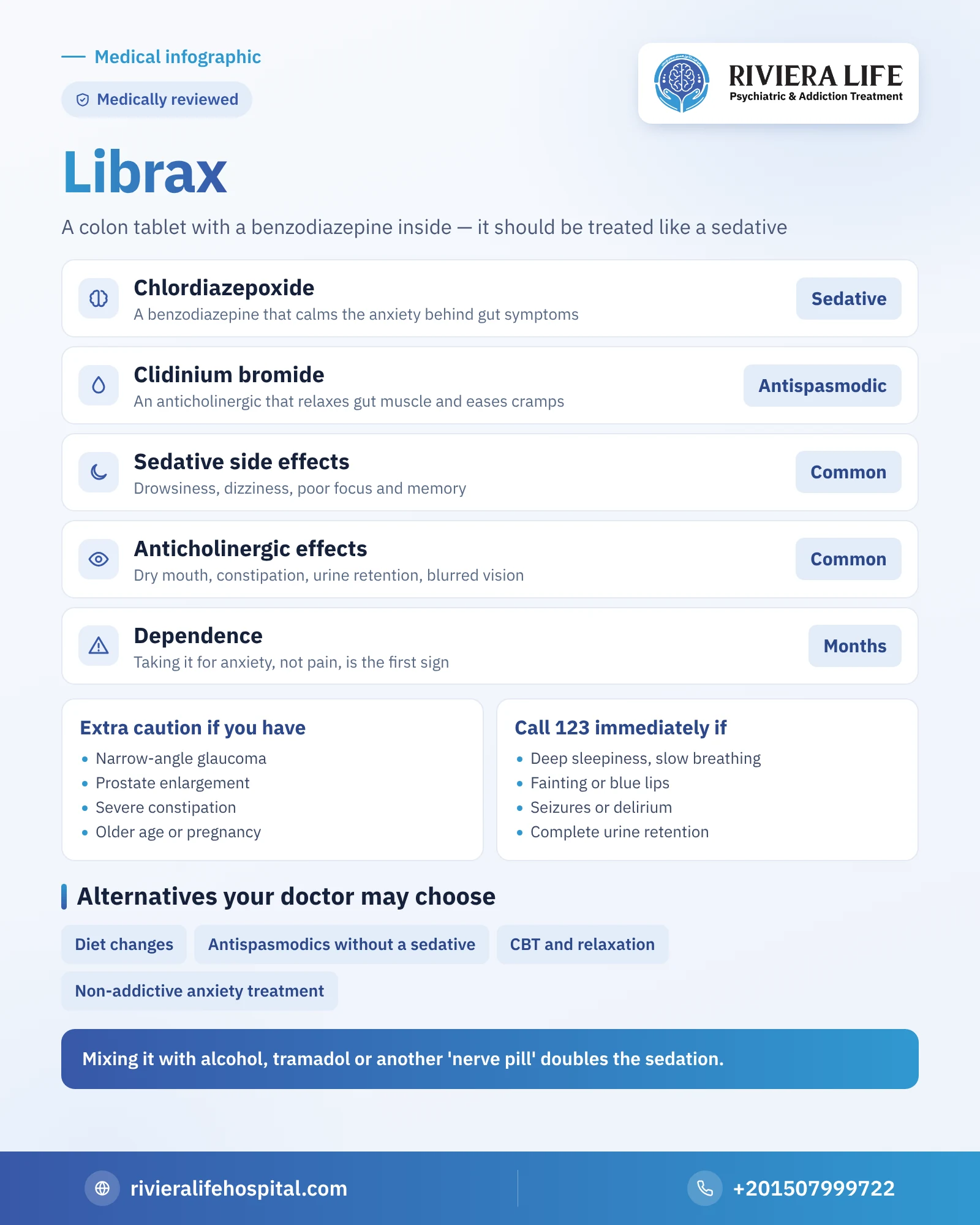
- Chlordiazepoxide: one of the benzodiazepines, among the oldest medicines in this family, which calms the anxiety and tension that often accompany digestive disorders.
- Clidinium bromide: an anticholinergic that relaxes the smooth muscle of the digestive system, easing colic and cramps, and doesn’t enter the brain to any great extent.
It is dispensed on prescription, and other brand names may be available, but the formula is the same: a sedative with an antispasmodic. That is why the patient and the pharmacist should treat it like a sedative, not like ordinary colic remedies.
Uses of Librax: why do doctors prescribe it for irritable bowel syndrome?
Irritable bowel syndrome is a functional disorder: the bowel looks healthy on examination, but its movement and sensitivity are affected by stress and anxiety. When pain linked to emotion becomes severe, combining an antispasmodic with a sedative seems logical for a short period. Doctors usually prescribe it in these situations:
- Colic and cramps made worse by stress and pressure.
- Colon symptoms accompanied by clear anxiety and insomnia.
- Some cases of stomach ulcer, as a supporting treatment, at the doctor’s discretion.
But modern guidelines for treating irritable bowel syndrome don’t make sedatives a first choice, and don’t recommend staying on them for long; they prefer adjusting diet, treating anxiety, cognitive behavioral therapy, and antispasmodic medicines without a sedative. To learn about the link between anxiety and the digestive system, read psychosomatic disorders.
Why does the patient feel better?
The colic settles partly because of the antispasmodic, and tension relaxes because of the sedative, so the patient feels that “the colon has calmed down” and feels psychologically relieved at the same time. This double relief is what makes it popular. But what actually calms down is the symptoms, not their cause, and the anxiety that feeds the colon returns when the tablet wears off, so the pain returns, and so does the need.
Side effects of the sedative component
- Drowsiness, a heavy head and slowed reactions.
- Dizziness and unsteadiness, especially in older people.
- Poor concentration and short-term memory.
- Emotional flatness and reduced desire in some users.
- A rare paradoxical effect: agitation and irritability instead of calm.
Side effects of the antispasmodic component
Anticholinergics dry up secretions and slow the muscles of the digestive and urinary tracts, so effects appear such as:
- Dry mouth and thirst.
- Constipation, which may make the colon worse in people already prone to constipation.
- Difficulty urinating, especially in those with an enlarged prostate.
- Blurred vision, and it may increase the risk of an attack of glaucoma in those prone to it.
- A faster pulse and muddled thinking in older people.
The two effects come together in older people, increasing the risk of confusion, falls, constipation and urine retention, which is why great caution is advised in this group.
The risks of combining it with alcohol and painkillers
Because the medicine contains a benzodiazepine, mixing it with alcohol, opioid painkillers such as tramadol, or other sedatives can weaken breathing and cause loss of consciousness. And many patients don’t notice that they are combining two sedatives: the “colon” tablet they take, and the “nerves” tablet prescribed for them before.
Call an ambulance immediately on 123 if you see
After taking a large amount of Librax, or taking it with alcohol or painkillers, or stopping it suddenly after long use:
- Deep sleepiness that makes waking difficult, or slow breathing
- Fainting or blue lips
- Seizures
- Confusion, delirium and hallucinations, or violent tremor
- Complete urine retention with severe pain in the lower abdomen
When does use turn into dependence?
The first sign is that the tablet becomes linked to anxiety rather than colic. If you take it when you are tense, afraid of a situation or can’t sleep, even without abdominal pain, then the sedative is what you are looking for. Other signs of dependence include:
- Staying on it for months although the prescription was for weeks.
- Feeling that its effect has weakened and that the pain or anxiety needs more.
- Moving between more than one doctor or pharmacy to get it.
- Anxiety, insomnia, tremor and sweating when a tablet is late.
For comparison, read benzodiazepine addiction symptoms.
Stopping Librax after long use
Chlordiazepoxide stays in the body relatively long, and has active by-products that remain, so stopping symptoms may be delayed for days and last for weeks. They include rebound anxiety, insomnia, tremor, sweating and nausea, and seizures can occur in severe cases. That is why the medicine isn’t dropped suddenly after regular use over a long period; instead the doctor sets a gradual reduction plan suited to the patient. See benzodiazepine withdrawal symptoms.
What are the better alternatives for treating irritable bowel syndrome?
There is no single alternative for everyone, and the doctor chooses according to the pattern of symptoms. The general options doctors talk about:
- Identifying irritating foods and adjusting diet; some doctors call on a dietitian.
- Antispasmodic medicines that contain no sedative.
- Treating constipation or diarrhea according to the pattern.
- Cognitive behavioral therapy and relaxation exercises, which have proven useful in stress-related bowel symptoms.
- Medicines for anxiety that don’t cause dependence, such as some antidepressants, at the psychiatrist’s decision.
- Regular exercise and organized sleep.
Before all of this, the doctor rules out physical causes that need different treatment, especially if blood appears in the stool, weight is lost, or symptoms started at an older age.
Who needs special caution before Librax?
Because of the two components together, there are groups whose condition the doctor must know about before prescribing the medicine:
- Those with narrow-angle glaucoma, because the anticholinergic may raise eye pressure.
- Men with an enlarged prostate or difficulty urinating.
- Those with severe constipation or bowel obstruction.
- Patients with myasthenia gravis, because the sedative may increase muscle weakness.
- Older people, because of confusion and falls.
- Pregnant and breastfeeding women, for whom it is discussed with the doctor before any use.
- Those with a history of alcohol, sedatives or medication misuse.
Questions to ask your doctor
If your doctor prescribes Librax, you have the right to ask calmly: how long is the treatment expected to last? Are there alternatives without a sedative for my condition? What should I do if the pain goes before the period ends? Does it interact with another medicine I take? And what signs mean I should call you? These questions turn the medicine from a habit into a clear, temporary plan, and prevent the silent continuation from which most dependence begins.
Librax, alcohol and other anxiety medicines
One common mistake is for a patient to take Librax for their colon alongside another medicine for anxiety or sleep without the doctor knowing. Here the sedative effect doubles, and drowsiness and the risk of accidents increase. Alcohol does the same. So if you take any psychiatric medicine or sleeping pill, mention it to the doctor and pharmacist before the first tablet.
How can Riviera Life help you?
If you discover that Librax, or something like it, has become a fixed part of your day, it is best to have it assessed early. At Riviera Life, licensed by the Ministry of Health, consultants in psychiatry and addiction treatment assess dependence in complete confidentiality, set a safe reduction plan, and treat the anxiety that was behind the pain, with round-the-clock medical supervision for those who need admission. The first consultation is free on +201507999722.
More from our benzodiazepine guide
- Benzodiazepines: the complete guide
- The harmful effects of benzodiazepines
- The causes of benzodiazepine addiction
- Benzodiazepine addiction treatment
Questions many people ask
It combines chlordiazepoxide, a benzodiazepine sedative, with clidinium bromide, an antispasmodic that relaxes the muscles of the digestive system.
No, because it contains a sedative that can cause dependence with continued use, which is why it isn't recommended as a long-term treatment for irritable bowel syndrome.
It can cause psychological and physical dependence when used for months, so the patient feels anxious and sleepless when a tablet is late.
Rebound anxiety, insomnia, tremor, sweating and nausea; symptoms may be delayed for days because the sedative stays a long time, and seizures can occur in severe cases.
The doctor chooses according to the symptoms: adjusting diet, antispasmodics without a sedative, treating anxiety, and cognitive behavioral therapy. The patient shouldn't stop on their own after long use.