Psychosomatic disorders are real physical symptoms and disorders strongly affected by the psychological state, so anxiety, sadness or suppressed stress appears as irritable bowel, recurrent headaches, chest tightness, skin irritation, or pain and fatigue that tests can’t fully explain. The pain here isn’t imaginary or acting, but the result of real communication between the brain and the body. In this article we explain how this happens, its best-known forms, the difference between functional symptoms and somatic symptom disorder, why the medical examination must not be neglected, and what treatment that treats body and mind together looks like.
What does “psychosomatic” mean?
The word combines mind and body, and expresses an old idea that modern medicine has confirmed: there is no real separation between what we feel and what happens in our bodies. The brain controls the gut, heart, muscles, immunity and skin through nerves and hormones, and when a person lives with long anxiety or stress these signals change, and tangible physical symptoms appear.
Doctors today use several related terms: “functional symptoms” when the organ is normal on tests but the way it works is disturbed, “medically unexplained symptoms” when examination finds no sufficient physical cause, and “somatic symptom disorder” when preoccupation with the symptoms itself becomes a problem that needs treatment.
How do emotions turn into physical symptoms?
When the brain senses danger, real or imagined, it launches the “fight or flight” response: it releases adrenaline and cortisol, so the heart races, muscles tighten, breathing changes, and digestion slows or is disturbed. This response is useful for minutes, but when it continues for weeks and months it starts to exhaust the body. We explained the mechanism of psychological stress and its daily signs in our article on psychological stress, and here we focus on what happens when these symptoms settle in and become an established medical problem.
Added to this is what is called “nervous system sensitization”: with prolonged stress the brain becomes more attentive to the body’s signals, so it feels normal gut contractions as pain, and normal heartbeats as an alarm, then anxiety about the symptoms increases the symptoms, in a self-feeding cycle.
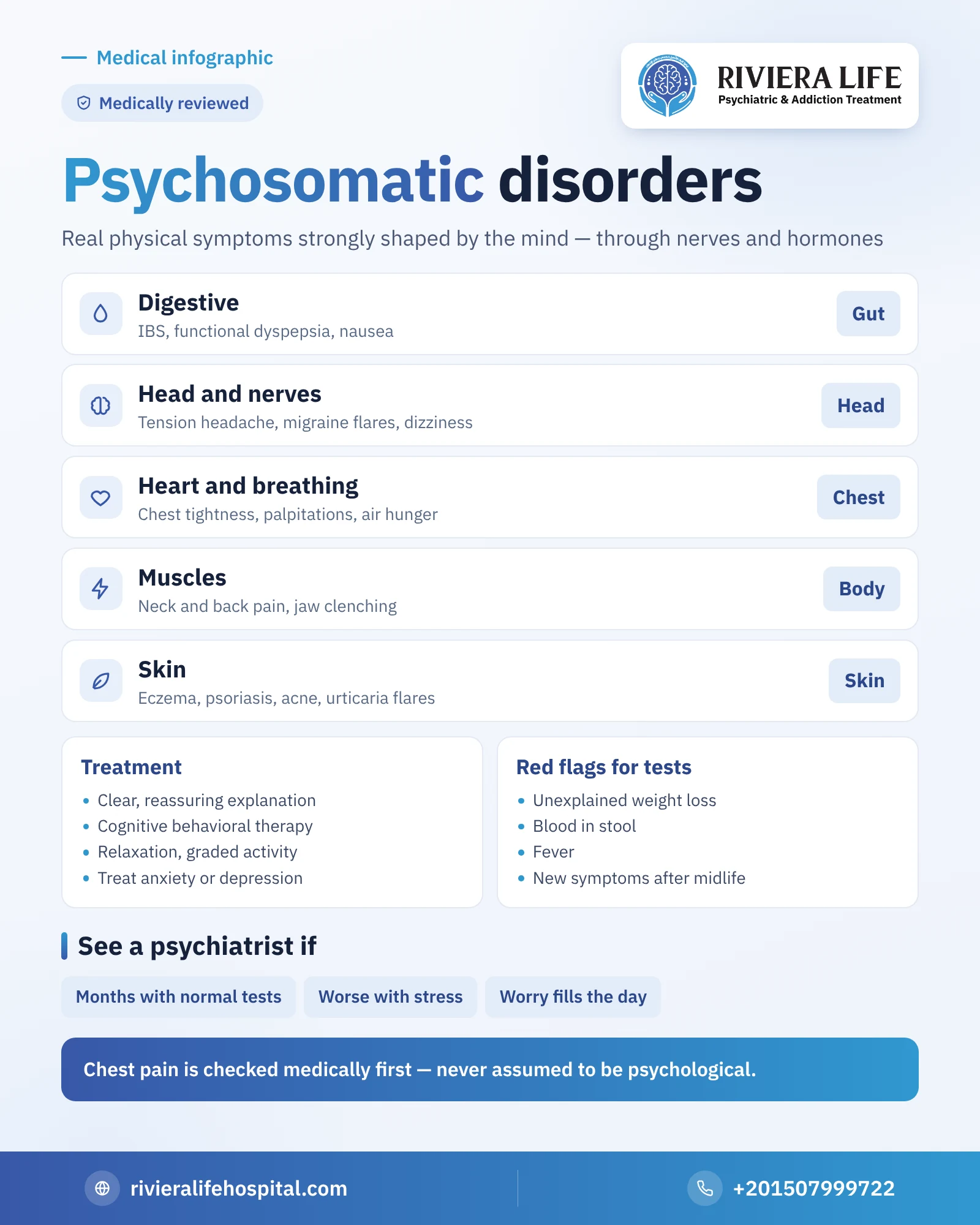
The best-known forms of psychosomatic disorders
| System | Common examples |
|---|---|
| Digestive system | Irritable bowel syndrome, functional dyspepsia, recurrent nausea, and bowel changes with stress |
| Head and nerves | Tension headache, more frequent migraine attacks, dizziness, and numbness |
| Heart and breathing | Chest tightness, palpitations, and a feeling of being unable to take a deep breath |
| Muscles and joints | Neck and back pain, jaw clenching and teeth grinding, and widespread pain with fatigue |
| Skin | Flares of eczema, psoriasis and acne, itching, urticaria, and hair loss |
| General symptoms | Persistent fatigue, disturbed sleep, weak immunity and frequent colds |
Note that some of these conditions, such as psoriasis and migraine, are fundamentally physical diseases, but psychological stress triggers them and increases their attacks. Others, such as irritable bowel syndrome, are functional disorders in which communication between the gut and the brain plays a central role.
Chest tightness: heart or anxiety?
One of the things that most worries people is feeling chest tightness and palpitations and thinking it is a heart attack. The rule here is clear: chest pain is assessed medically first, especially when there are risk factors, so it isn’t right to assume it is psychological before examination. But if it recurs with sudden bouts of fear and the tests are normal, it may be panic attacks, and we have explained the difference between the two in our article on panic attacks.
Functional symptoms and somatic symptom disorder
Not everyone who has a physical symptom affected by the mind has a psychiatric disorder. The American diagnostic manual describes “somatic symptom disorder” when three things come together:
- One or more physical symptoms that cause clear distress or disrupt daily life.
- Excessive thoughts, feelings or behaviors about the symptom: constant worry about its seriousness, or a great deal of time and effort spent thinking about it.
- The condition persisting for a long time, usually more than six months, even if the symptom itself changes.
Importantly, the diagnosis doesn’t depend on the absence of a physical cause; the person may have a real physical illness, but their preoccupation with it far exceeds what the doctor would expect. This differs from “illness anxiety”, in which physical symptoms are mild or absent but the fear of having a serious illness dominates the person.
The symptoms are real, not imaginary
What most hurts patients is hearing “there’s nothing wrong with you” or “it’s all in your head”. The truth is that pain is always produced in the brain, whether its cause is inflammation, a fracture or tension, and the patient genuinely feels it. Psychosomatic symptoms aren’t acting, pretending or weakness, and the person doesn’t choose them or control them by will.
Understanding that the symptoms have a psychological side isn’t an accusation, but good news: it means there is an additional route to treatment that hasn’t been tried yet.
Assessment: so that no physical cause is missed
The first mistake is telling the patient their symptoms are psychological without examination, and the second mistake is moving between dozens of doctors and tests without anyone asking about their psychological state. Good assessment combines both directions:
- A medical examination suited to the symptom that rules out important physical causes, such as thyroid disease, anemia, and heart and digestive diseases.
- Attention to warning signs that call for deeper examination, such as unexplained weight loss, blood in the stool, fever, or symptoms appearing for the first time after middle age.
- A psychological assessment looking for accompanying anxiety, depression, trauma or ongoing stress.
- Coordination between the treating doctor and the psychiatrist instead of endlessly repeating tests.
Some stress symptoms may resemble hormonal diseases, and we have detailed this in our article on high cortisol symptoms.
How are psychosomatic disorders treated?
The most successful treatment deals with the person as one unit, and usually includes:
- A clear, reassuring explanation: the patient’s understanding of what is happening in their body reduces anxiety, and less anxiety means milder symptoms.
- Cognitive behavioral therapy: among the treatments with the most evidence in functional symptoms and somatic symptom disorder, helping to break the cycle of anxiety and symptoms. Learn about it in our article on cognitive behavioral therapy.
- Relaxation techniques: slow breathing, progressive muscle relaxation and mindfulness.
- Graded physical activity: restores confidence in the body and eases pain and fatigue.
- Treating accompanying anxiety or depression: the doctor may prescribe medicines such as some antidepressants, which also help ease pain and bowel symptoms in some patients, under the doctor’s supervision only.
- Treating the affected organ: such as skin treatment or a suitable diet for the bowel, in parallel with psychotherapy.
- Reducing unnecessary tests: with a regular follow-up plan with one doctor the patient trusts.
Caution is needed about relying on painkillers or sedatives for long periods to ease these symptoms, as they may turn into a bigger problem than the original.
Daily steps that help you
- Write down your symptoms and the situations or feelings that came before them for several weeks, as a clear pattern often appears that helps the doctor.
- Keep fixed times for sleep and meals, as an exhausted body is more sensitive to pain.
- Set aside a short daily time for movement and another for relaxation, even when symptoms are present.
- Cut down on caffeine and smoking, as both increase palpitations and stomach upset.
- Talk about what bothers you with someone you trust instead of bottling it up, as suppressed emotions look for a way out.
When should you see a psychiatrist?
If physical symptoms persist for months with normal tests, your symptoms clearly increase with stress, worry about the symptoms has started consuming your day, or persistent sadness or anxiety appears with them, a psychological assessment is a logical step that doesn’t mean your symptoms are “not real”. You can learn what happens at the first visit in our article on when do you need a psychiatrist.
How can Riviera Life help you?
At Riviera Life, psychiatric consultants review the tests you have had, request only what is needed, then set a plan that combines psychotherapy and treatment of accompanying anxiety or depression, in complete confidentiality. The first consultation is free, in Sheikh Zayed.
Read also
- Psychological stress: its signs and effect on the body
- Panic attacks
- Anxiety: symptoms, causes and treatment
- When do you need a psychiatrist
- Librax: its components, use for the bowel and dependence risks
- Psychological IBS: how anxiety moves the gut and what calms it
- Psychogenic urticaria: when stress triggers the rash and how it is treated
- Tension headache: its signs, the difference from migraine and when it is serious
- Conversion disorder: real neurological symptoms without a physical disease
- Inability to express emotions: alexithymia and how to deal with it
Questions many people ask
No, the symptoms are real and the patient genuinely feels them; the difference is that the psychological state plays a large role in their appearance or increase through nerves and hormones.
IBS is a functional disorder of the digestive system, strongly affected by communication between the gut and the brain, which is why it increases with stress and many benefit from psychotherapy alongside dietary and medical treatment.
This isn't assumed except after a suitable medical examination that rules out physical causes. A clear link between the symptoms and stress, and their persistence with normal tests, makes the psychological side more likely.
Cognitive behavioral therapy is among the treatments with the most evidence, with relaxation, graded activity and treating accompanying anxiety or depression when present.
Stress doesn't cause all skin diseases, but it may trigger or worsen conditions such as eczema, psoriasis, acne, itching and urticaria.