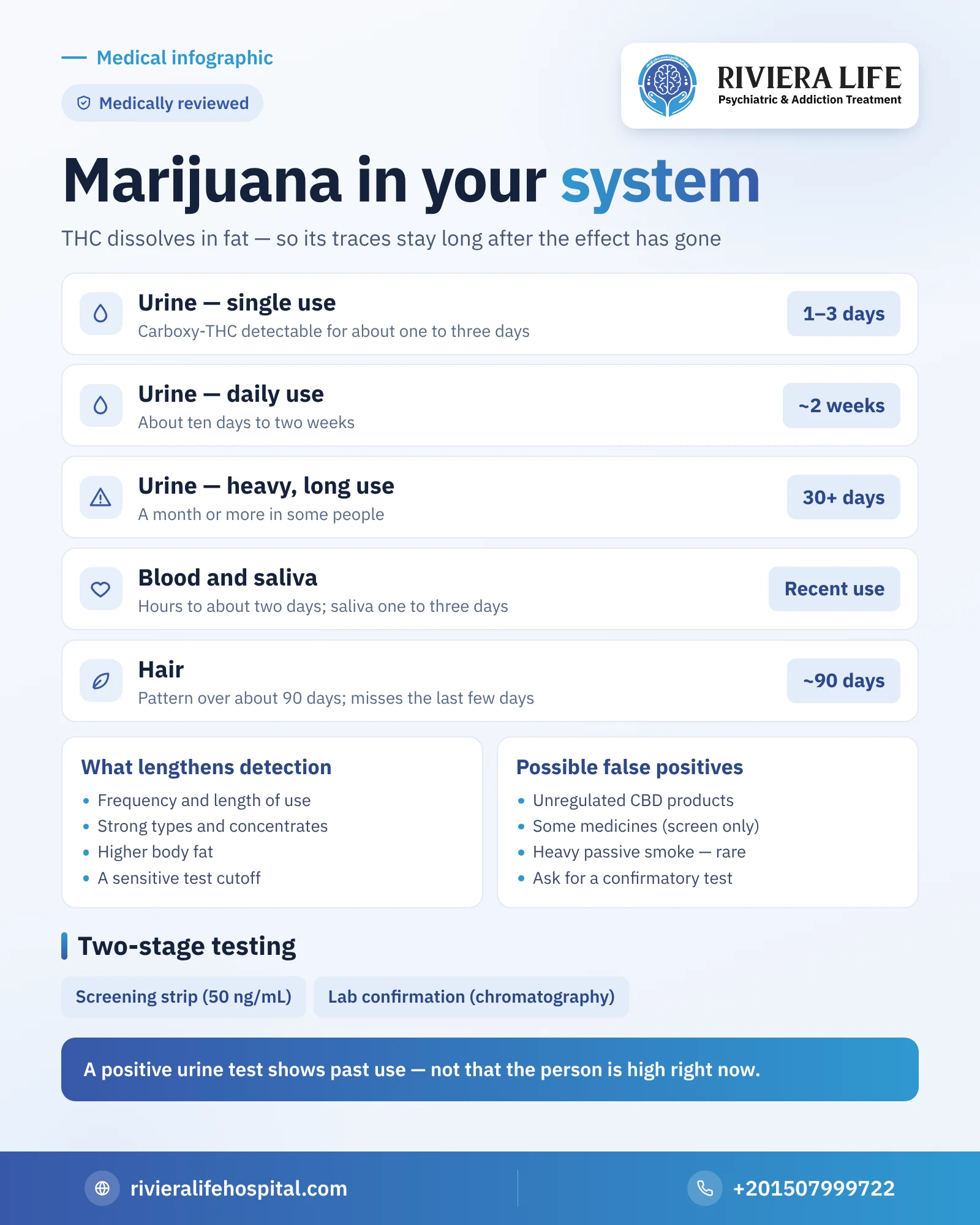
How long marijuana stays in the body depends on the type of test and the pattern of use: in urine it stays about one to three days after a single use, may extend to two weeks with daily use, and to a month or more in heavy long-term users.
In blood it shows for hours to about two days, in saliva for one to three days, and in hair for about ninety days. These relatively long times make marijuana one of the substances most often detected in workplace and school tests. This article explains why it stays, the detection window in each type of test, the factors that lengthen or shorten it, and when a positive result is wrong.
Why does marijuana stay in the body longer than other drugs?
Most drugs dissolve in water and leave in the urine within a few days, but THC dissolves in fat. After use, part of it moves quickly to the brain, and another part is stored in fatty tissue, then seeps slowly back into the blood over days and weeks. The liver converts THC into by-products, the most important being a compound called carboxy-THC, which isn’t psychoactive but stays a long time, and this is exactly what urine tests look for. That is why a person may still test positive days after the effect has completely worn off.
How long marijuana stays in urine
The urine test is the most widely used, and the time it covers is linked first of all to the pattern of use:
| Pattern of use | Approximate detection window in urine |
|---|---|
| A single or rare use | One to three days |
| Several times a week | Five to seven days |
| Daily use | About ten days to two weeks |
| Heavy daily use over a long period | Sometimes a month or more |
These are approximate figures taken from laboratory references, and individual cases may fall outside them in either direction. Someone who used strong concentrates daily for years may still be positive weeks after genuinely stopping, while someone who used a weak type once may be negative after a single day. That is why a general table isn’t suitable for judging a particular case, and the doctor reads the result in light of what the patient says and the sequence of tests.
How long marijuana stays in the blood
THC peaks in the blood within minutes of smoking, then falls quickly, and remains detectable for a few hours to about two days after occasional use; the time may be longer in a daily user. The blood test is used mainly in emergencies and in assessing recent use, such as road accidents, because it is closer to what is happening in the body “now” than the urine test.
How long marijuana stays in saliva
The saliva test detects THC remaining in the mouth after smoking or vaping, and its window is relatively short: from hours to one to three days depending on frequency and amount. Its advantage is that it is easy and quick and done directly in front of the person, which is why some countries use it in roadside testing. With edibles, detection in saliva may be weaker because the substance doesn’t pass through the mouth in the same way.
How long marijuana stays in hair
THC by-products enter the hair as it grows, so each centimeter keeps roughly a month’s record of use. The usual sample, close to the scalp, reflects about ninety days. But this test has limits: it doesn’t detect use in the last few days because hair needs time to grow, and it may not accurately detect rare or one-off use. That is why it is used more to assess the long-term pattern.
Factors that lengthen or shorten the time
- Frequency and length of use: by far the most important factor, as the store in fat builds up with daily use.
- The strength of the substance: strong types and concentrates leave a larger amount of by-products.
- Body fat: the time may be longer in those with a higher proportion of body fat.
- The route of use: edibles are metabolized differently in the liver, and their by-products may differ in timing.
- Liver function and metabolism: these differ from person to person and affect how fast the substance is cleared.
- Test sensitivity: each laboratory uses a specific threshold for positivity, and the lower the threshold, the longer the detection window.
How does a marijuana test work?
Testing usually goes through two stages:
The screening test
A strip or device based on an immune reaction that detects cannabis by-products above a certain threshold. The common positivity threshold in urine is 50 nanograms per milliliter, and some strips are more sensitive. This test is quick and cheap, but it can sometimes be wrong.
The confirmatory test
Done in the laboratory with chromatography equipment and mass spectrometry, it identifies the compound and its amount precisely, and its usual threshold is lower than the screening threshold. Any positive screening result on which an important decision depends — at work, in the family or in court — must be confirmed this way.
Can the result be positive without use?
This can happen in limited cases:
- Cannabidiol products: many unregulated oils and preparations contain proportions of THC that the label doesn’t mention, and regular use of them can lead to a positive result.
- Some medicines: a limited number of medicines can interfere with the screening test, and the confirmatory test settles the matter.
- Passive smoking: rarely exceeds the usual positivity threshold, except under conditions of intense exposure in a completely closed space.
That is why anyone who takes medicines regularly should tell the laboratory about them before the test. And anyone who receives a positive result they believe is wrong has the right to request a confirmatory test on the same sample instead of relying on the strip; this is the professionally accepted procedure.
Does strox show up in a marijuana test?
Usually not. Synthetic cannabinoids differ chemically from THC, aren’t detected by the usual cannabis strip, and need special tests that keep changing as market formulas change. So a cannabis test may be negative in someone showing severe symptoms, because they used a synthetic substance sold to them as marijuana. The details are in our article on how long strox stays in your system.
Does a positive test mean the person is under the influence now?
No. A urine test reveals that the person used the substance in the past days or weeks, but it doesn’t determine exactly when, and doesn’t prove they are affected by it at the moment of the test. The effect itself lasts hours, while the by-products stay for days. This is an important point for families following their son during recovery: a positive test in the first days after stopping may be from leftover old use, and the doctor reads the trend across successive tests, not a single result.
“Body cleansing” products: promises without evidence
Drinks and capsules claiming to flush marijuana out of the body in hours are widespread online. There is no scientific evidence that they work, and modern laboratories examine the urine sample itself and detect tampering with its composition. More importantly, the substance leaving the body doesn’t mean recovery: the craving and the habit remain, and what the person really needs is treatment, not a trick.
The role of testing in the treatment journey
Within a treatment program, testing turns from a tool of accusation into a tool of support. The team agrees regular tests with the patient, so successive negative results give them tangible evidence of their progress, and give their family reassurance instead of daily suspicion. In some programs negative results are linked to incentives, an approach that has proven effective with marijuana addiction. The details of the plan are in our article on marijuana addiction treatment, and what the person feels during those same weeks is in our article on marijuana withdrawal symptoms.
More from our marijuana guide
- Marijuana: the complete guide
- Marijuana withdrawal symptoms
- Marijuana addiction symptoms
- The harmful effects of marijuana
Questions many people ask
Usually about one to three days after a single use, and the time may vary slightly with the strength of the substance and the sensitivity of the test.
Because THC is stored in fat and released slowly, so with heavy daily use a store builds up that keeps coming out for weeks after stopping.
Pure cannabidiol shouldn't give a positive result, but many unregulated products contain THC that can show up in a test.
This rarely happens in normal conditions, because passive exposure usually doesn't reach the positive threshold except in a completely closed space for a long time.
No. A urine test indicates use during the past days or weeks; it doesn't pinpoint the timing or prove the person was under the influence at the time of the test.