The difference between hashish and marijuana starts from the part taken from the cannabis plant, not from the plant itself or the active substance (THC) both carry. Marijuana is the dried flowers and upper leaves, while hashish is the sticky resin those flowers secrete, collected and pressed into dark pieces. This difference in source creates a difference in form, potency and method of use, but it doesn’t make either of them “safe”. In this article there is a clear comparison between them, with where bango fits on the Egyptian street, and an answer to a question families often ask: which is more dangerous?
Hashish vs marijuana in a table
| Comparison | Hashish | Marijuana |
|---|---|---|
| Part of the plant used | Resin secreted by the flowers | Dried flowers and upper leaves |
| Form | Brown to black pieces or paste | Green or brownish herb, crumbled or as buds |
| Potency of the active substance | Usually higher per piece | Usually lower, varying a lot with quality |
| Common method of use in Egypt | Heated and mixed with tobacco in a cigarette or smoked in a goza | Rolled in a cigarette alone or with tobacco |
| Smell | Pungent, with the smell of burning tobacco | Sharp and herbal, like burnt grass |
| Risk of addiction | Real, and rising with high potency | Real, and rising with strong strains |
| Showing up in tests | Detected by the same cannabis strip | Detected by the same cannabis strip |
Where does each come from?
Fine hairs grow on the female flowers of the cannabis plant and secrete a shiny resinous substance, and most of the plant’s active compounds are concentrated in this substance. When the flowers themselves are dried and cut, we get marijuana. When that resinous substance is separated from the plant, by sieving, rubbing or heat, and then pressed into a solid mass, we get hashish.
In this sense, hashish is the “extract” of what is in marijuana, concentrated into a smaller volume. That is why a small piece of it carries what a much larger amount of the herb carries. To learn about each in more detail, see our pages on hashish and marijuana.
Form and appearance: what does each substance look like?
Hashish in Egypt usually appears as hard pressed pieces colored between light brown and black, which soften and crumble when heated, and sometimes as a soft sticky paste. The family may find a small piece wrapped in silver foil or plastic, or burn marks on a lighter.
Marijuana is a dry green or brownish herb, which may be in the form of dense buds or crumbled leaves with seeds and stems. It is usually kept in small sealed bags because of its strong smell. Form alone isn’t enough to judge, as ordinary herbs may be sprayed with synthetic cannabinoids and sold as marijuana, and these are completely different substances.
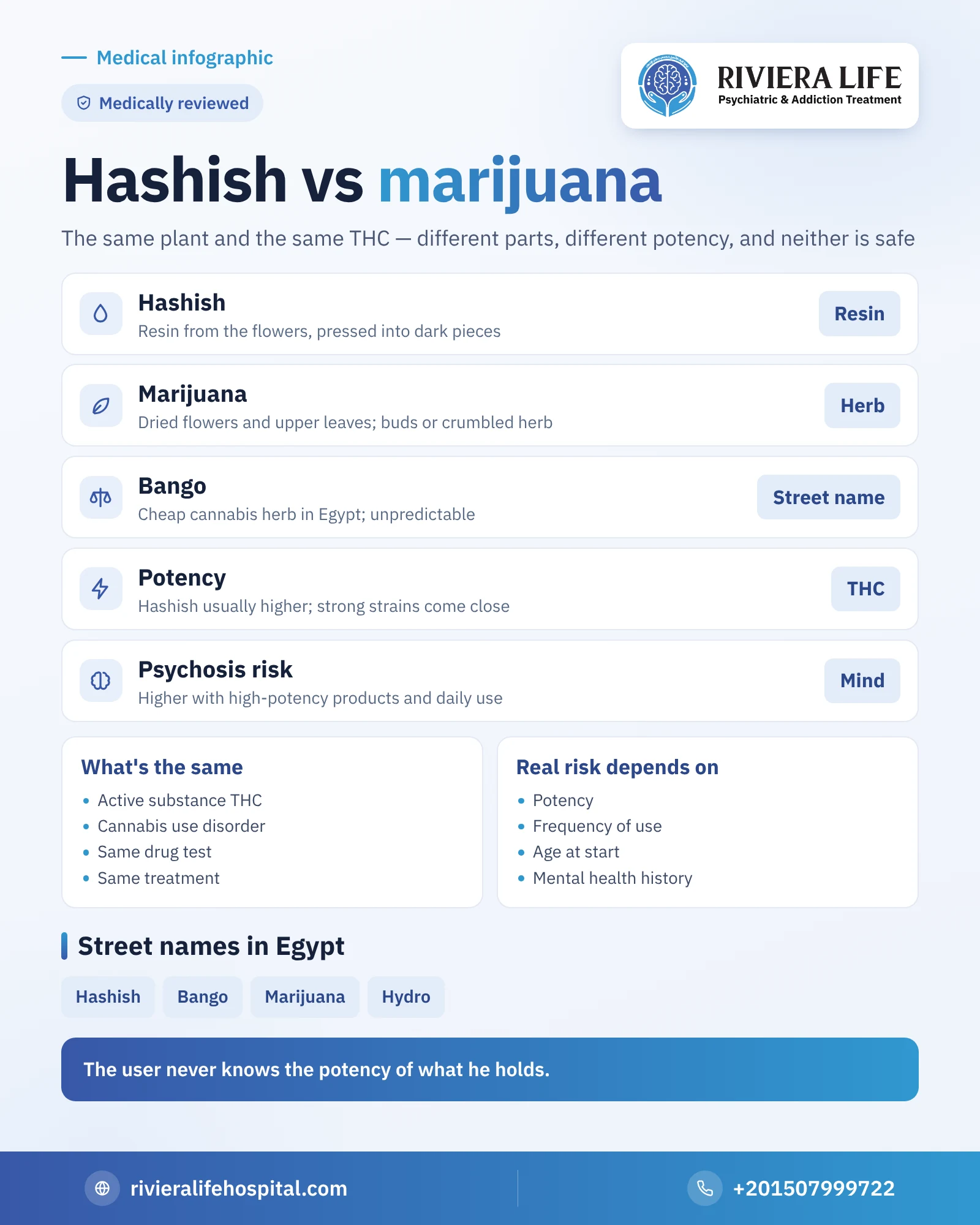
Bango, marijuana and hashish: the names on the Egyptian street
A lot of confusion happens here. In common Egyptian usage:
- Bango: usually means cheap cannabis herb, leaves, stems and seeds of varying quality, with lower potency on average but unpredictable. Its details are on our page on bango.
- Marijuana: usually used to describe higher-quality dried buds, including types grown indoors and promoted as “hydro”.
- Hashish: the pressed resin, known by many popular names that refer to the size or quality of the piece.
So bango and marijuana are scientifically one thing, cannabis herb, and the difference between them is in quality and the part of the plant used, while hashish is a product that differs in how it is prepared. Our article on hydro addiction explains why carefully grown types carry higher potency.
Potency of the active substance: where does the real difference lie?
There are no fixed figures, because potency varies with the strain, the method of growing and storage. But the general picture reflected in international monitoring reports is:
- Ordinary cannabis herb may carry a potency in the range of single figures up to around ten percent, and may rise in strong strains to more than twenty percent.
- Resin (hashish) carries a higher potency on average, and in many samples has exceeded the twenty percent mark in recent years.
- Potency in both forms has clearly risen compared with two or three decades ago.
What matters isn’t the exact figure, but two facts: that the user never knows the potency of what is in his hand, and that higher potency means a greater risk of addiction and psychiatric symptoms.
Does the effect differ?
The active substance is the same, so the general effect is similar: relaxation or laughter, a change in the perception of time and sounds, hunger, red eyes, dry mouth and slow reactions. The difference comes from the amount that reaches the brain. With strong hashish a person may reach a stronger effect with a small amount, so the chances of anxiety, panic and a feeling of strangeness increase. With marijuana the effect may be milder at a single time, but repeated smoking makes up for that. And mixing hashish with tobacco in Egypt adds nicotine and its harms to the equation.
Which leads to addiction faster?
Both cause cannabis use disorder, a real addiction with clear signs: urgent craving, increasing the amount, inability to stop, and withdrawal symptoms such as insomnia and irritability. What determines the speed of reaching it is potency, frequency of use, starting at a young age, and personal predisposition. So high-potency hashish and strong marijuana tend to push the user toward dependence faster than weak bango, without any of them being far from this risk.
The risk of psychosis and psychiatric symptoms
High-potency products are linked to a greater risk of psychotic symptoms, such as suspicion, a feeling of being watched and hallucinations, especially with daily use or in those with a family history of psychotic disorders. This makes strong hashish and high-potency marijuana more worrying from this angle. Chronic use is also linked to anxiety, depression and weak motivation. This aspect is explained in our articles on the harms of hashish and the harms of marijuana.
Does the test distinguish between them?
No. A drug test looks for the breakdown products of the active substance in the body, which are the same whether they came from hashish, marijuana or bango. So the result is “cannabis” without specifying the source. The detection time depends on the number of times and duration of use and body mass more than on the type of product, and you will find details in our article on how long hashish stays in the body.
Which is more dangerous: hashish or marijuana?
If a short answer is needed: hashish is stronger on average, so its risk per dose is greater, especially to mental health. But high-quality marijuana may come close to it or exceed it, and cheap bango may be sprayed with synthetic substances more dangerous than both. The real danger is determined by three questions: what is the potency of the substance? How often does the person use it? And who is this person in terms of age and psychiatric history? That is why the comparison between hashish and marijuana can’t be used to justify either of them. And if you are looking for a comparison between hashish and a substance from a different family, our article on tramadol vs hashish covers it.
The legal position in Egypt
Hashish, marijuana and bango are all forms of cannabis criminalized under Egyptian law, and the law doesn’t distinguish in criminalization between one form and another. Possession, use and trafficking are punished according to the law, while the law allows those who seek treatment voluntarily to receive it, and treatment takes place in specialized hospitals confidentially.
The treatment is the same whatever the form
Because the active substance is the same, treatment of hashish and marijuana addiction follows the same steps: medical and psychiatric assessment, getting through withdrawal with support, cognitive behavioral and motivational psychotherapy, treatment of any accompanying disorder, then a relapse prevention plan. At Riviera Life the journey begins with a free, confidential first consultation with a specialist consultant who determines what the patient really needs. You can read the full plan in our article on hashish addiction treatment.
More from our hashish guide
- Hashish: the complete guide
- The harms of hashish on the brain and body
- Hashish addiction symptoms
- Medicines for treating hashish addiction
- Spice vs hashish: a lab substance and a plant substance
- Strox vs hashish: what an episode looks like and what the family notices
- Hydro vs bango: growing, potency, effect and dependence risks
- Opium vs hashish: the chronic user, the body, withdrawal and treatment
- The benefits of hashish: what science has really proven and what remains a myth
Questions many people ask
Yes, both come from the cannabis plant. Marijuana is the dried flowers and leaves, and hashish is the resin secreted by the flowers after it is collected and pressed.
Scientifically both are dried cannabis herb, but in Egypt bango usually refers to cheap types with many leaves and stems, and marijuana to higher-quality buds.
Hashish is on average more potent because it is a resin concentrate, but some strong marijuana strains may come close to it, and the user never knows the potency of what he is using.
No, the test detects breakdown products of the active substance itself, and the result shows as cannabis without specifying whether the source was hashish, marijuana or bango.
No, marijuana causes cannabis use disorder just like hashish, and the risk rises with high potency, daily use and starting at a young age.