Borderline personality and marriage is a relationship that combines intense love and intense fear at the same time. A partner with borderline personality disorder may be warm, loyal and devoted, then turn within hours to anger, accusation or a threat to leave, because his fear of abandonment is stronger than his ability to calm himself. This article isn’t for diagnosing your partner, as diagnosis is for the psychiatrist alone, but for understanding the patterns that recur in these relationships, what actually helps, how to set healthy limits, and when the relationship becomes unsafe. The most important message: borderline personality improves with treatment, and many couples get through this stage.
Borderline personality and marriage: why is the relationship specifically affected?
The core of borderline personality disorder is difficulty regulating emotions and a deep fear of rejection and abandonment. The closest relationship in a person’s life, marriage, is the place where this difficulty appears in its clearest form. A colleague at work sees only a small part, while the partner lives the swings daily. That is why the affected person may seem composed in front of people and then collapse at home, so the partner thinks the problem is in him. We have explained the nine signs of the disorder in our article on borderline personality disorder symptoms.
Recurring patterns in a borderline marriage
Fear of abandonment
A husband being an hour late coming home may be read by the affected partner as proof that he no longer loves her or that he is cheating. So come the successive messages, the calls that don’t stop, then anger on his return.
Swinging between idealization and devaluation
At the start of the relationship the affected partner sees the other as “the best person in the world”, and after a simple disagreement may see him as “the worst person”. This split in vision, black or white, is exhausting for both.
Intense emotions that change quickly
Joy, sadness and anger all come with greater force, and change in hours, not days. This is what distinguishes them from bipolar swings, which last days or weeks, as our article on the difference between bipolar disorder and borderline personality explains.
The conflict cycle
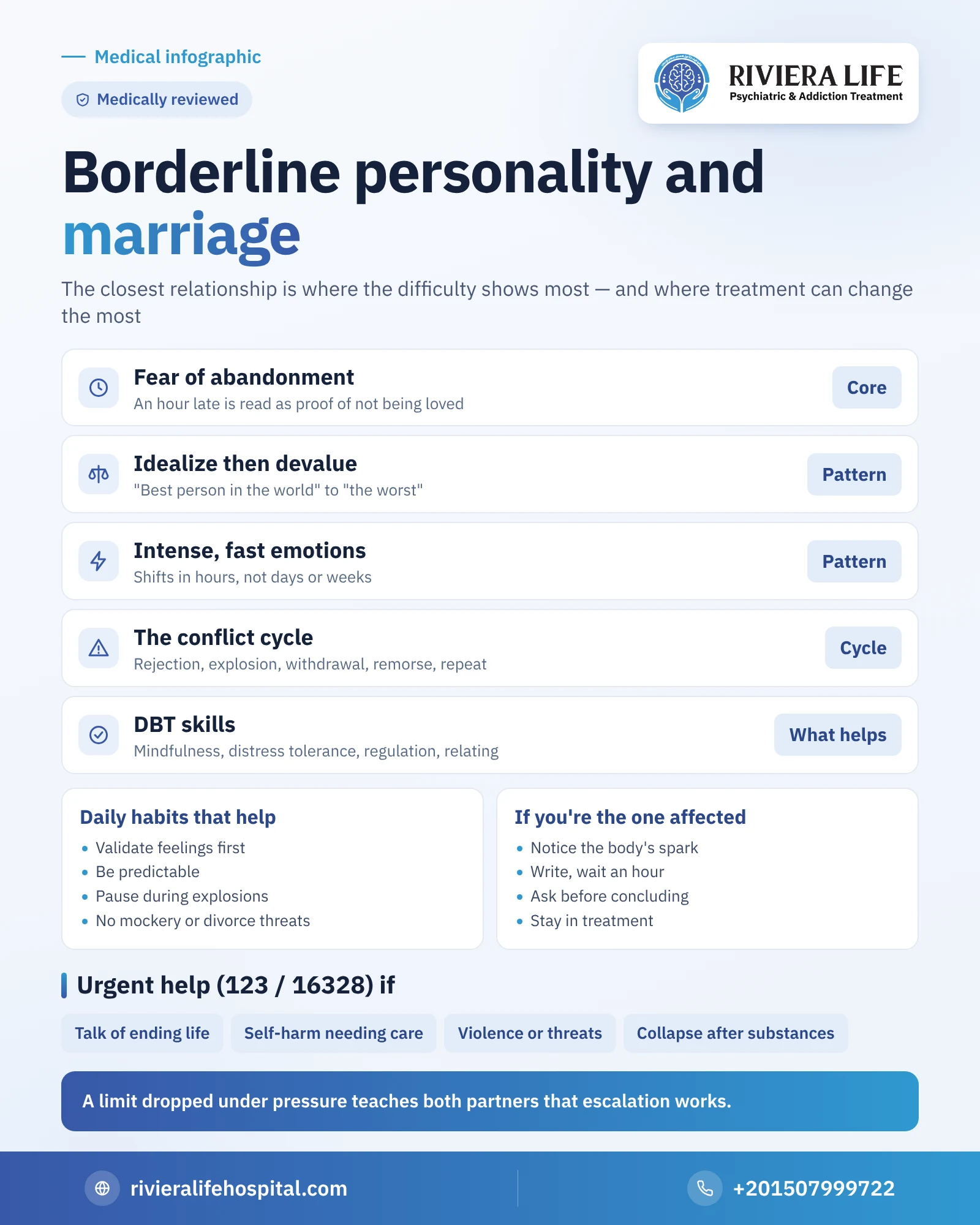
The cycle begins with a feeling of rejection, then an explosion of anger, then the partner withdraws to protect himself, which the affected partner reads as abandonment, so the anger intensifies or turns into a threat, then comes regret, a warm apology and intense closeness, then the cycle starts again.
What does the affected partner feel?
From outside the behavior looks like control or pathological jealousy. From inside, many patients describe unbearable pain: an inner emptiness, a feeling that they are “too much” and will inevitably be left, and intense shame after every explosion. Understanding this doesn’t mean justifying harm, but it changes the way of responding from counter-attack to calming. The roots of these feelings, between genetic predisposition and childhood experiences, are explained in causes of borderline personality.
What helps in daily life?
- Acknowledge feelings before discussing facts: “I understand you felt afraid when I was late” before “but I really was at work”.
- Consistency and clarity: known times, a short message when late, and small promises that are kept.
- Postpone discussion during an explosion: agree in advance on a word that means “we stop now and continue in an hour”, while affirming you will come back.
- Avoid mockery and threats of divorce in moments of anger, as they confirm his worst fears.
- Notice the good days: praising calm and mature handling reinforces it more than focusing on mistakes.
Dialectical behavior therapy skills for couples
Dialectical behavior therapy (DBT) is one of the most studied treatments for borderline personality, and is based on skills the patient learns, some of which the partner can learn too. In general they include:
- Mindfulness: noticing feelings and naming them without being carried away by them immediately.
- Distress tolerance: ways to get through a moment of intense pain without an action he will regret, such as postponing a reply or changing place.
- Emotion regulation: understanding what ignites emotion, and caring for sleep and food, which reduces its intensity.
- Interpersonal effectiveness: asking clearly for what he needs and refusing what he doesn’t want, while maintaining respect.
Some programs offer sessions for the family or the couple in a style close to these skills. These skills are learned with a specialist therapist, and the details of the treatment plan are in our article on borderline personality disorder treatment.
If you are the one affected: steps that protect your marriage
Many readers here aren’t the other party, but the affected people themselves, who realize that their reactions hurt those they love and don’t know how to stop. Your knowing this is a real beginning, not a reason for self-blame. Practical steps that help:
- Learn to notice the moment of ignition in your body before it turns into words: heat in the face, tightness in the chest, or a pressing urge to call repeatedly.
- Write what you want to say in a message and don’t send it until an hour later; many messages look different once the emotion has calmed.
- Ask before you conclude: “You’re late, is everything OK?” instead of “You must have been with someone”.
- Explain to your partner what happens inside you at a calm time, not in the middle of a disagreement.
- Stay committed to treatment even in the good weeks, as real improvement is built by accumulation.
- Stay away from alcohol and drugs, as they double impulsivity and mood swings.
Healthy limits: love doesn’t mean enduring without limit
Limits aren’t a punishment, but clear rules that protect the relationship. Examples include:
- “I won’t continue the conversation if voices are raised or insults begin, and I’ll come back when we’re calm”.
- “I won’t leave my work or my friends to prove my love”.
- “I won’t accept my phone being searched every day, but I’m ready to reassure you in other ways”.
The secret of limits is that they are said calmly, and applied every time. A limit that is withdrawn under pressure teaches both sides that escalation works.
When does the relationship become unsafe?
Not every relationship with borderline personality is harmful, but some cross the line. The relationship is unsafe if there is physical violence or a threat of it, complete control over money, movement and communication, the use of threats of self-harm as a constant means of control, or children exposed to violence or constant fear. Your safety and your children’s safety are the priority, and seeking a temporary separation or legal and family help isn’t a betrayal of the sick partner.
Seek urgent help immediately if you see
Call an ambulance on 123 or the mental health hotline on 16328, or go to the nearest emergency department if:
- The partner talks about ending his life or appears to be in immediate danger
- Self-harm has occurred that needs medical care
- Violence or a serious threat has happened to you or the children
- He is in a severe collapse after using or mixing substances
When there is a threat of self-harm, take it seriously every time, seek specialist help, and don’t try on your own to be the therapist and the rescuer.
Children in the home
Children pick up tension even if they don’t understand its causes. They don’t need a medical explanation, but three things: that sharp disagreements stay away from them as far as possible, that they hear in simple language that what is happening isn’t their fault, and that they find a stable routine and a calm person to turn to. If they show signs of anxiety, academic decline or repeated anger outbursts, consulting a child psychiatry specialist is a wise step, not an exaggeration.
Is there hope?
Yes, and this is a fact confirmed by long-term studies: many with borderline personality disorder see their symptoms recede clearly with the years and treatment, and a large part of them reach a stage where they no longer meet the diagnostic criteria. The basic condition is that the affected person accepts treatment and commits to it, and that the partner gets support that protects him from exhaustion. A marriage that goes through this journey honestly may come out of it stronger.
How can Riviera Life help you?
At Riviera Life in Sheikh Zayed, psychiatry consultants offer a confidential assessment of borderline personality and accompanying depression or substance use, with a psychotherapy plan, involving the partner and family when that is useful, and a supervised stay around the clock in crises. The first consultation is free on +201507999722.
More from our borderline personality guide
- Borderline personality disorder: the complete guide
- Borderline personality disorder treatment
- Types of borderline personality
- The difference between bipolar disorder and borderline personality
- Stockholm syndrome: why people become attached to those who hurt them and how to break free
Questions many people ask
Yes, especially when the affected partner accepts treatment and commits to it, and both partners learn communication skills and setting limits.
In borderline personality a simple situation such as being late or a curt reply may be read as rejection or abandonment, so the reaction comes with more force than the situation.
No. Diagnosis is for the doctor or psychotherapist after a full assessment, and some traits resemble other disorders.
In some programs the partner or family is invited to education sessions or skills training, and the therapist decides what suits each case.
When there is violence, a serious threat, complete control or children exposed to danger, as safety comes first along with seeking specialist help.