The short answer
The PC-PTSD-5 test begins with a question: have you been through a traumatic event, such as a serious accident, an assault, war or a sudden loss? If the answer is yes, you answer five yes or no questions about the past month, covering intrusive memories, avoidance, hypervigilance, emotional numbness and guilt. Three or more yes answers call for a specialist assessment. It was developed by the US National Center for PTSD for use in primary care, and it is a screening tool, not a diagnosis.
- First conditionExposure to a traumatic event
- Questions5 yes or no questions
- 3 or moreCall for a specialist assessment
After traumatic events most people go through days or weeks of insomnia, fear and painful memories, which then gradually calm down. But for some they don’t calm: the event returns in nightmares, the person avoids particular places and conversations, and stays on alert as if the danger hasn’t ended. This test helps you know whether what you are living through is a normal response that will pass, or signs that deserve help.
Start the PTSD test
Post-traumatic stress disorder test (PC-PTSD-5)
People sometimes go through frightening or traumatic events, such as a serious accident, an assault, war, a disaster, or the sudden loss of a loved one. In the past month, because of an event of this kind:
To discuss your result with a psychiatrist in confidence, the first consultation is free on +201507999722.
This is an initial screening test for awareness, not a diagnosis. Your answers are not saved or sent to anyone; the calculation happens on your device only.
How is the result read?
| Number of yes answers | Meaning |
|---|---|
| You haven’t been through a traumatic event | The test doesn’t apply |
| 0 to 2 | The answers don’t point to PTSD |
| 3 to 5 | Possible PTSD, and assessment is advised |
We used the more sensitive cut-off, three answers, so as not to miss cases that need help, as some studies suggest four answers as the cut-off for men, while that cut-off misses many cases in women.
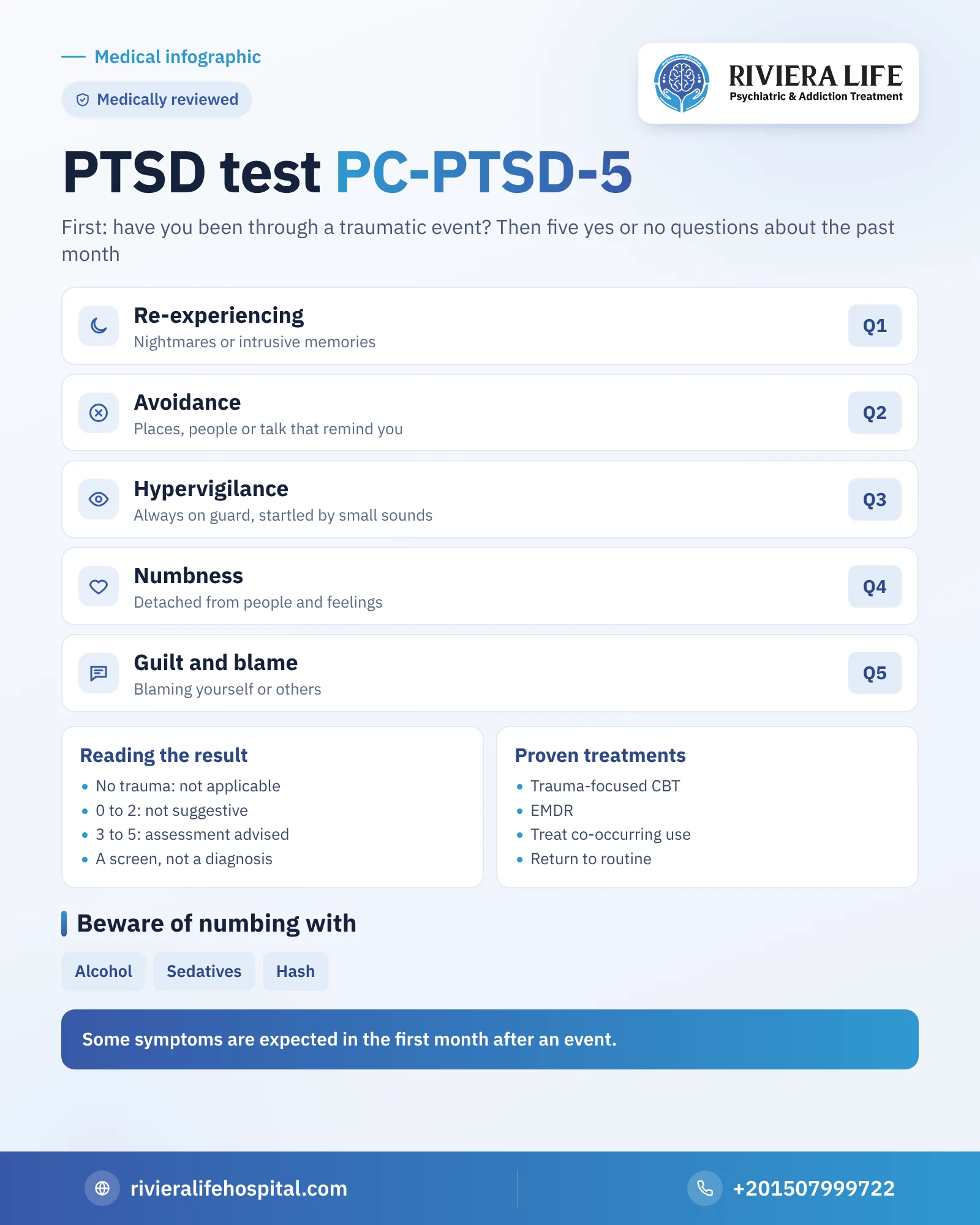
The five symptoms the test asks about
- Re-experiencing: nightmares or memories that intrude on the mind uninvited. Read recurring nightmares.
- Avoidance: staying away from places, people or conversations that recall the event.
- Hypervigilance: constant alertness and being startled by simple sounds.
- Numbness: detachment from people, feelings and what used to make you happy.
- Guilt and blame: blaming yourself or others for what happened or its consequences.
What do you do after the result?
If the event was recent, within the last month, some symptoms are expected, and support, talking and a gradual return to routine help. But if the symptoms continue for more than a month or disrupt your life, there are psychological treatments of proven effectiveness, such as trauma-focused cognitive therapy and eye movement desensitization and reprocessing. The details are in PTSD treatment.
Many who suffer the effects of trauma turn to alcohol, sedatives or hash to forget or to sleep, so the problem becomes two problems. Read PTSD and addiction.
About the PC-PTSD-5 scale
It was developed by the National Center for PTSD of the US Department of Veterans Affairs, and updated in 2016 to match modern diagnostic criteria; it is used to screen adults in clinics. The version here is a simplified translation for awareness.
How can Riviera Life help you?
The psychological team at Riviera Life assesses the effects of trauma in a calm interview that respects your pace, and sets a psychotherapy plan, with treatment of any accompanying substance use or depression. The first consultation is free and confidential on +201507999722.
Read also
- PTSD symptoms
- Psychological trauma: normal reactions
- PHQ-9 depression test
- Psychological tests: the complete guide
Questions many people ask
Three or more yes answers to the five questions call for a specialist assessment.
Some symptoms are expected in the first weeks after the event, and the diagnosis is considered when they last more than a month and affect life.