Morphine addiction treatment is possible, and the best results are achieved when treatment combines safe withdrawal under medical supervision, an approved medicine that protects against relapse, psychotherapy, and follow-up that extends for months after discharge. What distinguishes morphine treatment from others is that many patients started with it on a medical prescription, and some still suffer real pain. That is why a plan that cuts off the substance alone isn’t enough; the patient needs a plan that treats the dependence and manages the pain at the same time. This article explains the stages of treatment and the medicines used, what can honestly be expected about recovery rates, and how to choose the right hospital.
What is the recovery rate from morphine addiction?
There is no fixed rate any patient can be promised, and whoever gives you a guaranteed number isn’t telling the truth. What research says is that addiction is a chronic illness resembling in its course illnesses such as diabetes and blood pressure, and that relapse rates in it are estimated at roughly 40 to 60%, close to the rates of symptom return in those illnesses. Relapse therefore doesn’t mean the failure of treatment, but a need to adjust it. On the other hand, continuing drug and psychological treatment for a sufficient period is linked to a clear decrease in relapse and deaths, and to many patients returning to their work and families.
Assessment first: real pain, addiction, or both?
The first step isn’t withdrawing morphine, but understanding the case. The team asks: did use start with a prescription? Is the cause of pain still present? What is the amount and method of use? Are there other substances such as pregabalin or sedatives? Is there depression or anxiety? Tests and liver and kidney function are done. The answers determine the path: a patient with physical dependence without addiction needs a gradual reduction and better pain management, and a patient with a clear use disorder needs a complete program.
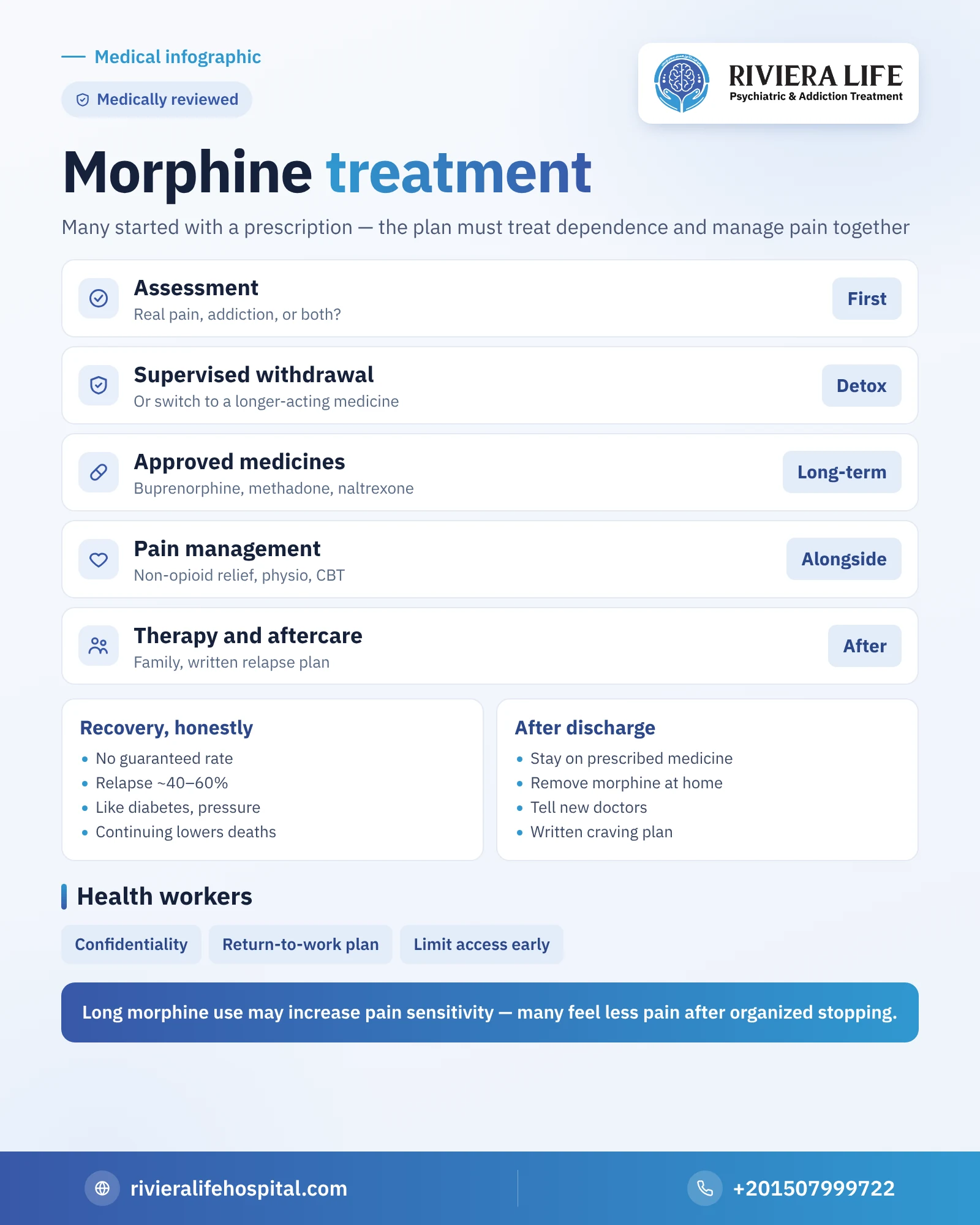
Stages of morphine addiction treatment
- A comprehensive medical and psychological assessment and setting an individual plan.
- Withdrawing morphine safely or switching to an approved medicine.
- Long-term drug treatment for those who need it.
- Managing pain with non-addictive alternatives when there is real pain.
- Psychotherapy, rehabilitation and involving the family.
- Follow-up after discharge and a written plan to prevent relapse.
Withdrawing morphine under medical supervision
The goal is for the patient to get through the withdrawal stage with the least possible pain and risk. The team follows pulse, blood pressure, fluids and sleep, and eases the symptoms with suitable medicines. Morphine may be replaced by a longer-acting medicine then reduced gradually, instead of stopping it suddenly. It is important for the family to know that detox alone doesn’t treat addiction, but makes the patient more prone to an overdose if they go back to morphine without later treatment. The details of the symptoms and their timing are in the article on morphine withdrawal symptoms.
Approved medicines in morphine addiction treatment
Buprenorphine
It partially occupies the opioid receptors, so it extinguishes craving and prevents withdrawal without any notable high, and its effect on breathing has a ceiling that makes it safer. The doctor starts it after a sufficient degree of withdrawal symptoms appears, and it suits many morphine patients, including those who also need a painkiller.
Methadone
A long-acting opioid medicine given once a day, so it keeps a steady level in the blood and prevents fluctuation between high and withdrawal. It needs careful dose adjustment and close follow-up in the first weeks, and its dispensing is subject to strict controls.
Naltrexone
It closes the receptors completely, so morphine gives no effect if taken. It suits the patient who has completely finished withdrawal and has a strong motive, and isn’t suitable for someone who needs opioid painkillers for continuing pain. It is started after the body has been free of opioids for several days.
Choosing the medicine and its duration is an individual medical decision, and none of them is used without supervision. To compare these options across the whole opioid family, see the article on opioid addiction treatment.
Managing pain during treatment
What most frightens a chronic pain patient is being left without a painkiller. Good treatment doesn’t do that. There are non-opioid painkillers, medicines used for nerve pain, physiotherapy, and local anesthesia techniques performed by the pain doctor, alongside cognitive behavioral therapy that changes the way the patient deals with their pain. It is useful for the patient to know that long use of morphine may increase their sensitivity to pain itself, so many feel improvement in the pain after weeks of organized stopping.
Psychotherapy and rehabilitation
- Cognitive behavioral therapy: to understand the situations and thoughts that lead to the dose and build alternatives to them.
- Motivational interviewing: to strengthen the patient’s inner motive instead of relying on pressure.
- Treating the accompanying depression, anxiety and sleep disorders, which are common in chronic pain patients.
- Group sessions that break the patient’s isolation and pass on to them the experiences of those who came before.
- A program for the family that teaches it how to support without watching or covering up.
Treating workers in the health sector
A doctor, nurse or pharmacist who has become addicted to morphine needs treatment that protects their confidentiality and professional future. The program here includes what any other program includes, with special attention to a plan for returning to work, avoiding access to narcotic substances in the first period, and regular follow-up that gradually restores trust.
How long does treatment take? And does it need residence?
Withdrawing morphine takes days to about two weeks, the intensive program weeks to a few months, while drug treatment and follow-up may extend a year or more. Full residence is preferred for those who use injections or large amounts, mix several substances, failed in previous attempts, or suffer a severe psychiatric disorder. Outpatient treatment suits milder cases or the stage after residence.
Relapse prevention after discharge
The first months are the most dangerous. What protects the patient in them is commitment to the prescribed medicine, attending follow-up, getting rid of any morphine remaining at home, telling any new doctor about their history before they prescribe a painkiller, and having a written plan for what to do when craving is urgent. To understand the factors that may return them to the cycle, see the article on the causes of morphine addiction.
The right hospital for morphine addiction treatment: how to choose
The right hospital for morphine addiction treatment is the one that provides what a morphine patient specifically needs: safe withdrawal, an approved medicine, a pain plan that doesn’t leave them in pain, and confidentiality that protects their work and reputation. Before you choose, ask:
- Is the hospital licensed by the Ministry of Health, with consultants in psychiatry and addiction treatment?
- Does it provide approved drug treatment, or settle for detox?
- Does it cooperate with pain medicine to set alternatives for the patient suffering chronic pain?
- Does it assess and treat depression, anxiety and other accompanying substances?
- Does it guarantee complete confidentiality, especially for workers in the health sector?
- Does it have a program for the family and clear follow-up after discharge?
Any provider that guarantees you a cure from morphine, or sets a few days for its treatment, stay away from it.
How Riviera Life meets these standards in morphine addiction treatment
This is what the patient and their family find in practice at Riviera Life:
- Government accreditation: the Ministry of Health license covers our work in psychiatry and addiction treatment.
- A long treatment record: fourteen years of work with addiction patients, during which thousands have recovered.
- Consultant doctors: a plan set by the consultants in psychiatry and addiction that balances withdrawing morphine with controlling pain.
- Constant medical oversight: a medical team that follows the patient night and day during morphine withdrawal and in the weeks after it.
- Complete confidentiality: full privacy for every patient, which matters to workers in the health sector specifically.
- A program for the family: sessions that help the family support the patient without clashes.
- Aftercare: regular follow-up and a written plan to prevent relapse after discharge.
Start with a free first consultation, and call us at any hour on +201507999722, and you will find us in Sheikh Zayed, Giza.
More from the morphine guide
- Morphine: a complete guide
- Morphine addiction symptoms
- Morphine withdrawal symptoms
- The harms of morphine
Questions many people ask
Look for a licensed hospital that combines safe withdrawal, approved medicine, pain management, confidentiality and follow-up. Riviera Life in Sheikh Zayed meets these criteria, with a free first consultation.
Many recover and live stable lives, especially with continuing treatment and follow-up. Addiction is a chronic condition whose symptoms may return, and relapse, if it happens, means adjusting the plan, not its failure.
With a joint plan between the addiction doctor and the pain doctor, using an approved medicine such as buprenorphine with non-opioid painkillers, physiotherapy and psychological treatment of pain, without leaving the patient without pain relief.
Withdrawal takes days to about two weeks, the intensive program weeks to months, and follow-up and drug treatment may extend a year or more depending on the case.
No, they are medicines given in fixed doses under supervision and don't cause the fluctuation and high that morphine misuse causes, and they clearly reduce relapse and deaths.