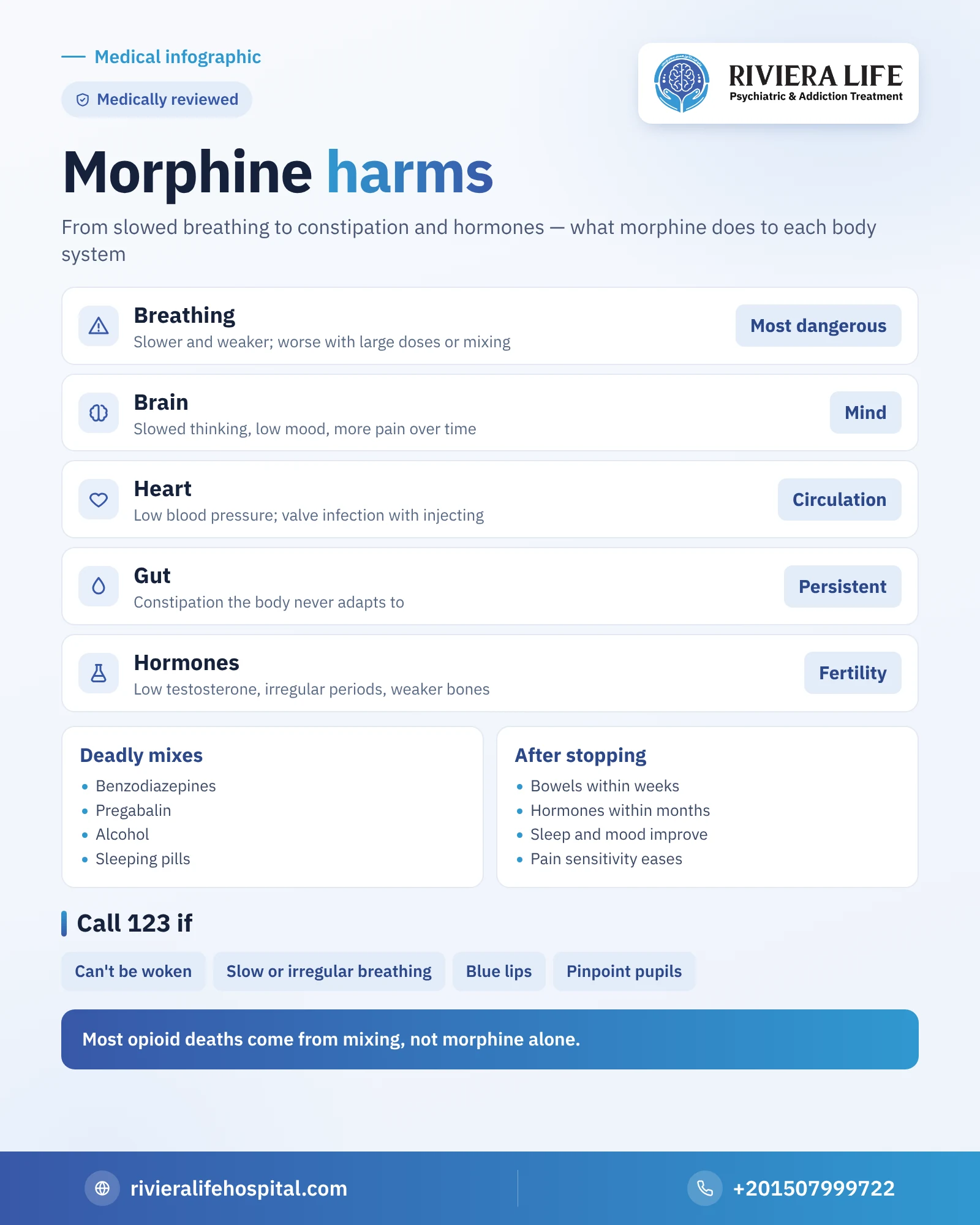
The harms of morphine begin with the most serious, slowed breathing that may end in death, and extend to chronic constipation, disturbed hormones and fertility, clouded thinking and mood, falls and fractures in older people, and then serious infections for those who inject it. Some of these effects appear even with medical use and the doctor manages them easily, and some appear only with misuse, large doses and mixing with other substances. This article details what morphine does to each system in the body, and what improves after stopping.
Short-term harms of morphine
In the hours after a dose, unpleasant effects may appear, most of them familiar to anyone who has received morphine in hospital:
- Nausea and vomiting, especially in the first days.
- Dizziness, drowsiness and slowed reactions that turn driving or operating equipment into a danger.
- Itching and skin redness due to histamine release.
- Difficulty urinating, especially in older men.
- A drop in blood pressure that shows as dizziness on standing.
- Passing confusion or hallucinations in some patients, especially the elderly.
Breathing: the most dangerous harm
Morphine reduces the response of the breathing center in the brainstem to rising carbon dioxide in the blood, so breathing becomes slower and weaker. At therapeutic doses this effect is limited and monitored, but it intensifies with large doses, with injecting, during sleep, or in those with sleep apnea or chronic lung disease. And when oxygen falls for minutes, the brain and heart may be damaged in a way that isn’t fully treatable even if the person survives.
Call an ambulance on 123 immediately if you see
These are signs of slowed breathing; don't wait for the person to wake up on their own.
- Deep drowsiness and no response to calling or shaking
- Very slow or irregular breathing, or unusual snoring
- Blue lips or nails
- Very small pupils and cold skin
Its effect on the brain and mental health
With long-term use, many complain of slowed thinking, weak concentration and memory, and general apathy and loss of enjoyment in usual things. Opioid misuse is linked to higher rates of depression and anxiety, and it may sometimes be hard to know which began first.
One of the effects that surprises patients is that morphine may increase the body’s sensitivity to pain over time, a phenomenon doctors call opioid-induced hyperalgesia: the patient hurts more despite a higher dose, and enters a vicious circle. And if the person has an overdose in which oxygen deprivation lasts long, problems with memory, balance or movement may remain afterward, varying in severity from case to case.
The heart and circulation
Morphine widens blood vessels and slows the pulse slightly, so blood pressure falls, and the person may feel dizzy or faint on standing suddenly. This effect is stronger in those who are dehydrated or taking blood pressure medicines. Those who inject morphine face an additional risk to the heart, which is inflammation of the valves caused by bacteria entering with contaminated injections, a condition that may need surgery.
The digestive system
Constipation is the most persistent side effect of morphine, and the body doesn’t adapt to it however long it is used, unlike drowsiness or nausea. That is why doctors prescribe laxatives with morphine from the start for patients on long-term treatment. With misuse it may reach a bowel obstruction requiring hospital admission.
Added to this are dry mouth and the tooth decay it brings, loss of appetite and malnutrition. Morphine may also cause spasm of the bile ducts that shows as pain in the upper abdomen, an effect doctors know and take into account when treating gallbladder and pancreas patients. And ignoring constipation for weeks isn’t a minor matter, as it may end in fissures, hemorrhoids and bleeding.
Hormones, fertility and married life
Chronic morphine use suppresses the sex hormone axis in the brain. In men, testosterone falls, so desire weakens, and erectile weakness, constant fatigue and loss of muscle mass may occur. In women, the menstrual cycle becomes irregular or stops, and fertility is affected. Over time, bone density may decrease in both sexes. Many of these changes improve within months of a managed stop.
The kidneys and older people
The kidneys excrete morphine’s by-products, one of which is active. If the kidneys are weak, the by-products build up and signs of toxicity appear even with normal doses: severe drowsiness, confusion, muscle twitches and slowed breathing. Older people are the most vulnerable to falls and hip fractures because of dizziness and low blood pressure, and to episodes of acute confusion. That is why the doctor starts them on small doses and follows them closely. To learn how weak kidneys affect how long morphine shows in tests, see our article on how long morphine stays in the body.
Harms of injecting and infection
Injecting morphine outside a medical setting, or injecting crushed tablets designed for the mouth, brings risks unrelated to the substance itself: abscesses and skin infections, damaged and blocked veins, transmission of hepatitis B and C and HIV when equipment is shared, and blood infection. Insoluble material in tablets may also block tiny vessels in the lungs and eyes. And chronic opioid use weakens the immune system’s ability to fight infection to some degree.
Mixing morphine with other substances
Most opioid deaths don’t happen with morphine alone, but with mixing. The most dangerous combinations are morphine with sedatives of the benzodiazepine family, with pregabalin, with alcohol, or with sleeping pills, because each of them also slows breathing, so the effect multiplies. Combining it with tramadol adds another opioid load plus the risk of seizures. You will find the harms of pregabalin alone on our page on pregabalin, and a broader picture of the harms of the whole family in our article on opioid harms.
Harms of morphine in pregnancy and to the fetus
Morphine crosses the placenta. Regular use during pregnancy may be linked to low birth weight and premature birth, and the baby may be born with withdrawal symptoms that need monitoring in the first days. But stopping suddenly during pregnancy is also dangerous for the fetus, which is why this situation must be managed between the obstetrician and the addiction doctor, not by an individual decision.
Social and professional harms
Beyond the body, morphine misuse consumes money, time and trust. Lies about prescriptions and amounts recur, the relationship with the spouse and children becomes strained, and performance at work declines. Among health-sector workers it may reach professional accountability, and on top of that comes legal liability for possessing morphine without a prescription.
The family pays a hidden price that doesn’t show in tests: constant worry about the patient, exhausting monitoring of medicines at home, and children who notice that one of their parents sleeps most of the day or is irritable for no clear reason. This pressure may push some family members themselves into depression or anxiety, which is why good treatment programs include sessions dedicated to the family, not just the patient.
Do the harms of morphine go away after stopping?
The good news is that many of them recede. Bowel function returns within weeks, hormones, desire and the menstrual cycle improve within months, sleep, mood and concentration improve gradually, and excess pain sensitivity decreases in those who had it. What may remain is what was caused by severe oxygen deprivation after an overdose, or chronic infection from injecting. So every day of delay in treatment increases what may become permanent. You will find the stages of treatment in our article on morphine addiction treatment, and the reasons for reaching this stage in our article on the causes of morphine addiction.
The lethal dose of morphine: why is there no fixed number?
Many search for a specific number for the lethal dose of morphine, and the frank medical answer is that there is no number that applies to everyone, which is why this article doesn’t give one. An amount a cancer patient accustomed to the medicine for months can tolerate may stop the breathing of someone who has never taken it before.
What determines the line between safety and danger are factors that vary from person to person:
- Tolerance: a body used to the medicine tolerates what a body new to it can’t, but this tolerance is lost quickly after weeks of stopping, so returning to the old amount becomes deadly.
- Mixing: alcohol, sedatives, pregabalin and tramadol multiply slowed breathing even with a small amount.
- Kidneys, liver and age: weakness in them slows the body’s clearance of morphine, so it builds up.
- Route of use: injecting raises the blood level faster than taking it by mouth.
Signs that call for an ambulance on 123 immediately: drowsiness the person doesn’t wake from, slow or irregular breathing, blue lips, and very small pupils. Learn about the role of naloxone in saving the person, and about overdose signs by substance and what to do until the ambulance arrives.
More from our morphine guide
- Morphine: a complete guide
- Morphine addiction symptoms
- Morphine withdrawal symptoms
- Morphine addiction treatment
- Heroin vs morphine: origin, effect, danger and treatment
- Pethidine: its uses, why its use declined and the risks of addiction to it
Questions many people ask
The most dangerous is slowed breathing, which may lead to oxygen deprivation and death, and it increases with large doses, injecting, and mixing with sedatives, pregabalin or alcohol.
Chronic use may lower testosterone in men, weakening desire and erection, and disturb the menstrual cycle in women. These changes usually improve within months of a managed stop.
Because it slows bowel movement through receptors in the intestinal wall, and the body doesn't adapt to this effect however long it is used, which is why doctors prescribe laxatives with morphine from the start.
Yes, because its by-products leave through the kidneys; if they are weak, the by-products build up and cause severe drowsiness, confusion and slowed breathing, so the doctor adjusts the dose or chooses another painkiller.
This can happen in some long-term users, in what is known as opioid-induced hyperalgesia, where the body's sensitivity to pain increases despite higher doses, and it usually improves after gradual stopping.