The short answer
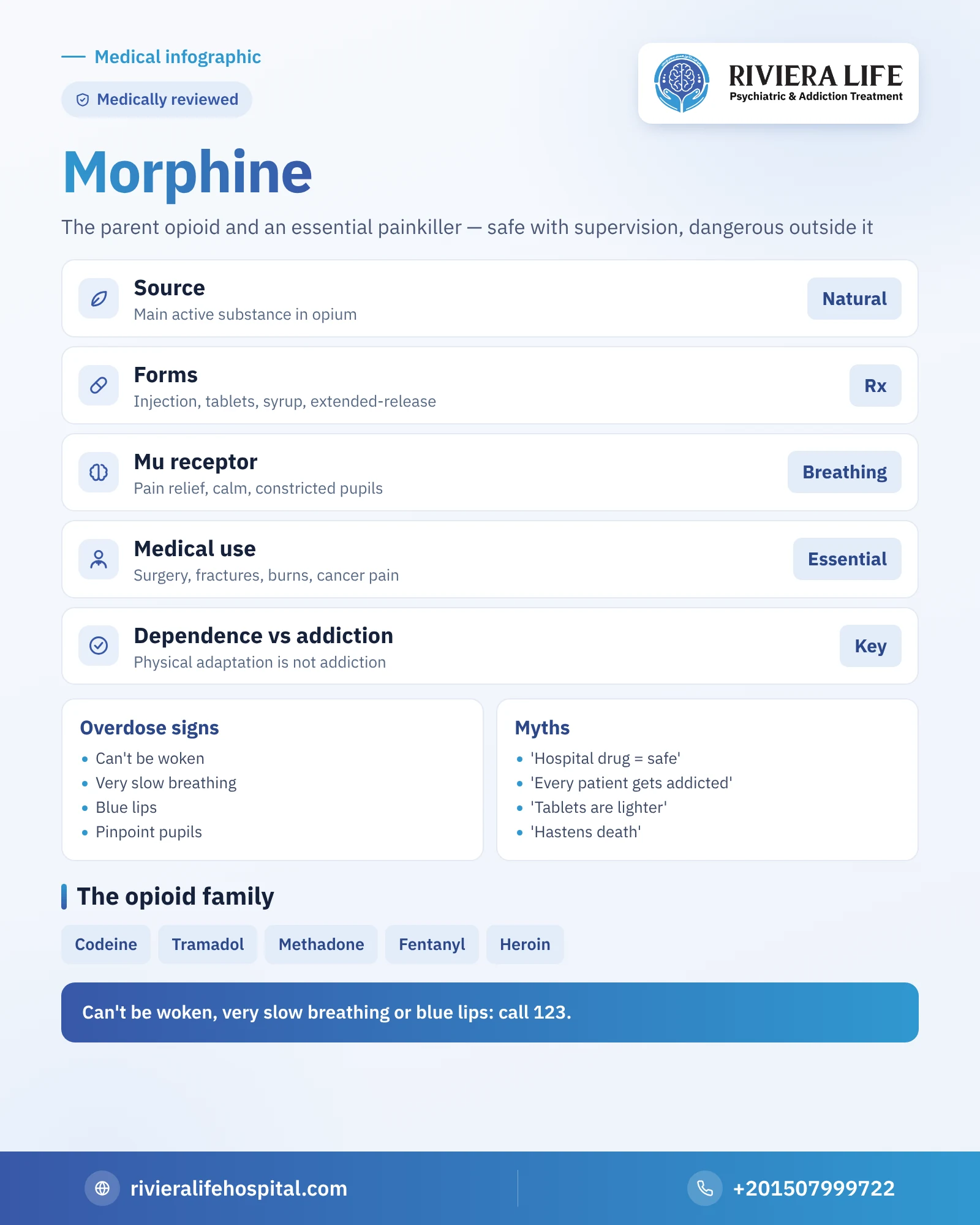
Morphine is the main active substance in opium, extracted directly from the sap of the poppy pod, and heroin is made from it. It is above all an indispensable medicine for relieving severe pain after surgery, fractures and burns and in cancer pain, and it comes as injections, tablets and syrup. It turns into a danger when it is used outside a prescription or at larger doses, causing addiction, and an overdose may slow breathing until it stops. Physical dependence in a treated patient isn’t addiction, and Egyptian law limits its circulation to an approved prescription.
- SourceOpium (the poppy)
- Medical useSevere pain and cancer pain
- Dispensing in EgyptBy prescription, under strict controls
And if you are looking for treatment of dependence on it, the morphine addiction treatment plan, with its stages and medicines, is explained in a separate article.
Morphine is a medicine and an addictive substance at the same time, and this is what makes talking about it different from most drugs. Inside the operating room or beside the bed of a cancer patient it eases pain no human could bear, and it is on the World Health Organization’s list of essential medicines. But when it is taken outside medical supervision, in an amount beyond the prescription, or to calm psychological distress rather than physical pain, it opens a quick door to dependence and overdose. This page gathers everything the patient and family need to know about morphine: its origin, its forms, what it does to the brain, and the line between therapeutic use and misuse, followed by detailed links for every aspect.
What is morphine?
Morphine is the main active substance in opium, that is, the sap collected from the unripe poppy pod. Unlike heroin, which is made in labs, morphine is a natural opioid extracted directly from the plant. A German pharmacist isolated it at the beginning of the nineteenth century, and named it after “Morpheus”, the Greek god of dreams, in reference to the drowsiness it causes.
Since then morphine has become the yardstick against which the strength of other opioid painkillers is compared; a medicine is said to be so many times stronger or weaker than morphine. Other substances are derived from its very molecule, the best known being heroin, which turns back into morphine inside the body.
Names of morphine circulating in Egypt
Unlike hashish or heroin, morphine doesn’t have a wide dictionary of street names in Egypt. It is usually known by its name, or by its form: “the ampoule” or “the injection” for the form intended for injection, and “the tablets” for the form taken by mouth. In foreign sources slang names appear for it, such as (M) and (Miss Emma). The danger lies in the fact that what is sold outside pharmacies as morphine may be a completely different substance, or leaked ampoules whose storage conditions are unknown, and the name is sometimes applied to powders that are actually heroin. The name, then, doesn’t guarantee the content, and only testing settles what the person took.
Forms of morphine and ways of using it
Medical morphine comes in several forms, among which the doctor chooses according to the type of pain and the place of treatment:
- A solution for injection into a vein, muscle or under the skin, used mainly inside hospitals.
- Immediate-release tablets or syrup, whose effect begins within a short time and lasts a few hours.
- Extended-release tablets or capsules, which release the substance slowly over half a day or a whole day, and are usually prescribed for severe chronic pain.
- Injections near the spinal cord in some operations, such as relieving pain after a cesarean section or major surgery, handled by the anesthetist.
Misuse takes other forms: taking larger or more frequent doses than prescribed, injecting what was designed to be taken by mouth, or tampering with extended-release tablets, an act that may release an amount intended for a whole day within minutes, becoming a direct cause of overdose.
What does morphine do in the brain and body?
Morphine binds to receptors in the brain, spinal cord and intestines called opioid receptors, the most important being the “mu” type. These receptors are responsible for regulating the sensation of pain and comfort, so when morphine activates them the following happens:
- Pain eases, and the perception of it changes even if it remains; some patients describe “feeling it from far away”.
- The person feels calm, warmth and relaxation, which may reach clear euphoria, especially with large doses or injection.
- The pupils narrow, and drowsiness and heavy eyelids appear.
- Bowel movement slows, so constipation becomes an almost constant symptom.
- The breathing center in the brainstem is depressed, and this is the effect behind most deaths.
The liver processes morphine and converts it into products that leave in the urine, one of which is active and contributes to pain relief. That is why kidney patients need special caution, because these products may accumulate in them, increasing the effect and the side effects. With repetition the brain adapts, so the effect of the same dose decreases, and troublesome symptoms appear when it is absent.
The medical use of morphine
Morphine isn’t a “drug” in the eyes of medicine, but an indispensable therapeutic tool. It is used for severe acute pain after surgery, fractures and burns, for the pain of a heart attack in some cases, and in cancer pain and palliative care, where it also eases the sensation of breathlessness in patients at advanced stages. When it is given at calculated doses with regular follow-up, it is safe and effective for most patients.
Here there is an important difference every family with a patient receiving morphine should know: physical dependence isn’t addiction. A patient who takes morphine for weeks to treat their pain will usually need to stop it gradually so that withdrawal symptoms don’t appear, and this is a natural adaptation of the body. Addiction, on the other hand, is loss of control: seeking the medicine for the feeling of its effect rather than to relieve pain, and continuing despite harm. Exaggerated fear of addiction may deprive a cancer patient of comfort they deserve, and underestimating it may open the road to it. Striking the balance is the responsibility of the treating doctor.
When does morphine turn from a medicine into a danger?
Several qualities come together in morphine that make its use outside supervision dangerous:
- Strength of effect: it is among the strongest painkillers available, and the gap between the therapeutic dose and the dose that depresses breathing narrows in the absence of supervision.
- Rapid tolerance: doses need continual increases to get the same effect, and this pushes towards dangerous amounts.
- Mixing: combining it with pregabalin, sedatives, alcohol or tramadol multiplies respiratory depression.
- Injecting: it adds the risk of infection with hepatitis C, HIV and abscesses.
- Easy access for some groups: health-sector workers and the families of palliative-care patients may find the substance within reach.
Morphine within the opioid family
Morphine belongs to the opioid family, which includes legitimate medicines such as codeine, tramadol, methadone and fentanyl, alongside banned substances such as heroin. These substances share acting on the same receptors, so they resemble each other in relieving pain and in the risk of dependence and overdose, and differ in their strength and duration of effect. Morphine occupies a central reference position: clearly stronger than tramadol and codeine, and much weaker than fentanyl. You will find the full picture of the family on the opioids page, and the list of medical opioid painkillers in the article on types of opioid painkillers, while the heroin page explains how heroin is made from morphine and why it reaches the brain faster.
Morphine and the law in Egypt
Egypt’s anti-narcotics law lists morphine among the substances subject to strict control. Its medical use is permitted under special controls on dispensing, storage and recording, while possessing or circulating it without an approved medical prescription is a crime punishable by law, with the penalty becoming harsher with trafficking. On the other hand, the law allows someone who comes forward on their own for treatment to be treated without a criminal case being brought against them, a point that reassures many hesitant families. For legal inquiries specific to a particular case it is preferable to consult a specialized lawyer, and the Fund for Drug Control and Treatment of Addiction provides a confidential, free hotline on 16023.
The morphine guide: each aspect in a separate article
We have dedicated an article to each question about morphine that answers it in depth without repetition:
- Morphine addiction symptoms: the signs the family notices, and how to tell a patient who needs their medicine from a person who has lost control over it.
- Causes of morphine addiction: how dependence starts after a therapeutic prescription, and who is most at risk of it.
- The harms of morphine: its effect on breathing, the intestines, hormones and the brain, and the risks of injecting and mixing.
- How long morphine stays in the body: when it shows in urine, blood, saliva and hair, and why a test result may be misleading.
- Morphine withdrawal symptoms: when they begin, when they peak and when they end, and when you need the emergency room.
- Morphine addiction treatment: the stages of treatment and approved medicines, and how someone who suffers real pain is treated at the same time.
Common myths about morphine
The myth: as long as morphine is a medicine hospitals dispense, it is safe in all circumstances. The truth is that its safety is linked to the calculated dose and follow-up, and outside them it becomes one of the most dangerous substances for breathing.
The myth: every patient who takes morphine will become an addict. The truth is that most patients who receive it for a limited period and under supervision don’t become addicted, even if they need to stop it gradually.
The myth: tablets are lighter than injections. The truth is that tablets, especially extended-release ones, carry the same addiction and overdose if misused, and injecting adds infection on top of that.
The myth: giving morphine to a patient in their last days hastens their death. The truth is that controlled doses in palliative care aim at comfort, and aren’t considered a cause of death when managed by a specialized team.
Suspect a relative is misusing morphine? Start here
The situation here is more complicated than others, because the person may actually be ill and need a painkiller. So don’t start by snatching the medicine or accusing them. First watch: do they ask for the medicine before its time? Do ampoules or tablets disappear faster than expected? Do they visit more than one doctor to get prescriptions? Have their mood and behavior changed? Then talk to the treating doctor themselves, as they are your first partner, and can review the doses or refer the patient for a specialized assessment. And if there is no illness at all, ask for an addiction consultation directly. You will find a detailed list of signs in the article on morphine addiction symptoms.
Signs of a morphine overdose
Call the ambulance on 123 immediately if you notice
A morphine overdose may stop breathing within minutes, whether it happens after an injection or after tablets.
- Deep drowsiness from which the person doesn’t wake when called or shaken
- Very slow or irregular breathing, or unusual snoring
- Bluish lips or nails
- Very narrow pupils, like a pinpoint
- Cold skin and a limp body
Until the ambulance arrives, keep the person on their side if they are unconscious and breathing, talk to them continuously, and don’t give them anything by mouth. Naloxone is the medicine that temporarily reverses the effect of morphine, but its effect may end before the effect of the morphine wears off, especially with extended-release tablets, so the patient must stay under observation in hospital.
When should you ask for help?
Ask for an assessment if morphine has come to be taken for something other than pain, or at doses larger than the prescription, or if attempts to stop it have failed, or withdrawal symptoms appear whenever the dose is late. And if the patient needs a real painkiller, the solution isn’t cutting the medicine suddenly but a plan set by a psychiatrist specialized in addiction in cooperation with the pain doctor. At Riviera Life in Sheikh Zayed, the psychiatry and addiction treatment team assesses each case in complete confidentiality, and puts in place a plan that combines safely withdrawing the dependence, managing pain and psychological support, and the first consultation is free on +201507999722.
Medical sources and referencesThe information in this article is based on reliable scientific sources