Morphine withdrawal symptoms usually start within roughly 6 to 12 hours of the last fast-acting dose, and are delayed with extended-release tablets. They intensify on the second and third day, then gradually settle within a week to ten days in most cases, while insomnia, anxiety and intense craving may continue for weeks afterwards.
Withdrawal is very exhausting but rarely threatens the life of a healthy person; its real danger lies in dehydration in some patients and in returning to morphine at a dose the body can no longer tolerate. Here we explain what happens hour by hour, what differs for a patient receiving morphine as treatment, and when you need emergency care.
Why do withdrawal symptoms appear?
When the body receives morphine regularly, the nervous system shifts its natural activity in the opposite direction to keep its balance. The release of natural pain-relieving substances decreases, and in return excitatory signals increase in an area of the brainstem responsible for alertness and tension. If morphine suddenly disappears, this counter-activity remains unopposed, so everything morphine was suppressing appears: pain, diarrhea, sweating and anxiety. In other words, withdrawal symptoms are roughly a mirror image of morphine’s effect.
When do morphine withdrawal symptoms start?
The timing depends on the form of the medicine. With injections and fast-acting tablets the first signs usually appear after 6 to 12 hours. With extended-release tablets they may be delayed to about a day or more, because the substance was seeping into the blood slowly. The size of the daily dose and the duration of use also matter: the longer the period and the larger the amount, the more severe and longer the symptoms usually are.
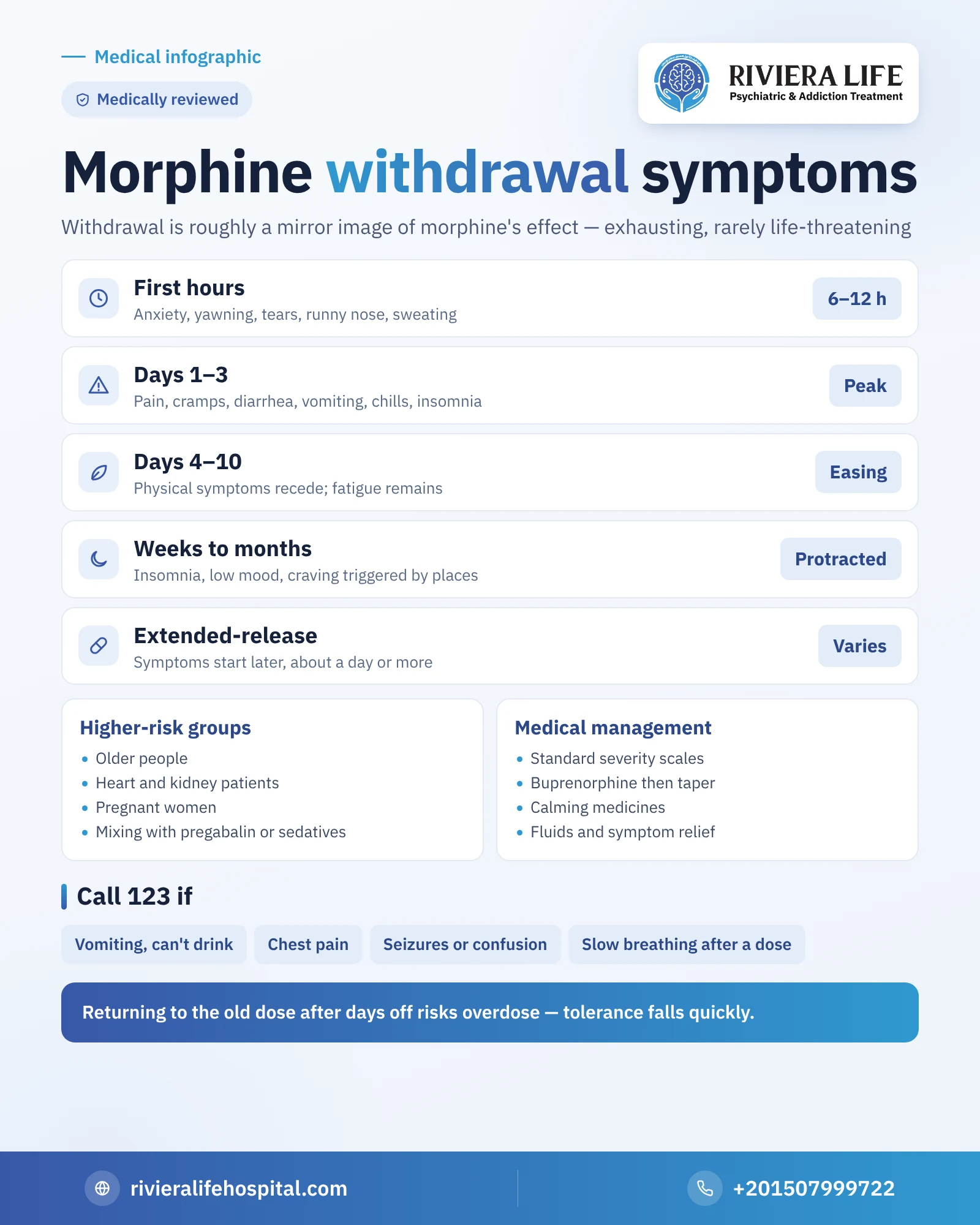
The morphine withdrawal timeline
The first hours
Anxiety, restlessness and a growing craving for the dose, with frequent yawning, tears, a runny nose and sweating. Many at first think it is a cold.
From day one to day three: the peak
Symptoms intensify, usually peaking on the second or third day: muscle, bone and back pain, abdominal cramps, diarrhea, nausea and vomiting, chills alternating with waves of heat, goosebumps, dilated pupils, a fast heart rate and near-total insomnia.
From day four to roughly day ten
The physical symptoms recede day by day, and general fatigue, poor appetite and disturbed sleep remain. At this stage many feel they have “recovered”, a misleading feeling.
The following weeks and months
In a number of patients, milder but troublesome symptoms continue: insomnia, anxiety, low mood, listlessness, and bouts of strong craving triggered by particular places or situations. Doctors call this condition protracted withdrawal symptoms; it improves slowly with time and treatment, but it is one of the most common causes of relapse if it isn’t prepared for with a clear follow-up plan and treatment for insomnia and mood.
The physical symptoms in detail
- Digestive system: cramps, diarrhea, nausea, vomiting and loss of appetite.
- Muscles and bones: widespread pain, and involuntary leg movements that prevent rest.
- Skin and temperature: heavy sweating, chills and goosebumps.
- Eyes and nose: tears, a runny nose, frequent sneezing and dilated pupils.
- Heart and circulation: a faster pulse and a slight rise in blood pressure.
- Sleep: insomnia lasting days, one of the most exhausting symptoms.
The psychological symptoms
Anxiety, irritability and a tight chest are present from the first hours, accompanied by complete preoccupation with the next dose. The patient may go through bouts of crying, deep sadness, or a feeling that this pain will never end. These feelings are part of withdrawal itself, not a weakness of character, but they need follow-up, because severe despair may push towards dangerous decisions.
Is morphine withdrawal dangerous?
Unlike alcohol or sedative withdrawal, morphine withdrawal alone doesn’t usually cause seizures or delirium in a healthy adult. But the picture changes in certain cases: older people and heart and kidney patients may be badly affected by the dehydration and salt imbalance caused by vomiting and diarrhea, and a pregnant woman’s fetus may be at risk if morphine is stopped suddenly. The biggest risk for everyone is relapse: someone who returns to their old dose after days of stopping may suffer an overdose, because their body’s tolerance has dropped quickly.
The patient receiving morphine as treatment
A patient with chronic pain or after major surgery may develop physical dependence without any misuse, so if the medicine is stopped suddenly the same symptoms appear. The solution here is a gradual reduction set by the doctor, at a pace suited to the patient and the length of their treatment. An important note is that the pain itself may seem worse during withdrawal, so the patient thinks their illness has worsened, while in fact it is part of the body’s adjustment and improves after weeks.
When morphine is combined with other substances
In Egypt many don’t use a single substance. Someone who combines morphine with pregabalin, sedatives, alcohol or tramadol may face a more complicated withdrawal, because withdrawal from some of these substances may cause seizures or delirium. That is why the doctor must know everything the person takes before setting the plan. You will find the broader picture of withdrawal in this family in our article on opioid withdrawal symptoms.
Why does withdrawal at home usually fail?
Not because the patient is weak-willed, but because the peak comes with pain, insomnia and vomiting that nothing eases, while the substance is one phone call away. At home there is also no one monitoring fluids, blood pressure and mental state. The common result is a return to morphine on the second or third day, sometimes at a larger dose to make up for the suffering.
How can the family help during withdrawal days?
The family’s presence matters even if the patient is in hospital. What they most need in the first days is reassurance that what they are going through is temporary and has an end, not lectures about their mistakes. Avoid sharp discussions about the past or money at the peak, as nerves are at their weakest.
If treatment is outpatient with medical supervision, help them drink fluids regularly, eat light meals, and keep to the prescribed medicine times without increasing or decreasing, and remove any non-prescribed painkillers or sedatives from the house. Notice mood changes; if severe despair or talk of self-harm appears, this is an emergency that can’t wait.
How is withdrawal managed medically?
Medical management starts by assessing the severity of symptoms using standard scales, then the most suitable method is chosen. The doctor may start a medicine that works on the same receptors, such as buprenorphine, to ease withdrawal and then reduce it gradually, or use medicines that calm excessive nervous activity, along with treating the accompanying symptoms of diarrhea, nausea, pain and insomnia, and replacing fluids. Most importantly, this stage isn’t the end of treatment but its beginning. Details of what comes after withdrawal are in our article on morphine addiction treatment.
When should you go to the emergency department?
Call an ambulance on 123 immediately if you see
During withdrawal or after a sudden return to morphine.
- Vomiting or diarrhea that doesn’t stop, with inability to drink fluids
- Severe dizziness on standing, or no urine for many hours
- Chest pain or severe palpitations
- Seizures, or confusion and delirium
- Slow breathing or no response after taking a dose
- Talk of self-harm or ending life
At Riviera Life, morphine withdrawal is carried out under round-the-clock medical supervision, with a plan that takes into account whether the patient has real pain that needs a safe alternative. To learn the signs that precede this stage see our article on morphine addiction symptoms.
More from our morphine guide
- Morphine: the complete guide
- Morphine addiction treatment
- How long morphine stays in the body
- The harms of morphine
- Heroin vs morphine: origin, effect, danger and treatment
Questions many people ask
The acute physical symptoms settle within roughly a week to ten days in most cases, but insomnia, anxiety and craving may continue for weeks or months to a milder degree.
Withdrawal alone rarely threatens the life of a healthy person, but severe dehydration may be dangerous for older people and heart and kidney patients. The biggest risk is an overdose when returning to morphine after tolerance has fallen.
Not necessarily; this is expected physical dependence after regular use. The solution is usually a gradual reduction set by the doctor, and addiction is only diagnosed when there is loss of control and compulsive behavior.
With injections and fast-acting tablets symptoms start earlier, within a few hours. With extended-release tablets symptoms are delayed because the substance seeped into the blood slowly.
Some mild cases may be managed as outpatients with medical supervision and a clear plan, but home withdrawal without follow-up often ends with a return to morphine, and may be dangerous with chronic illness or mixed substances.