Narcissistic personality and marriage usually follow a repeating pattern: a dazzling beginning in which the other partner feels they have found the ideal spouse, then criticism and belittling that grow over time, then coldness and neglect, and perhaps a sudden return to kindness that brings back hope. This pattern leaves a deep mark on the partner’s self-confidence and on the children. In this article we explain how to recognize it, the limits of couples therapy, and how a decision to stay or separate is made.
In this article we explain the relationship cycle and its signs, its effect on the partner and children, the limits of couples therapy, what to do if the relationship turns into abuse, and how to make a conscious decision to stay or separate. Your partner can’t be diagnosed from an article; diagnosis is for a specialist, and what matters here is the behavior and its effect on you.
Why are people drawn to a narcissistic partner?
Because the beginning is often genuinely attractive. During the engagement or getting-to-know period, the person appears confident, generous and intensely interested: constant messages, big promises, and the feeling that they understand you as no one has. Some call this stage “love bombing”. The problem is that it isn’t built on real knowledge of you, but on an ideal image they paint of you that reflects their own value: the wife he is proud of, the husband who raises her status. And people who are giving and used to pleasing others are often drawn to this pattern, a lovely quality that is easy to exploit.
The relationship cycle: from idealizing to devaluing
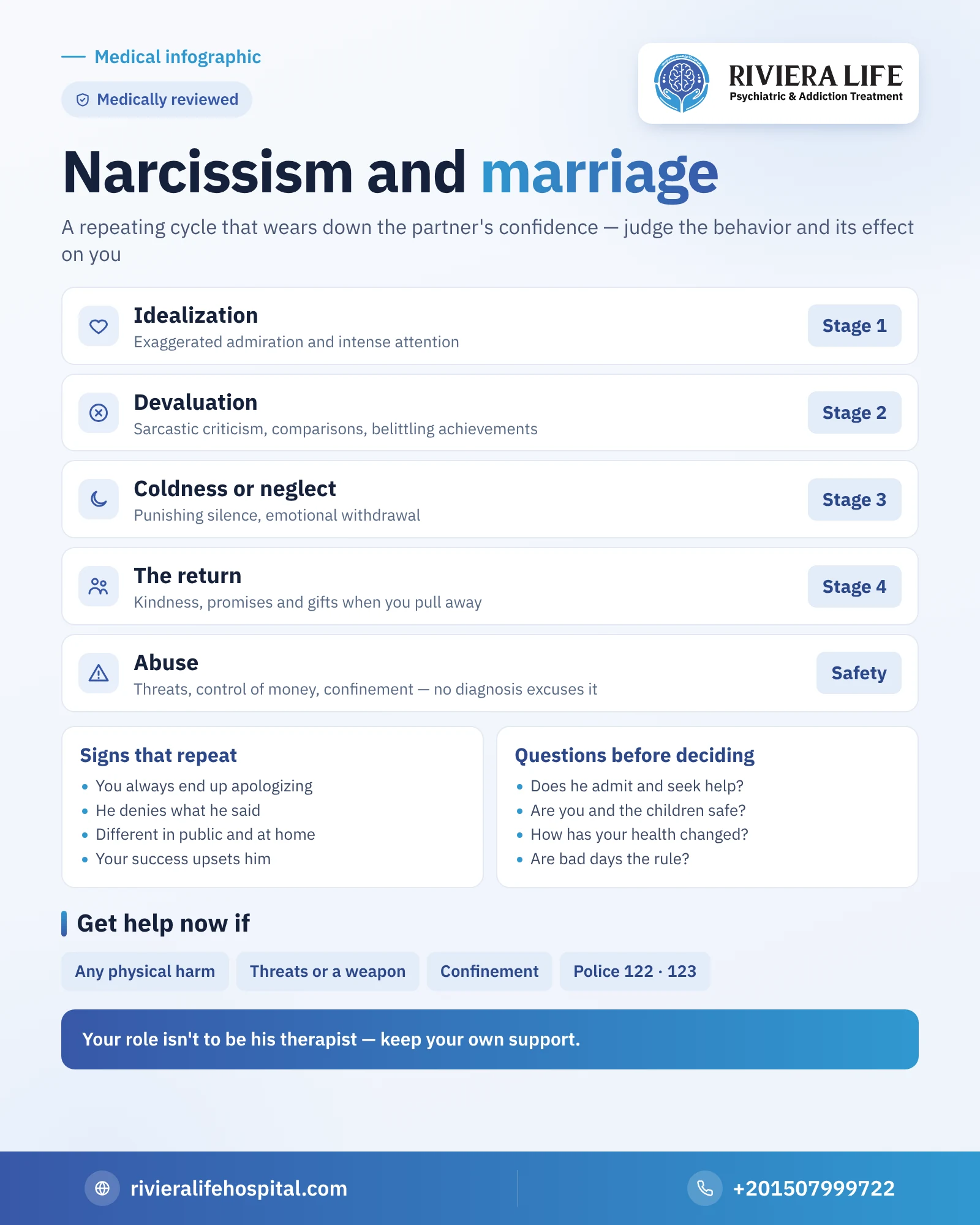
Many husbands and wives describe similar stages:
- Idealization: exaggerated admiration and intense attention; in their eyes the partner has no faults.
- Devaluation: when the partner shows themselves as a human being with needs, opinions and mistakes, the image changes. Sarcastic criticism, comparison with others and belittling of achievements begin.
- Coldness or neglect: punishing silence, emotional withdrawal, or preoccupation with other sources of admiration.
- The return: when they feel the partner is really pulling away, kindness, promises and gifts return, and the cycle begins again.
These stages are descriptive and don’t apply in the same order to every relationship, but their repetition is what makes leaving hard: the sweet days keep hope alive, and the harsh days destroy self-confidence.
Signs that recur in a marriage to a narcissistic person
- Every disagreement ends with you apologizing, even for things you didn’t do.
- They deny what they said or call your memory confused, until you start to doubt yourself.
- Your needs are met with mockery or with “you’re too sensitive”.
- They are completely different in front of people than at home, so no one believes you if you complain.
- They control the money, the decisions, or your relationship with your family and friends.
- Your success upsets them or provokes competition instead of making them happy.
- They get very angry at any remark, and punish with silence for days.
Narcissistic personality and marriage: the effect on the partner
The effect doesn’t happen in a single day, but seeps in gradually. The partner notices they have become more anxious and less confident, checking their words before saying them, and avoiding whole topics for fear of the reaction. Many complain of insomnia, headaches, exhaustion and symptoms of depression or anxiety. And with isolation from family and friends, the partner loses an outside mirror telling them that what is happening isn’t normal. A complicated bond may form that is hard to break, in which the hurt partner longs for the rare moments of tenderness despite the pain, a dynamic close to what we explain in our article on love addiction.
Children in a home with a narcissistic parent
A narcissistic parent may treat their children as an extension of their image; glorifying a child who brings them prestige in front of people, blaming another for everything, and sometimes putting the children in the role of go-between or comforter. Some children grow up constantly seeking to please or afraid to express their feelings. What protects children here is finding a stable, warm environment with the other parent, hearing from them that their worth isn’t tied to grades or anyone’s approval, and not being used in the disagreement between the parents. And if a child shows signs of anxiety, withdrawal or falling behind at school, an early psychological assessment helps them.
Does couples therapy work?
Couples therapy is useful for many problems, but it has limits with a narcissistic personality. The narcissistic partner may use the sessions to prove they are the victim, to win the therapist to their side, or to punish their partner at home for what they said in the session. So many specialists prefer each partner to start with individual therapy first, then joint sessions come when the narcissistic partner is able to hear feedback without collapsing or attacking. And the clearest rule: couples therapy isn’t suitable if there is violence or intimidation in the relationship, because a frightened partner can’t speak freely, and their words may put them in danger.
If your partner accepts treatment: what should you expect?
Accepting treatment is a big step that deserves appreciation, but it isn’t a promise of quick change. Improvement is gradual, extending over months and often years, with setbacks along the way. Encouraging signs are that they keep their sessions, acknowledge at least sometimes the effect of their words, and that periods of punishing silence become shorter. We explain the approaches used and realistic goals in our article on narcissistic personality treatment. During this period, don’t stop looking after yourself and your boundaries; your role isn’t to be their therapist.
When the relationship turns into abuse: your safety first
Abuse isn’t limited to hitting. Threats, intimidation, breaking things, total control of money, confinement, and preventing you from seeing your family are all forms of abuse. And no psychiatric diagnosis justifies this behavior. If you live in fear, prepare a simple plan: save the emergency numbers and someone you trust, keep copies of your important papers and a small sum of money in a safe place, and agree with a relative on a code word that means you need help.
Seek help immediately if you see
Call the police on 122 if you are in danger, an ambulance on 123 if there is an injury, and go to a safe place.
- Hitting, pushing or any physical harm to you or your children
- Threats to kill or harm, or carrying a weapon
- Being locked inside the home or prevented from seeking help
- The partner threatening to harm themselves if you leave
- Thoughts of your own about harming yourself or that life isn’t worth it
You can also ask for psychological support from the hotline of the General Secretariat of Mental Health on 16328.
Staying or separating? How to make the decision
There is no single answer that suits every home; the children, money, family and society all enter the calculation, and the decision is yours. But some questions help you think clearly:
- Does your partner acknowledge there is a problem, and have they actually accepted help, not just in words?
- Are you and your children physically and psychologically safe at home?
- How has your health changed in recent years, and do those close to you see that you have changed?
- Are the hard days the exception, or are they the rule interspersed with a few kind days?
- What do you need to make the decision safely, such as legal advice, your family’s support or financial independence?
Avoid making the life-changing decision at the height of an argument or straight after a reconciliation, and seek a therapist’s help to see the whole picture away from fear and guilt.
If you decide to stay: how do you protect yourself?
Some spouses choose to stay for reasons they consider sound. In this case it helps to keep your relationships with family and friends, to keep a source of income or private savings if possible, to set clear boundaries on specific matters and enforce them, and to stop trying to convince them of your version in every disagreement. We explain boundary techniques and short responses in our article on how to deal with a narcissistic person. Most importantly, have a place where you can speak freely, such as individual therapy sessions.
Recovering after a narcissistic relationship
Whether the marriage ends or continues, the hurt partner needs time to regain confidence in their own judgment. It is normal to go through waves of sadness, anger and longing, and to doubt your decision at times. Psychotherapy helps you understand what happened without blaming yourself, treat symptoms of anxiety and depression, and recognize the patterns that make a person accept a harmful relationship so it doesn’t happen again. Many come out of this journey more aware of their boundaries and better able to form healthy relationships.
How can Riviera Life help you?
At Riviera Life, consultant psychiatrists help you understand what you are living through in your marriage, treat the anxiety or depression it has left, and think through your decisions calmly, and offer the other partner assessment and treatment if they accept it, with a family program and complete confidentiality. The first consultation is free, and you can get in touch around the clock on +201507999722.
More from our narcissistic personality guide
- Narcissistic personality: the complete guide
- How to deal with a narcissistic person
- Narcissistic personality treatment
- Dependent personality
- The toxic personality: signs of toxic behavior and how to protect yourself
- The manipulative personality: its tactics, signs of manipulation and how to protect yourself
Questions many people ask
The marriage may continue if the narcissistic partner acknowledges the problem and commits to treatment and the relationship is safe, with clear boundaries and support for the other partner.
He can only be diagnosed by a specialist assessment, but repeated belittling and denial, constantly blaming you, control and a lack of empathy are signs that deserve attention and a consultation.
It may help after each partner has started individual therapy, and it isn't suitable for relationships involving violence or intimidation.
Children may grow up constantly seeking to please or afraid to express their feelings, and a stable, supportive other parent protects them.
Your safety comes first: call the police on 122 or an ambulance on 123 if you are injured, go to a safe place, and ask for the support of someone you trust.