Treating narcissistic personality is possible, but it differs from treating most psychiatric disorders: there is no medicine that treats the disorder itself, the core treatment is relatively long psychotherapy, and its hardest step is for the person with the disorder to accept sitting in front of a therapist at all. Among the methods specialists use are schema therapy, transference-focused therapy and mentalization-based therapy, alongside treating what often accompanies the disorder, such as depression and addiction. In this article we explain why seeking help is delayed, how treatment actually begins, what happens in sessions, and what realistic goals can be expected.
Can narcissistic personality be treated?
The honest answer: yes, with conditions. Personality disorders are patterns formed over years, so they don’t change in weeks. But research on personality disorders in general shows that regular psychotherapy eases suffering and improves relationships and functioning, and that some traits soften with age in many people. Studies specifically on narcissism are fewer than others, so therapists rely on methods that have proven useful in related personality disorders, adapted to the nature of narcissism.
The most important condition is that the person has a real motive to continue, even if this motive isn’t “I want to change” but “I don’t want to lose my marriage” or “I’m tired of this depression”.
Why does a narcissist rarely ask for help?
Because the disorder protects itself. The person sees their traits as a natural part of their personality, even a source of their distinction, and explains their problems as others not appreciating them or envying them. And asking for treatment is in itself an admission of weakness, which touches what they fear most: appearing lacking. Added to this is fear that the therapist will judge them or expose the fragility they hide. That is why most reach the clinic through another door, not the door of narcissism.
Where does treatment actually begin?
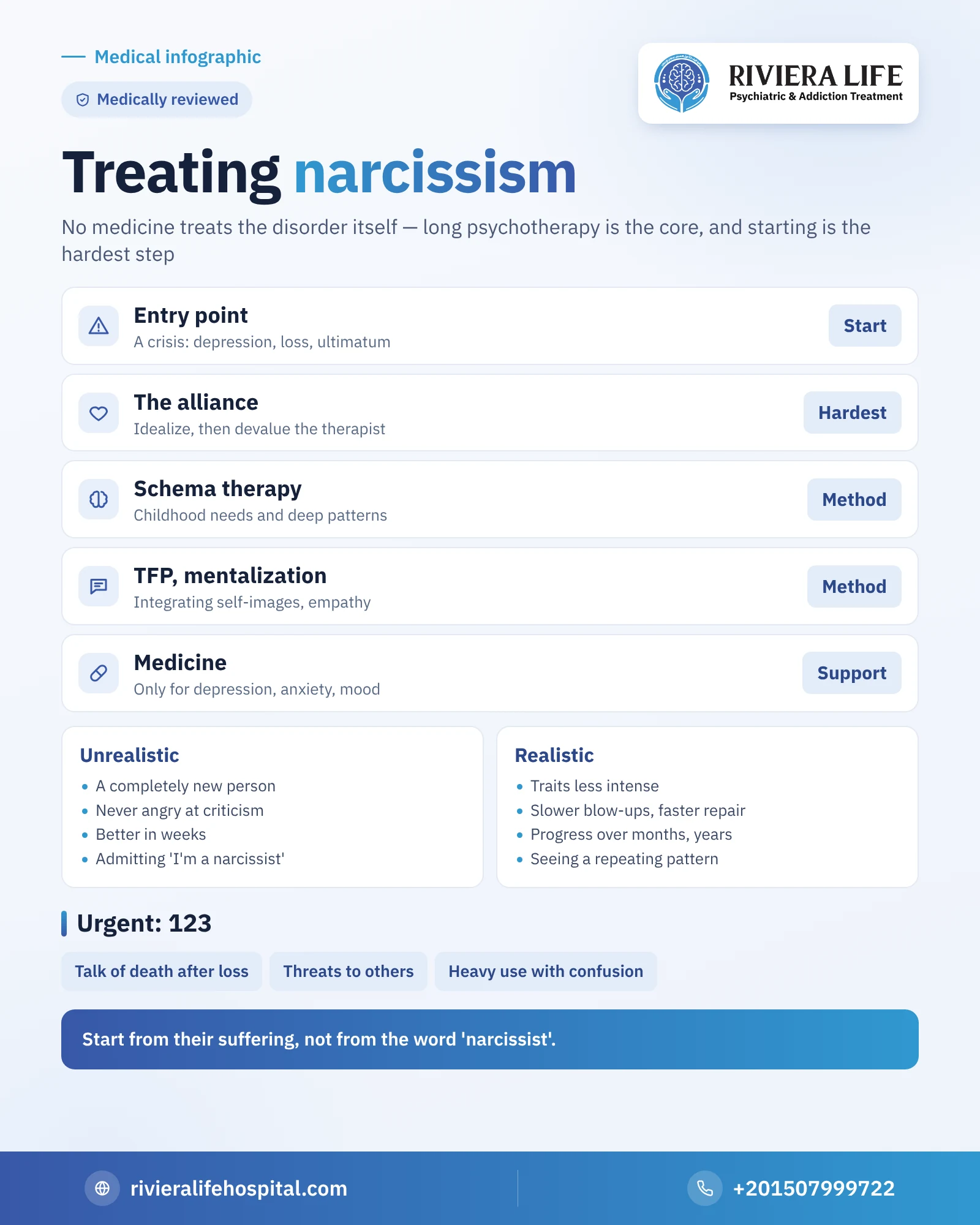
The most common entry point is a crisis: an episode of depression after losing a job or position, a separation, a final warning from the wife, a problem at work, or use that has gone out of control. The doctor starts here with a comprehensive assessment: detailed interviews, sometimes standardized psychological scales, and information from those close with the patient’s consent. They look for what accompanies the disorder, such as depression, anxiety, mood disorder or addiction, and for overlapping personality disorders such as borderline personality.
A skilled therapist doesn’t start by announcing the diagnosis as a verdict, but starts from the suffering the patient came with: “I’ve noticed the same conflict repeats in every job; shall we try to understand why?”. This beginning makes treatment a collaboration, not a confrontation.
The therapeutic alliance: the hardest stage
The patient often goes through, in their relationship with the therapist, the same cycle they live with people: exaggerated admiration at first (“you’re the only one who understood me”), then disappointment, criticism and belittling the therapist at the first remark they don’t like. This is where most dropouts from treatment happen. The therapist deals with these moments as material for work, not as a personal insult, calmly pointing out that what happens in the session resembles what happens at home and work. This needs a delicate balance: respect for the patient’s dignity without going along with their arrogance, and frankness without humiliation.
Psychotherapy methods
Schema therapy
It assumes that basic needs in childhood, such as unconditional acceptance or clear limits, weren’t met as they should have been, so deep “schemas” formed, such as a sense of entitlement or hidden inadequacy. The patient learns to recognize their modes, such as the “self-aggrandizer” mode that protects them or the “lonely child” hidden behind it, and trains to meet their needs in ways that don’t hurt others.
Transference-focused psychotherapy
A structured psychodynamic therapy that focuses on the relationship between patient and therapist within the session, because the patient’s image of themselves and others appears clearly in it. This helps them integrate two contradictory images they live between: a grand self that never errs and a worthless self without value.
Mentalization-based therapy
It trains a skill that seems simple but is hard for someone with the disorder: pausing to think about what the other person may feel and mean, and about what they themselves actually feel behind the anger. This skill gradually improves empathy.
Psychodynamic and cognitive behavioral therapy
Psychodynamic therapy traces the roots of the need for admiration, while cognitive behavioral therapy targets specific thoughts and behaviors, such as collapsing in the face of criticism or dealing with conflict at work. The therapist chooses the right mix for each person.
Group, couples and family therapy
Group therapy may help after individual therapy has settled, because peers’ remarks are sometimes easier to accept than the therapist’s. Couples sessions have a role, but within limits: they rarely succeed if they are the only starting point, and become unsuitable if there is violence or intimidation in the relationship. We cover these limits in detail in the article on narcissistic personality and marriage.
Is there a medicine for narcissistic personality?
There is no approved medicine that treats narcissistic personality disorder itself, and no medicine changes self-image or the capacity for empathy. But the doctor may prescribe medicines for what accompanies the disorder: antidepressants in episodes of depression, or medicines for mood swings or severe anxiety when needed. Only the doctor determines the type and duration, and the medicine isn’t changed or stopped except with them.
Treating accompanying depression and addiction
Depression in someone with the disorder usually comes after what specialists call a “narcissistic injury”: losing a position, a scandal or rejection. It may be severe and sudden because the image on which their whole life was built has suddenly collapsed, which is why the doctor takes it seriously and assesses the risk of self-harm. On the other hand, the disorder coexists with substance use more than expected: stimulants such as cocaine inflate the feeling of power, and alcohol numbs the pain of failure. Here treating one side and leaving the other isn’t enough; the most successful plan treats the addiction and the personality together, as in the dual diagnosis program.
Seek urgent help immediately if you see
Call the ambulance on 123 or go to the nearest emergency department, and don't leave the person alone if they are in danger.
- Serious talk of death or ending life after a loss or humiliation
- Suddenly cutting off food, sleep and people
- Threats to harm another person they blame for what happened
- Heavy use of a drug or alcohol with disturbed consciousness
Guidance can also be requested from the hotline of the General Secretariat of Mental Health on 16328.
Realistic goals for treatment
A large part of treatment success is for the patient and family to know what can be expected:
| Unrealistic expectations | Realistic goals |
|---|---|
| Becoming a completely different person | The traits becoming less intense and affecting those around less |
| Never getting angry at criticism | The explosion coming later, recovering from it faster, and sometimes apologizing |
| Improvement within weeks | Gradual progress over months and usually years |
| Admitting they are “a narcissist” | Seeing a pattern that repeats and accepting to work on it |
| Medicine doing the job | Medicine for accompanying symptoms only, with psychotherapy as the core |
How do you know treatment is progressing?
The signs are small but important: keeping appointments despite frustration, saying “maybe I was harsh” even once, the period of estrangement after a quarrel getting shorter, asking about their partner’s or children’s feelings without being asked, and tolerating a remark at work without resigning or attacking. These shifts don’t appear regularly, and may be interspersed with setbacks, but they are a sign that something is changing.
If your relative refuses treatment
A person can’t be forced into psychotherapy for a personality disorder unless they are in direct danger. What you have is the ability to protect yourself and set clear boundaries, and to ask for support for yourself. Sometimes your firm boundaries are what finally push them to seek help. We explain these boundaries and strategies in the article on how to deal with a narcissistic person.
The right place to treat narcissistic personality: how to choose
The right place to treat narcissistic personality is the one that offers what this patient specifically needs: therapists experienced in personality disorders, patience for long treatment, and the ability to treat what accompanies it. Ask before you choose:
- Is the assessment carried out by a consultant psychiatrist who distinguishes narcissism from depression, mania and other personality disorders?
- Are there psychotherapists who use structured methods for personality disorders, not just general support sessions?
- Can the team treat accompanying depression or addiction in the same plan?
- Is care under round-the-clock medical supervision available if danger appears in an acute crisis?
- Is there support for the family or partner, not just the patient?
- Is the patient’s confidentiality respected, a very sensitive matter for someone with this disorder?
Beware of any party that promises to change the personality in a few sessions or with a medicine that treats narcissism.
How Riviera Life meets these standards in treating narcissistic personality
At Riviera Life these criteria take the following form:
- Consultants in psychiatry and addiction: a precise assessment that distinguishes the disorder from what resembles it and what accompanies it.
- Complete confidentiality: an environment that protects the patient’s privacy and makes it easier to start treatment.
- Dual diagnosis treatment: when the disorder coexists with cocaine, alcohol or other substance use.
- Round-the-clock medical supervision: in acute crises and severe depression.
- A family program: support for the partner and relatives who live with the patient.
- Aftercare: follow-up suited to a treatment that is long by nature.
- Fourteen years of experience and a Ministry of Health license: and thousands of recovered cases.
The first consultation is free, and you can get in touch around the clock on +201507999722; we are based in Sheikh Zayed, Giza.
More from the narcissistic personality guide
- Narcissistic personality: the complete guide
- How to deal with a narcissistic person
- Narcissistic personality and marriage
- Borderline personality treatment
- Narcissistic traits test: instant result
Questions many people ask
Change is possible but gradual and slow, and it happens in those who commit to regular psychotherapy and have a real motive to continue.
Treatment usually lasts months to years, because the aim is to modify patterns formed since childhood, not to treat a temporary symptom.
There is no approved medicine that treats the disorder itself, and the doctor may prescribe medicines for accompanying depression, anxiety or mood swings.
Start from their own suffering, such as insomnia, depression or repeated conflicts, instead of confronting them with the word narcissist, which increases their refusal.
Look for consultant psychiatrists, structured therapy for personality disorders, dual diagnosis treatment, crisis care, family support and full confidentiality. Riviera Life in Sheikh Zayed meets these criteria.