How to deal with a narcissistic person starts with a fact that may bring you relief: you don’t have the power to change them, but you do have power over how you respond to them. The most successful strategies rest on calm instead of argument, short replies instead of long explanations, clear boundaries that you actually carry out, documenting what happens so you don’t doubt your memory, and sometimes the “gray rock” method that makes you less interesting to them.
The details differ between a narcissistic boss and a mother, father, sibling or friend. In this article we explain these strategies in practice, how to protect your mental health, and when distance becomes the right decision. And remember that only a specialist can make a diagnosis, and that what matters to you here is the harmful behavior, not the label.
Before any strategy: understand what drives them
A narcissistic person relies for their sense of worth on what comes from outside: admiration, obedience, winning the argument, and attention, even if it is anger. Beneath this arrogance there is usually extreme fragility in the face of criticism, which is why they respond to any remark as if it were an attack. Understanding this doesn’t mean justifying the harm, but it changes your goal: you won’t try to make them “admit it”, and you won’t wait for a moment when they see the truth; instead you will focus on protecting your time, feelings and decisions. For the full picture of the disorder, see our guide to narcissistic personality.
General rules that work with any narcissist
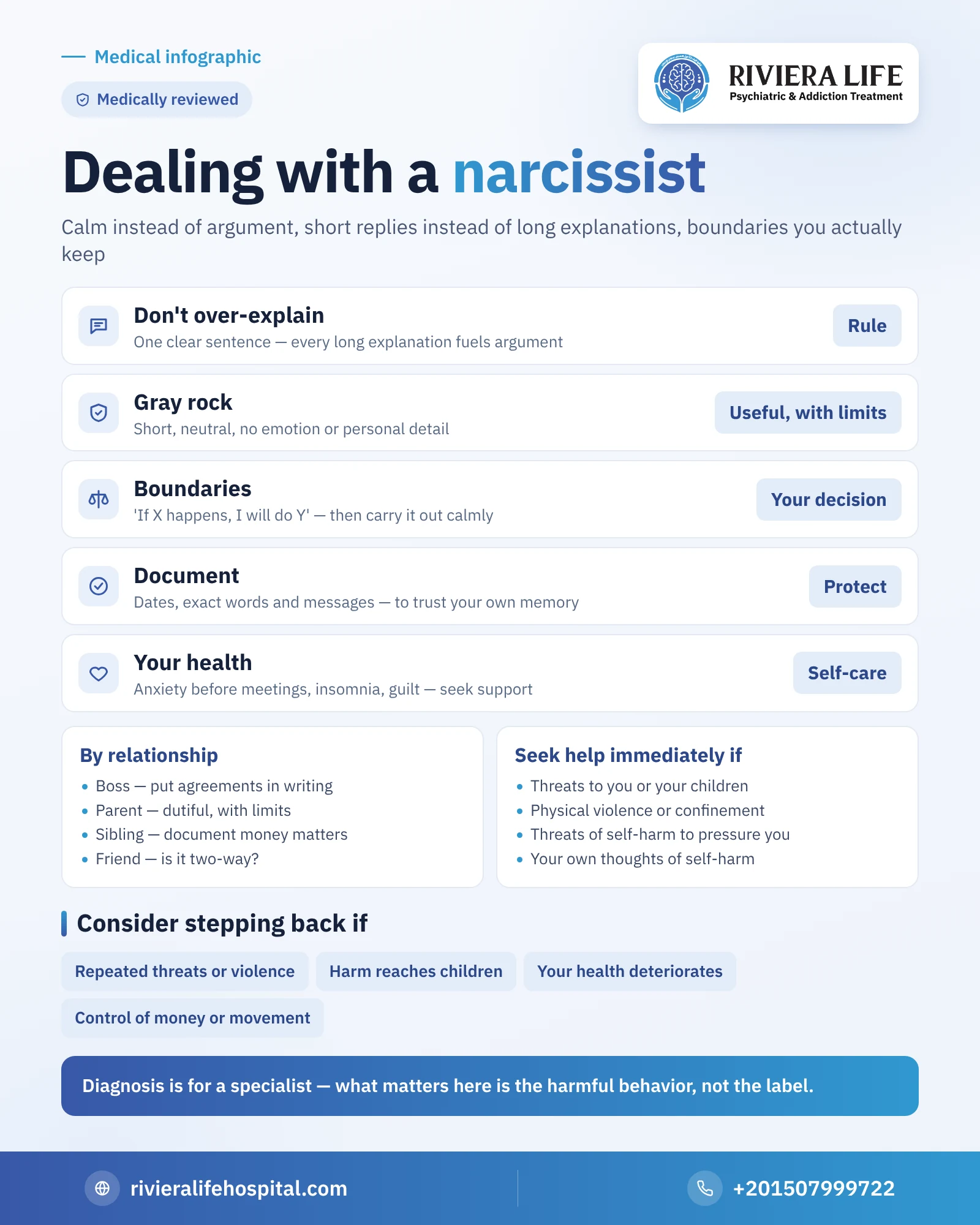
- Don’t over-justify: every long explanation gives them new material for argument. One clear sentence is enough: “I won’t be able to come on Friday.”
- Don’t defend yourself against every accusation: constant defense drags you onto their ground. It is enough to say “I see it differently” and end the conversation.
- Keep a calm tone: your emotional reaction is sometimes what they are waiting for, because it gives them attention or proof that you are “the problem”.
- Choose your battles: not every provocative comment deserves a reply. Save your energy for what actually touches your rights and decisions.
- Speak in facts, not traits: “The report was two days late” is better than “you don’t respect anyone”.
- Don’t expect empathy: if you need emotional support, ask for it from someone else who is able to give it.
The gray rock method: when does it help, and when does it harm?
The idea is to become as boring in their eyes as a gray rock: short, neutral replies, no visible emotions, and no details about your personal life that can be used later. When they find nothing to provoke or criticize, their interest in stirring up conflict with you gradually decreases.
This method works with a colleague, a distant relative, or an ex-spouse you have to communicate with about the children. But it has limits: it isn’t suitable as a permanent way of life with a partner you live with, because over time it switches you off too. At first it may trigger anger or stronger attempts to provoke you before things calm down. And if there is violence or threats in the relationship, safety comes first, not techniques.
Boundaries: how do you set and keep them?
A boundary isn’t a request for them to change, but a decision about what you will do. Its simple form is: “If X happens, I will do Y.” For example: “If you raise your voice, I’ll end the call and call you later.” Then comes the harder step: carrying it out calmly and without discussion every time, because a boundary that isn’t enforced turns into an empty threat that teaches them persistence works.
Expect the boundary to be tested. Pressure often increases after the first boundary you set, through blame, complaining to the family or punishing silence, before it eases. This doesn’t mean you made a mistake, but that the boundary has started to work.
With a narcissistic boss
- Put every important agreement in writing; after the meeting send a short message: “To confirm, we agreed on X by day Y.”
- Keep a record of your achievements and important messages, as they may take credit for your success or blame you for a failure that isn’t yours.
- Present your remarks in a way that preserves their standing: “What do you think if we tried X to reach your goal faster?”
- Don’t criticize them in front of others or share complaints about them with colleagues, as they may reach them in a distorted form.
- Learn the organization’s official complaint channels, and calmly consider an alternative plan if the situation becomes unbearable.
With a narcissistic father or mother
These are the hardest relationships because you don’t choose them, and because what you learned in childhood pushes you to please them constantly. Being dutiful and respectful doesn’t mean accepting insults or giving up your decisions about marriage, work and raising your children. You can visit, help and check on them, and at the same time set the length of the visit and the topics you won’t discuss. If one of your parents compares you with your siblings or uses guilt to pressure you, respond calmly without putting the past on trial: “I understand you’re upset, but my decision won’t change.” And remember that protecting your children from hurtful criticism is part of your responsibility.
With a brother or sister
A dispute with a narcissistic sibling often turns into a conflict involving the whole family: they pass on words in a distorted way, rally the family to their side, and portray you as the unjust party, a picture that intensifies over inheritance and money. Don’t try to gather allies against them, as this feeds the conflict. Talk to them directly and briefly, keep financial matters written and documented, and use a neutral party or legal adviser when needed.
With a narcissistic friend
Ask yourself a simple question: is this friendship mutual? Do they listen to you as you listen to them, are they happy at your success, and do they show up when you need them? If the answer is mostly no, you may reduce meetings gradually without announcing a break, and direct your energy toward relationships that give back what you give.
Documenting: why write everything down?
One of the most common complaints of those around a narcissistic person is that they deny what they said or did with such confidence that others doubt their own memory. That is why it helps to write down important situations with their dates and exactly what was said, and to keep messages. Don’t do it to win an argument, as you usually won’t convince them, but to protect your trust in your own account, and because this record may be needed at work or before an official body.
Protect your mental health
Living or working with a narcissistic person leaves a mark you may not notice at first: anxiety before meeting them, reviewing every word before you say it, insomnia, a feeling that you no longer trust your judgment, and a constant sense of guilt. These are signs of chronic psychological stress that deserve attention. Keep up relationships with people who see you as you are, maintain your sleep and activity routine, and seek psychological counseling for yourself if the symptoms continue. And if you find it hard to leave a relationship you know is hurting you, our article on love addiction may explain part of what you are going through.
When should you step back?
Not every relationship can be fixed with techniques. Seriously consider reducing contact to a minimum, or cutting it off if possible, if:
- Threats, intimidation or physical violence recur.
- The harm starts to reach your children.
- Your mental or physical health clearly deteriorates despite all your efforts.
- They come to control your money or movements, or isolate you from people.
And if the narcissistic person is your life partner, the decision has particular dimensions that we discuss in our article on narcissistic personality and marriage.
Seek help immediately if you see
Your safety and your children's safety come first: call the police on 122 or an ambulance on 123.
- Threats to harm you, your children or anyone else
- Physical violence or being locked in the house
- Threats to harm themselves to pressure you, or after a separation
- Your own thoughts of harming yourself, or that life isn’t worth living
You can also ask for psychological guidance from the hotline of the General Secretariat of Mental Health on 16328.
How can Riviera Life help you?
The first step may be for you, not for them. Riviera Life’s consultant psychiatrists offer sessions that help you understand what you are going through, set boundaries that suit your situation, and treat the anxiety or depression this kind of relationship may leave, in complete confidentiality. And if the other person agrees to seek help, our article on treating narcissistic personality explains what awaits them. The first consultation is free on +201507999722.
More from our narcissistic personality guide
- Narcissistic personality: the complete guide
- Narcissistic personality and marriage
- Treating narcissistic personality
- Love addiction
- The manipulative personality: its tactics, the signs and how to protect yourself
- The toxic personality: signs of toxic behavior and how to protect yourself
- Stockholm syndrome: why people attach to those who hurt them, and how to break free
- Narcissistic traits test: instant result
Questions many people ask
Responding to a narcissistic person with short, neutral replies without emotion or personal details, so they lose interest in stirring up conflict with you.
It usually doesn't help, and increases attack and denial; it is more useful to talk about a specific behavior and set a clear boundary that you carry out.
You can be dutiful, visit and help while limiting the length of meetings and the topics you won't discuss; respect doesn't mean accepting insults.
Because the blame is constantly turned on you until you believe it; documenting, support from people close to you and psychological counseling help you regain trust in your own judgment.
When threats or violence recur, when the harm reaches your children, or when your health clearly deteriorates despite your efforts, making safety the priority.