
A manipulative personality is someone who steers other people’s decisions and feelings toward their own interest through hidden or pressuring tactics: embarrassment, making others feel guilty, disguised lies, or swinging between kindness and coldness. The word is a common description, not a medical diagnosis: there is no disorder called “manipulative personality”, but manipulation is a behavior that appears in several personality disorders and in people with no disorder at all. This article explains how manipulation works, its best-known tactics, why it succeeds with intelligent people, how to protect yourself without turning into an investigator, and when it becomes a reason to seek specialist help.
The manipulative personality: what is the difference between influence and manipulation?
We all try to persuade those around us: a child cries to get a toy, and a colleague praises his manager before asking for leave. This is ordinary influence. It turns into manipulation when three things come together: hiding the real intention, exploiting a weak point in the other person such as their fear, love or guilt, and ignoring what follows for them. The question that reveals the difference: does the other person have enough information and real freedom to say no without being punished?
Tactics that recur
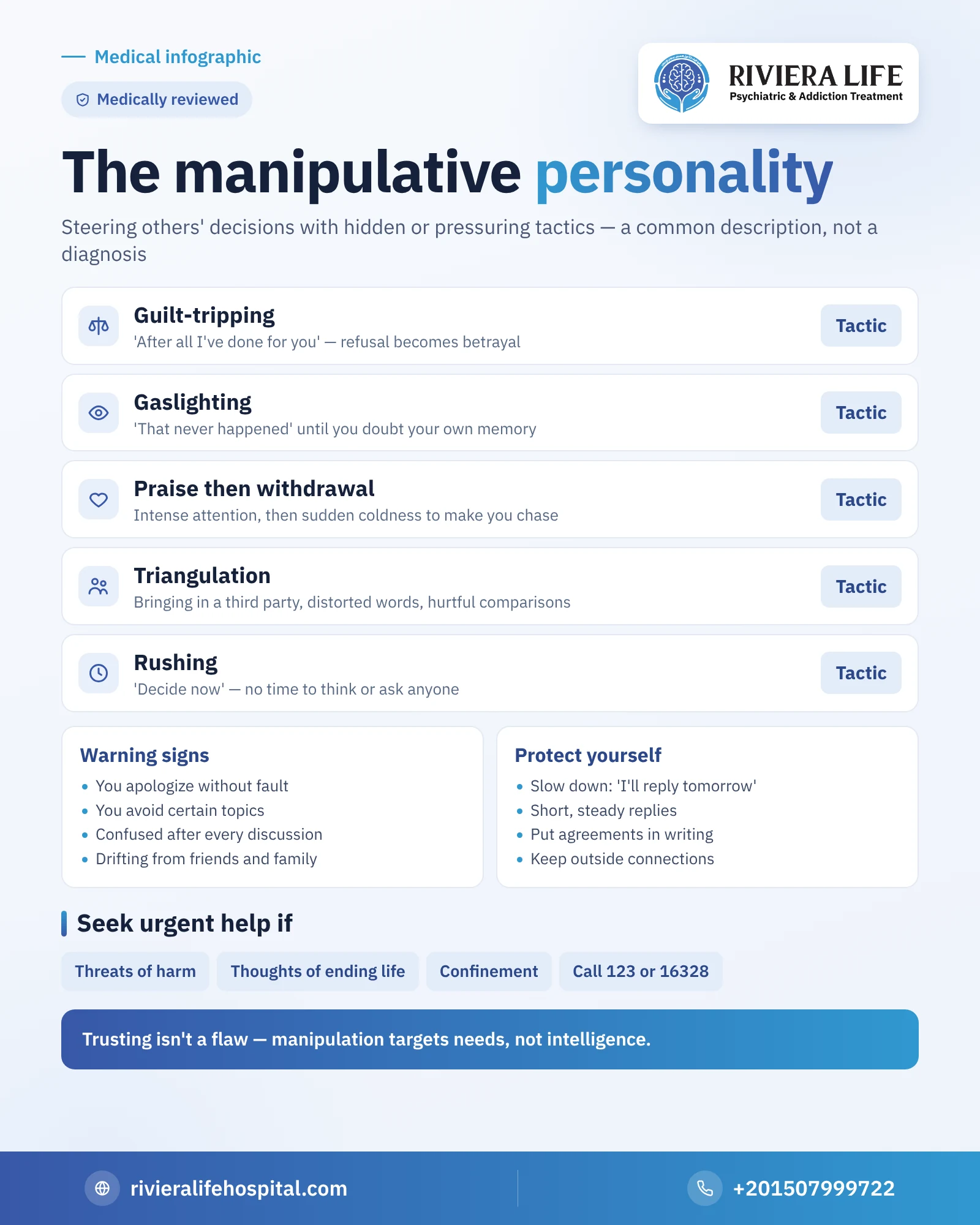
- Guilt-tripping: “After all I’ve done for you.” Refusing becomes betrayal.
- Casting doubt on memory and perception: “That never happened” or “you’re imagining it”. With repetition the person starts to doubt themselves, which many call “gaslighting”.
- Playing the victim: turning the situation around until you are the one apologizing.
- Praise then withdrawal: intense attention followed by sudden coldness, so the other person runs to win back affection.
- Triangulation: bringing a third party into the dispute, by passing on distorted words or making hurtful comparisons.
- Punishing silence: withholding speech until the other makes a concession.
- Rushing: “Decide now”, so there is no time to think or consult.
Who turns to manipulation?
The answer isn’t simple, because manipulation has different motives:
- Out of self-interest and exploitation: most visible in antisocial personality, which you will find in our article on antisocial personality.
- To protect self-image and superiority: common in narcissism; for dealing with it see how to deal with a narcissist.
- Out of fear of abandonment: some people with borderline personality may exaggerate emotional pressure to keep the other person close, often without planning it but driven by intense pain. This differs from cold exploitation, as in borderline personality and marriage.
- Out of learning: someone raised in a home where requests were only met through maneuvering carries this style into adulthood without awareness.
Understanding matters here because it determines how to respond: someone who manipulates out of fear may change with treatment and reassurance, while someone who manipulates because they enjoy control needs firmer boundaries.
Why does manipulation work on intelligent people too?
Because the manipulator doesn’t address the mind but needs: the need for acceptance, to feel you are a good person, and to avoid conflict. Manipulation is usually gradual: at first, kindness, generosity and unusual attention, then small requests, then greater pressure when refusing has become psychologically costly. Many who have fallen into it say one sentence: “I don’t understand how I got here.” And you shouldn’t blame yourself; the capacity to trust isn’t a flaw.
Signs that alert you in a relationship
- You apologize a lot even when you can’t find any wrong you did.
- You avoid talking about certain matters for fear of the reaction.
- You feel confused and doubt your memory after every discussion.
- Your relationships have changed: you have drifted from friends and relatives because this person isn’t comfortable with them.
- You make major decisions, about money or work, under pressure, then regret them.
- Their kindness and harshness switch depending on whether you obey.
Where does manipulation show up in daily life?
At work it may take the form of taking credit for others’ efforts, sharing information as needed, or praising one employee in front of a colleague to create rivalry between them. In the family it may be a father or mother who links love to obedience, making a son feel that refusing the family’s choice is betrayal. In marriage and engagement it appears as jealousy presented as love, monitoring presented as concern, or constant comments about your friends and family. In friendship it may be a friend who only calls when they need something and disappears when you need them. What matters isn’t the single situation, but the pattern that repeats and always serves the same person.
Questions to ask yourself before judging
- Can I say no without paying a heavy psychological price?
- Does this person actually apologize, or apologize to go back to how things were?
- Have I become less confident in myself since this relationship began?
- Do I hide things from my friends or family so they don’t misunderstand them?
If most of the answers are worrying, you don’t need conclusive evidence of bad intent to set boundaries. Protecting yourself is enough, and a psychotherapist can help you see the picture more clearly.
How do you deal with them without being drained?
The goal isn’t to expose masks or to win, but to protect your decision. These general steps help:
- Slow the pace: “I’ll think about it and reply tomorrow.” Time is the strongest defense against rushing.
- Keep your replies short and steady: long explanations give material for argument.
- Write down what was agreed: a simple message confirming what was said reduces the room for doubt.
- Don’t discuss intentions: talk only about behavior and result.
- Keep your outside connections: a trusted friend who hears you rebalances the picture.
- Decide what you won’t accept, and stick to it: a boundary with no action behind it changes nothing.
How does the family deal with a child or teenager who manipulates?
Many children try crying, pretending to be ill or making comparisons to get what they want; this is part of growing up and not evidence of a disorder. What helps here is consistent rules: boundaries that don’t change with nagging, encouraging and praising direct requests when they happen, and avoiding making love a conditional reward. But if manipulation is accompanied by constant lying, cruelty to others and repeated rule-breaking from an early age, have the child seen by a child psychologist.
When you are the one manipulating
Some people read this article and stop at a line that resembles them. That alone is a rare step. Many manipulate out of fear of rejection or of someone leaving, not out of a wish to harm. What helps: noticing the moment you prefer hinting to asking directly, trying the direct request with the possibility of hearing “no”, and tolerating that feeling. Psychotherapy, especially cognitive behavioral therapy or dialectical behavior therapy, teaches skills for expressing needs clearly. You can read about dialectical behavior therapy to learn how it works.
When should you seek specialist help?
- If symptoms of anxiety or depression appear because of a particular relationship, or you constantly doubt yourself.
- If the relationship has ended and its effects remain: fear, loss of trust and insomnia.
- If manipulation is accompanied by threats, harm, or control over money and movement.
- If the person uses drugs or alcohol and becomes more intense with them.
Seek urgent help immediately if you see
Call an ambulance on 123 or go to the nearest emergency department, and don't stay alone.
- Threats of harm or physical violence
- Thoughts of ending your life after a harmful relationship
- Being confined, or prevented from going out or contacting family
You can also call the hotline of the General Secretariat of Mental Health on 16328.
How can Riviera Life help you?
At Riviera Life in Sheikh Zayed, consultant psychiatrists listen to you in a confidential session, distinguish between the effect of a harmful relationship on you and a disorder that may need treatment, then set a plan with you that suits your situation and involves the family if you wish. The first consultation is free, and the number is available around the clock: +201507999722.
More from our personality disorders guide
- Personality disorders: the complete guide
- Narcissistic personality and marriage
- The sensitive personality
- The sadistic personality
Questions many people ask
No, it is a common description, but manipulation is a behavior that appears in several personality disorders and in people with no disorder.
Influence respects the other person's freedom and knowledge, while manipulation hides its intention, exploits a weak point and ignores the consequences for the other person.
A tactic in which someone casts doubt on your memory and perception with phrases like 'that never happened', until you start to doubt yourself.
No. Some manipulate out of fear of abandonment or from old learning, and some do it for their own benefit while ignoring the harm.
When symptoms of anxiety, depression or constant self-doubt appear in you, when the relationship's effects remain after it ends, or when there are threats or control over money and movement.