Narcolepsy is a chronic neurological disorder that leaves the brain unable to regulate the cycle of wakefulness and sleep, so sleepiness overcomes the person in the middle of the day even while they are talking, eating or driving. It isn’t laziness or weak will, nor is it a mental illness, but it is often misunderstood and attributed to depression, negligence or drug use, and its diagnosis is delayed for years. The article explains its symptoms, how it is diagnosed, how it differs from ordinary sleepiness, its psychological and social impact, and where the psychiatrist’s role lies and where the sleep and neurology doctor’s role lies.
What exactly is narcolepsy?
Normally a sleeper passes through successive stages of sleep, and the dream stage (rapid eye movement) comes after about an hour and a half of sleep. In narcolepsy the boundaries overlap: the patient enters the dream stage very quickly, and its elements leak into wakefulness, such as muscle relaxation and dream-like hallucinations. The clearest type is linked to a deficiency of a neurotransmitter released by cells in the hypothalamus called orexin or hypocretin, which maintains wakefulness. The exact cause of the destruction of these cells isn’t known, and immunity, heredity and some triggers are thought to play a role.
The illness usually begins in adolescence or early youth, and may appear at any age; it is uncommon, which is why it is absent from many doctors’ minds at first.
Symptoms: more than just sleepiness
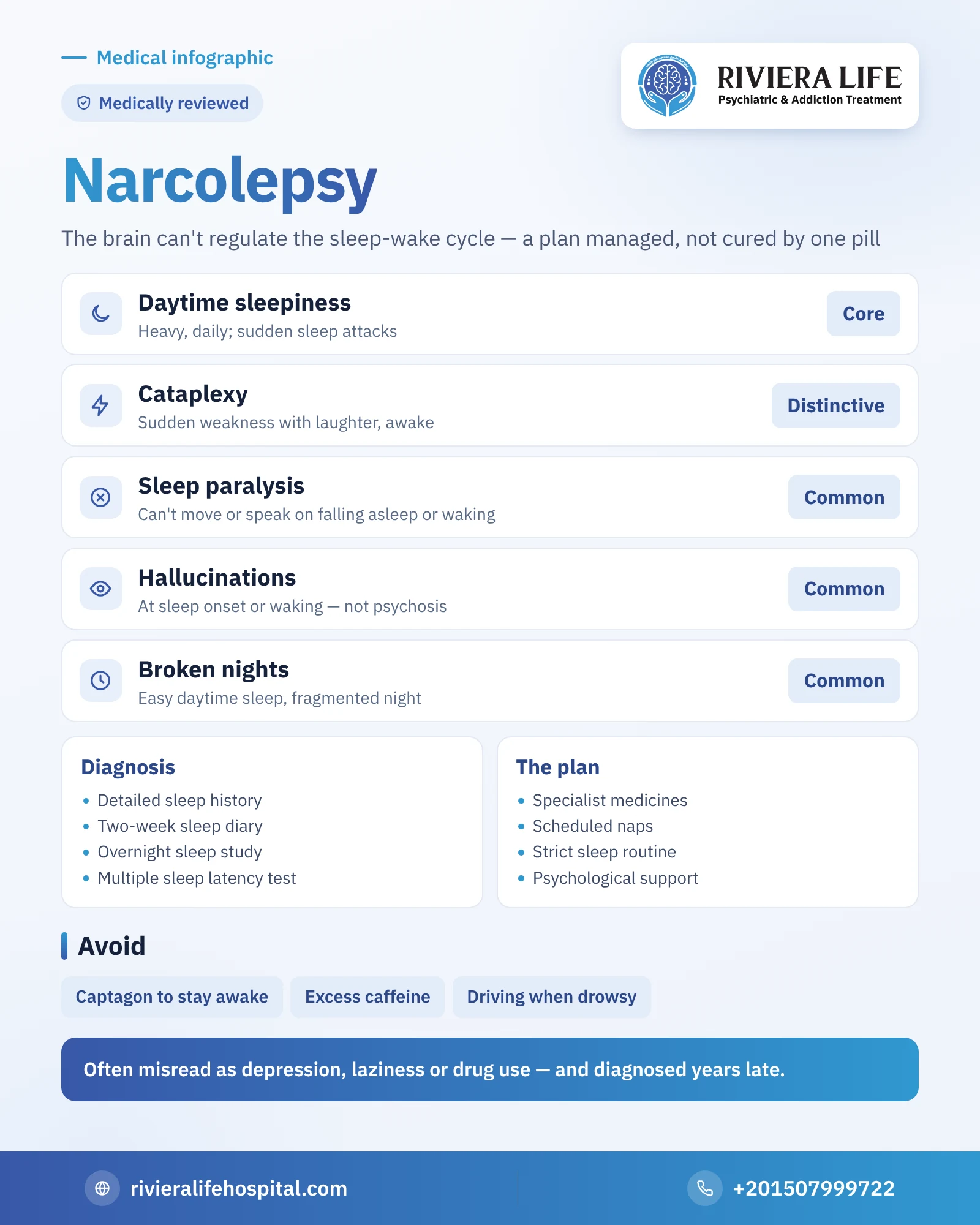
- Excessive daytime sleepiness: the main symptom. Heavy, recurring sleepiness day after day, and there may be sudden “sleep attacks” for minutes from which the person wakes relatively refreshed, then sleepiness returns hours later.
- Cataplexy: sudden muscle weakness lasting seconds or minutes with consciousness preserved, usually triggered by a strong emotion such as laughter or surprise. It may appear as slackness in the face or jaw, the head dropping, or knees giving way. It is a very distinctive sign of type one.
- Sleep paralysis: a temporary inability to move or speak at the start of sleep or on waking.
- Hallucinations on falling asleep or waking: clear images or sounds, sometimes frightening, which are part of the disorder itself and don’t necessarily mean psychosis. To distinguish them from others, see types of hallucinations.
- Broken night sleep: strangely, the patient falls asleep easily during the day but their night is fragmented by repeated waking.
- Automatic behaviors: the person continues writing or talking for seconds while half asleep, then doesn’t remember what they wrote.
Not all of this appears in every patient. Many suffer sleepiness alone at first, the other signs appear later, and some never develop cataplexy.
Ordinary sleepiness or narcolepsy?
| Sleepiness from lack of sleep or exhaustion | Narcolepsy |
|---|---|
| Improves by catching up on sleep for several nights | Continues despite enough night sleep |
| Increases in monotonous situations and after meals | Strikes even during conversation and activity |
| No slackness with laughter | Cataplexy may come with emotion |
| No sleep paralysis or repeated hallucinations | Sleep paralysis and dream-like hallucinations are common |
| Goes away after treating the cause, such as sleep apnea | Remains chronic and needs a long plan |
Narcolepsy can’t be correctly diagnosed from symptoms alone, as there are many causes of sleepiness: sleep apnea, chronic lack of sleep, iron deficiency or thyroid disorder, depression, and some medicines and substances.
How is it diagnosed?
It starts with a detailed sleep history, and the patient may be asked to record their sleep in a diary for two weeks. Then two tests are usually carried out in a sleep center: an overnight sleep study that records breathing, oxygen and brain waves, followed by a daytime multiple sleep latency test, which measures how quickly the person falls asleep in successive opportunities and how quickly they enter the dream stage. Before the test, regular sleep for two weeks is usually requested, and the doctor may ask to review some medicines and substances that affect the result; don’t stop any medicine on your own. In some cases other tests are done according to the doctor’s opinion.
Narcolepsy and psychological misunderstanding
Because the symptoms resemble lethargy and listlessness, many patients are wrongly diagnosed with depression or accused of laziness or staying up late. On the other hand, those affected may really suffer a secondary psychological disorder: anxiety, social withdrawal and depression due to embarrassment, loss of performance and the frustration of those around them. Research points to higher rates of depression and anxiety in patients compared with others. That is why some need psychological follow-up alongside sleep treatment. And if you want to distinguish between sadness and depression, read sadness vs depression.
Hallucinations and sleep paralysis may be understood as the start of a psychotic illness, but when they happen only on falling asleep and waking, in the context of excessive sleepiness, they are usually part of narcolepsy. Distinguishing is the doctor’s job after assessment.
Treatment: a plan that is managed, not an illness cured with one medicine
There is no completely curative treatment yet, but the symptoms can be well controlled. The plan consists of:
- Medicines prescribed by the specialist doctor: some boost daytime wakefulness, some ease cataplexy, sleep paralysis and hallucinations, and some improve the consolidation of night sleep. The doctor chooses the type and duration according to the case, and these medicines must not be handled without supervision.
- Scheduled daytime naps: two or three short naps at fixed times ease sleepiness and organize the day.
- A strict sleep routine: fixed times throughout the week and a suitable room.
- Adjusting daily life: avoiding heavy meals and alcohol, and organizing work so it doesn’t require long late nights.
- Psychological support: treating accompanying anxiety or depression, and cognitive behavioral therapy to deal with frustration and stigma.
- Educating those around: explaining the condition to family, work and school so it is understood for what it is.
An important warning about substances: some people take stimulants, a lot of caffeine or Captagon to resist sleepiness, and this is a dangerous path that increases psychological problems and leads to dependence. And if you have accompanying insomnia, see the complete guide to insomnia.
Narcolepsy in teenagers and children
In many the illness begins at school age, appearing as a student who sleeps in lessons and whose achievement declines, so they are punished and described as careless. In children it may appear as sleepiness with irritability and hyperactivity instead of calm. If parents notice unusual sleepiness not explained by staying up, it is better to show the child to a pediatrician or neurologist early, and to communicate with the school with a report explaining the condition, as early diagnosis changes the course of both study and psychological wellbeing.
Driving, work and study: safety issues
The most dangerous thing about narcolepsy is dozing off while driving or operating machinery. Ask your doctor frankly about driving before you drive, and don’t drive while feeling heavy drowsiness. At work and in study, adjustments can be requested: short breaks, scheduling difficult tasks at more active times, and flexibility in hours. A medical report helps a lot in convincing those around that the problem is organic.
When should you see a doctor?
See a doctor if you have suffered severe daytime sleepiness despite enough sleep for more than three months, or sudden naps, or muscle weakness with laughter and emotion, or repeated sleep paralysis with hallucinations. Start with a neurologist or a sleep doctor if available. And if persistent sadness, severe anxiety or dependence on stimulants or substances appears with the symptoms, the psychiatrist is a partner in the plan. See sleep disorders to compare the other types.
How does Riviera Life help you?
Riviera Life doesn’t treat narcolepsy itself, which is the specialty of the sleep and neurology doctor, but its consultant psychiatrists assess the accompanying psychological side such as anxiety and depression or dependence on stimulants and substances, and cooperate with the treating service. The first consultation is free and confidential on +201507999722.
More from the insomnia guide
- Insomnia: the complete guide
- Sleep disorders: types and signs
- Types of hallucinations
- Melatonin and sleep
Questions many people ask
No, it is a chronic neurological disorder in regulating sleep and wakefulness, but it may cause secondary anxiety and depression that need psychological support.
Sudden muscle weakness with consciousness preserved, usually triggered by a strong emotion such as laughter, and it is a distinctive sign of one type of narcolepsy.
With a detailed history and an overnight sleep study, followed by a daytime multiple sleep latency test in a specialized sleep center.
There is currently no complete cure, but medicines, scheduled naps and a sleep routine control the symptoms in most patients.
The doctor decides this according to how well the symptoms are controlled, and anyone who feels heavy drowsiness or sudden naps must not drive.