Sleep disorders are a wide group of conditions that spoil the quantity, quality or timing of sleep, or bring into it strange behavior the person doesn’t remember. Insomnia is the best known, but it isn’t the only one: there are those who sleep eight hours and wake exhausted because their breathing stops many times in the night, those overcome by sleep suddenly in the middle of a conversation, those whose legs deprive them of lying down, and those who walk or scream while asleep. This article presents a map of these disorders, the signs that distinguish each type, when the sleep doctor is the right address and when it is the psychiatrist, and how these conditions intertwine with anxiety, depression and drugs.
What is meant by sleep disorders?
Doctors speak of a sleep disorder when the problem recurs for weeks and affects the day: concentration, mood, work and driving. A bad night before an exam isn’t a disorder, but loud snoring with irresistible daily sleepiness for several months deserves assessment. Modern medical classifications divide these conditions into major families: insomnia, breathing disorders during sleep, hypersomnia, body clock disorders, parasomnia, and sleep-related movement disorders.
And because insomnia specifically has a separate guide explaining its causes and cognitive behavioral treatment in detail, we refer you to the complete insomnia guide, and focus here on the other families.
A quick map of the types of sleep disorders
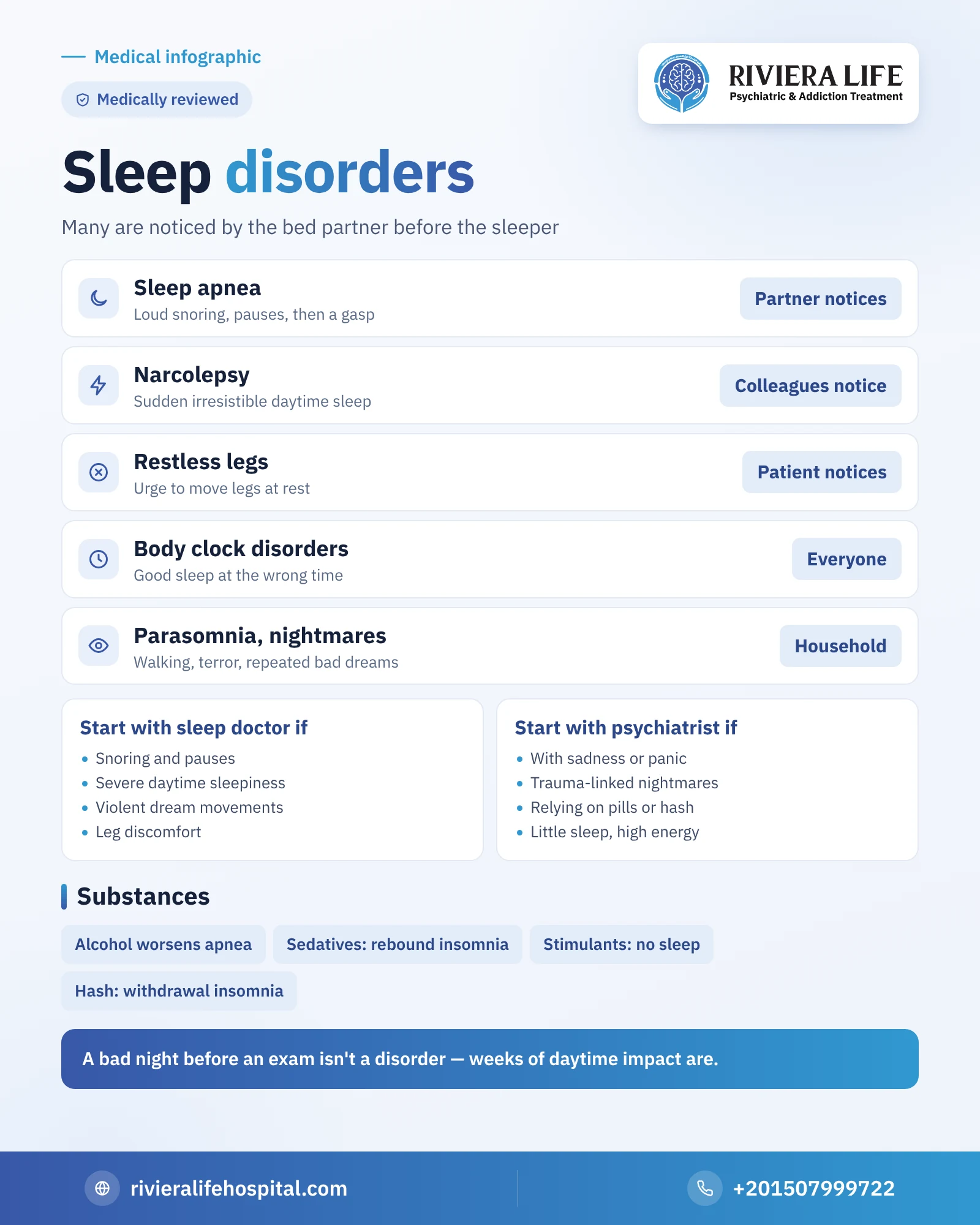
The first question a sleep doctor usually asks isn’t “how many hours do you sleep?” but “who notices the problem?”, because many of these disorders are seen by the bed partner before the person themselves:
| The disorder | The most prominent sign | Who usually notices it |
|---|---|---|
| Sleep apnea | Loud snoring and a pause in breathing then a gasp | The husband or wife |
| Narcolepsy | Sudden irresistible episodes of sleepiness during the day | Colleagues and family |
| Restless legs | An urgent desire to move the legs at rest in the evening | The patient themselves |
| Body clock disorder | Good sleep but at the wrong time | The patient and those around them |
| Parasomnia | Walking, talking or terror during sleep | The household |
| Nightmare disorder | Repeated frightening dreams that wake the person | The patient themselves |
Sleep apnea
In the obstructive type, the most common, the throat muscles relax during sleep so the airway narrows or closes for seconds, oxygen drops and the brain wakes for a brief moment to reopen it. This sometimes repeats dozens of times an hour without the sleeper remembering anything, then they spend their day heavy-headed.
- Loud, interrupted snoring, broken by periods of silence then a gasp or choking.
- Morning headache and a dry mouth.
- Daytime sleepiness, especially while driving or in meetings.
- Irritability and poor memory, and frequent urination at night.
Obesity, a wide neck circumference, enlarged tonsils and older age increase the likelihood. And the matter isn’t just a nuisance: untreated cases are linked to high blood pressure, heart disease and stroke, and to road accidents because of sleepiness.
Narcolepsy and hypersomnia
Narcolepsy is a chronic neurological disorder that weakens the brain’s ability to separate wakefulness from sleep. The person feels severe sleepiness throughout the day, and may doze off suddenly in unexpected situations. Some patients have episodes in which the body goes limp or the head drops with a strong emotion such as laughter, which is called cataplexy. It may be accompanied by sleep paralysis and hallucinations when falling asleep or waking.
These hallucinations specifically sometimes worry families and are understood as a psychotic illness, while in this context they are part of the sleep disorder itself. The article on types of hallucinations explains how doctors distinguish sleep hallucinations from others.
Restless legs syndrome
Patients describe it as an annoying sensation inside the legs, as if something is crawling or pulling, with an urgent desire to move them. It appears when sitting for long or lying down in the evening, and calms temporarily with walking or stretching, so it delays sleep for hours. It may be linked to iron deficiency, pregnancy, kidney failure or some medicines, which is why the doctor usually starts with simple tests before thinking of any treatment.
Body clock disorders
Here the problem isn’t the ability to sleep, but its timing. The internal clock that regulates the release of melatonin doesn’t match the required life schedule. Its best-known forms:
- Delayed sleep phase: a young man who doesn’t feel sleepy before three in the morning however hard he tries, then can’t wake up for university. It is common in teenagers and is made worse by late nights on screens.
- Shift work disorder: nurses, factory workers and drivers whose working hours switch between night and day, so the body doesn’t get a chance to adapt.
- Advanced sleep phase: very early sleepiness and waking long before dawn, more common in older people.
- Travel across time zones disorder: usually temporary, but exhausting for those who travel a lot.
Parasomnia: when the body acts while the mind sleeps
Walking and talking during sleep and night terrors
They usually happen in the first third of the night during deep sleep, are common in children and lessen with age. In a night terror the child may sit up screaming with open eyes, not respond to attempts to calm them, then remember nothing in the morning. Sleep deprivation, fever and pressure make them worse.
Sleep paralysis
The person wakes up aware but unable to move or speak for seconds or minutes, and may feel a weight on their chest or the presence of someone in the room. The experience is terrifying but not dangerous in itself, and recurs more with lack of sleep and irregular sleep.
REM sleep behavior disorder
Normally the body relaxes during dreams. In this disorder this relaxation is absent, so the sleeper hits, kicks and shouts as if living the dream, and may hurt themselves or their partner. It usually appears after the age of fifty, and deserves a neurological assessment because it may precede some diseases of the nervous system by years.
Recurring nightmares
Everyone sees a nightmare sometimes. But when frightening dreams recur until the person fears sleep itself, and wakes remembering their details clearly, it may be nightmare disorder. Nightmares are common after trauma, and are among the basic signs of post-traumatic stress disorder, and they also appear with anxiety and depression, and with stopping some substances and medicines. The good news is that they have effective psychological treatments, including techniques in which the patient rewrites the dream and imagines it with a different ending under a therapist’s supervision.
Signs worth taking seriously
- Daytime sleepiness that makes you doze off in the car or at work despite enough sleep.
- Loud snoring with which a family member noticed a pause in breathing.
- Violent behavior or strong movements during sleep, or unexplained injuries in the morning.
- Repeated inability to sleep or wake at the required times however hard you try.
- An annoying sensation in the legs that stops you lying down.
- Nightmares that make you avoid sleep or deliberately postpone it.
- Sleep changing with a clear change in mood or after starting a medicine or substance.
Sleep doctor or psychiatrist?
There is no rigid rule, and the two often cooperate. But this division helps you choose where to start:
| Start with a sleep, chest or neurology doctor if | Start with a psychiatrist if |
|---|---|
| Snoring and pauses in breathing are the most prominent sign | The sleep disorder came with sadness, anxiety or panic attacks |
| Daytime sleepiness is severe despite long sleep | The nightmares are linked to a traumatic event |
| There are violent movements during dreams after middle age | You depend on a sleeping pill, sedative or hash to sleep |
| An annoying sensation in the legs prevents sleep | Little sleep comes with excessive energy and impulsivity |
The sleep doctor may ask for an overnight sleep study in the lab or a home device that records breathing, oxygen, brain waves and leg movement, which is the most accurate way to diagnose sleep apnea and narcolepsy.
Sleep disorders and mental health: a two-way relationship
Disturbed sleep isn’t just a result of psychiatric illness; it may pave the way for it or increase it. Chronic lack of sleep raises the risk of depression and anxiety, and depression itself changes the structure of sleep so it wakes the person early or makes them sleep long hours without rest. In bipolar disorder, a decline in the need for sleep may be the first sign of a coming manic episode. And untreated sleep apnea is linked to symptoms resembling depression, so mood sometimes improves just by treating the breathing.
Drugs and sleeping pills and their effect on sleep disorders
Many turn to a substance to solve a sleep problem, and it creates a more complicated problem:
- Alcohol: relaxes the throat muscles so it makes sleep apnea worse, and interrupts sleep in the second half of the night.
- Sedatives and benzodiazepines: may depress breathing in sleep apnea patients, and stopping them suddenly leads to severe rebound insomnia. See benzodiazepine withdrawal symptoms.
- Some sleeping pills: have sometimes been linked to complex behaviors during sleep such as walking, eating and even driving unconsciously, including zolpidem, to which we dedicate the article on zolpidem addiction treatment.
- Stimulants: such as captagon, shabu and ice prevent sleep for days, followed by long disturbed sleep and depression.
- Hash: may cause sleepiness at first, but stopping it after long use causes clear insomnia and disturbing dreams for weeks.
That is why the assessment of any sleep disorder doesn’t start properly without a frank question about substances and medicines, and this doesn’t mean accusing anyone, but is an essential part of diagnosis.
How does Riviera Life help you?
When a sleep disorder overlaps with anxiety, depression or dependence on a sleeping pill or substance, the consultant psychiatrists at Riviera Life assess the whole picture, and set a plan that treats the cause, not just the symptom, coordinating with the sleep doctor when the case needs a sleep study. The first consultation is free and confidential, and you can contact us on +201507999722.
More from the insomnia guide
- Insomnia treatment
- Insomnia: the complete guide
- Melatonin and sleep
- Psychological stress and its effect on sleep
- Zolpidem addiction treatment
- Anxiety at bedtime: why it intensifies at night and how to calm your mind before sleep
- Recurring nightmares: their causes, their link to trauma and what stops them
- Narcolepsy: its symptoms, diagnosis and psychological impact
- Parasomnia: sleepwalking, night terrors and keeping the home safe
- Insomnia test: instant result
Questions many people ask
No, many people snore without pauses in breathing. But loud snoring with pauses others notice and daytime sleepiness calls for a medical assessment.
Yes, broken sleep may cause exhaustion, poor concentration, irritability and apathy. That is why the doctor asks about sleep when assessing any depression, and mood may improve after the breathing is treated.
Sleep paralysis is frightening but not dangerous in itself, and it increases with lack of sleep and irregular sleep. If it recurs a lot or is accompanied by severe daytime sleepiness, it is better to see a sleep doctor.
A test that records breathing, oxygen, heart rate, brain waves and body movement during sleep, in a lab or with a home device, and helps diagnose sleep apnea and narcolepsy.
Yes, alcohol makes sleep apnea worse, stimulants prevent sleep, and stopping hash or sedatives may cause insomnia and nightmares for weeks.