Parasomnia is when a person does, says or experiences something unusual during sleep, or when entering or leaving it, without being aware of what they are doing. Sleepwalking, night terrors and acting out dreams with movement are all forms from this family. Most are benign in children and go away with age, but in adults they deserve assessment, because the real danger isn’t the strangeness of the situation but injury, and sometimes the hidden cause behind it. This article explains the types and how to tell them apart, and how to protect the person sleeping beside you or protect yourself.
What is parasomnia and what happens in the brain?
Sleep isn’t one state. The brain moves between deep slow-wave sleep, and dreaming sleep in which the eyes move rapidly and most of the body’s muscles relax. Parasomnia happens when the brain gets stuck between two states: part of it deeply asleep and part working and moving the body. That is why the person walks with open eyes and a blank expression, then remembers nothing in the morning.
In terms of timing, parasomnias divide into two groups: a type that appears from deep sleep in the first third of the night, which is the most common in children, and a type that appears from dreaming sleep near dawn. This difference directs the doctor to the cause, and accordingly the risk of the illness and the way of treating it differ.
Sleepwalking: what does it look like?
The person may sit up in bed then get up and wander around the house, open the fridge, arrange things, or try to go out of the door. Their eyes are open but they don’t respond to your words normally, and if they reply it is with an unintelligible sentence. The episode usually lasts a few minutes, and may sometimes be longer. And if they are woken forcefully they may be confused or agitated for moments.
It is common among families to believe that waking a sleepwalker is dangerous for them. The truth is that it isn’t dangerous in itself, but it is better to guide them calmly back to bed, because waking them suddenly confuses them and may make them act agitatedly. The real danger is falling down the stairs or from a window, hitting glass, or opening the flat door and going out into the street. Some adults drive a car or cook in rare cases, and this is what makes the matter worth medical assessment, not a family joke.
Night terrors: not a nightmare
In a night terror the child or person suddenly sits up in bed and lets out a sharp scream, their heart racing, eyes wide with fear, and they don’t calm down however much you try to reassure them. After minutes they go back to sleep, and in the morning they remember nothing. Many mistakenly think it is a nightmare, and the difference is fundamental:
| Element | Night terror | Nightmare |
|---|---|---|
| Time of occurrence | First third of the night | Second half of the night |
| Waking | Doesn’t wake fully and doesn’t respond to you | Wakes and is aware of surroundings |
| Remembering | Usually doesn’t remember | Remembers the dream in detail |
| Appearance | Screaming, panic and sweating | Fear and anxiety after waking |
| Most common in | Children | Children and adults |
A child in a night terror doesn’t need reassuring talk as much as your presence and physical safety. Sit near them and wait, then let them go back to sleep. Repeated nightmares in adults after a frightening event may point to the effect of trauma, and are detailed in PTSD symptoms.
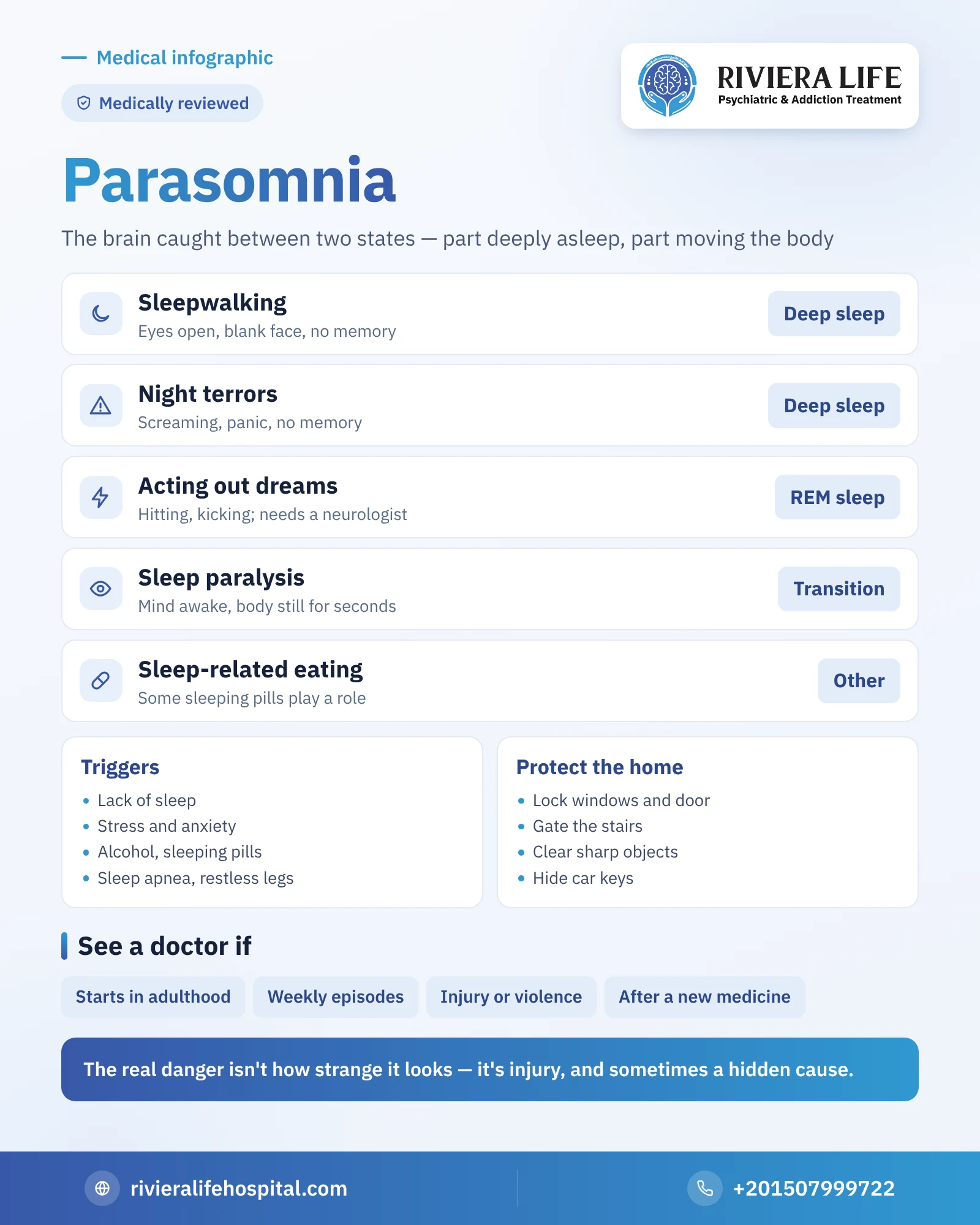
REM sleep behavior disorder: when the body acts out the dream
In dreaming sleep the body normally relaxes so we can’t carry out what we see in the dream. In some people, most of them middle-aged and older, this relaxation doesn’t happen fully, so the person hits, kicks or shouts while dreaming that they are defending themselves. They may hurt themselves or the person sleeping beside them. Unlike sleepwalking, this person can usually be woken and tells a dream that matches their movements exactly.
This type deserves special attention, because long follow-up studies found that a proportion of those with it later develop a neurodegenerative disease such as Parkinson’s or dementia with Lewy bodies, and it may precede that by years. This doesn’t mean every person with it will develop them, nor that treatment is useless, but it means the matter needs a neurologist or a sleep doctor, not just waiting. And some antidepressants may increase it or reveal it, so don’t change your medicine yourself.
Other, less known types
- Confusional arousal: the person sits up in bed confused and speaks incoherently then goes back to sleep, and it is common in children.
- Sleep paralysis: the mind waking while the body stays paralyzed for seconds or minutes when falling asleep or waking, and it may be accompanied by a feeling that someone is in the room. Frightening but not physically harmful, and usually linked to lack of sleep and irregular sleep.
- Sleep-related eating: the person getting up from sleep and eating unconsciously, and they may not know the reason for the leftovers in the kitchen in the morning; sleeping pills have a known role in some of it.
- Talking in sleep and teeth grinding: common and usually harmless, though teeth grinding may tire the jaw over time.
What sets off parasomnia?
Genetic predisposition plays a clear role; many who sleepwalk have relatives who did. But what lights the spark is usually an external factor, the most important of which are:
- Lack of sleep and chaotic sleep times, as sleep deprivation increases the depth of slow-wave sleep the following night and makes it less stable.
- Tension, anxiety, depression and any prolonged psychological pressure.
- Alcohol, sedatives and sleeping pills. Some insomnia medicines are linked to complex behavior during sleep, so much so that the US Food and Drug Administration added a strict warning about this for some of them. Read sleeping pill addiction and the zolpidem page.
- Sleep apnea and restless legs, because they interrupt sleep and trigger repeated partial waking.
- Fever, pain, a full bladder and noise, especially in children.
- Some antidepressant, antipsychotic and other medicines, and here the plan is reviewed only with the treating doctor.
Sometimes the condition resembles nocturnal epileptic seizures, which is why the doctor assesses the whole picture and isn’t satisfied with the description.
How do you protect the home?
The top priority is safety, and it doesn’t depend on treating the condition itself. These are simple practical steps:
- Put covers on windows or locks the sleeper can’t easily reach, and lock the flat door with a key or a bell that rings when it is opened.
- Close the stairs with a gate, and don’t let a child prone to sleepwalking sleep in an upper bunk bed.
- Remove sharp and broken objects and electrical cables from their path, and keep the floor of their room clear.
- Keep car keys out of their reach.
- In REM sleep behavior disorder, move hard objects away from the bed and put a mattress on the floor if necessary, and consider the partner sleeping in another room temporarily.
- If there is a child in the family who suffers from it, put their room on the ground floor if possible.
When do you see the doctor?
A child who sleepwalks once every few months rarely needs more than protecting their environment. An adult, however, deserves assessment if the condition started after adulthood, recurs weekly, has caused an injury, involves violence, driving or eating, or appeared after a new medicine. Likewise if they suffer from severe daytime sleepiness or loud snoring.
Call an ambulance on 123 or go to the emergency department if this happens
During or after a night episode:
- A fall from height, a head injury or a deep wound
- Leaving the house at night, walking in the street or driving the car while asleep
- Hitting oneself or another person during sleep
- Loss of consciousness, seizures or tongue biting with night episodes
How is it diagnosed?
Diagnosis relies first on the story: what happens, when in the night, which medicines, and whether there are cases in the family. It helps for the sleep partner to record what they see, and to film the sleeper on video if possible with their consent. In complex or violent cases, or those that start after forty, the doctor may ask for a sleep study in the lab with recording of waves and movement, and tests to rule out sleep apnea and epilepsy. For the general picture of the types of sleep disorders see sleep disorders.
What is the treatment?
Most mild cases don’t need medicine, and the basis of treatment is three things: controlling what sets it off, protecting the environment, and regulating sleep.
- Controlling triggers: enough sleep at a fixed time, reducing alcohol and caffeine in the evening, and treating sleep apnea or restless legs if present.
- Reviewing medicines: the doctor may see that a particular medicine sets off the condition, so they adjust or replace it. Don’t stop a medicine yourself.
- Psychotherapy: managing anxiety and stress before sleep; relaxation techniques and cognitive behavioral therapy for insomnia may help, and it is explained in the insomnia guide.
- Scheduled waking: in children whose episodes recur at a fixed time, the doctor may recommend gentle waking a little before the usual time.
- Medicine when necessary: in dangerous or violent cases the doctor may prescribe medicines suited to the type, and the choice and duration are the doctor’s decision alone; no sleeping pill or sedative is used for sleepwalking without supervision, because some of them may themselves cause the problem.
How does Riviera Life help you?
If parasomnia is accompanied by anxiety, depression or dependence on a sleeping pill or alcohol, we at Riviera Life in Sheikh Zayed, Giza, assess the psychological state and sleep together under the supervision of psychiatrists. The first consultation is free and confidential, and contact is available on +201507999722.
More from the sleep disorders guide
- Insomnia: the complete guide
- Sleep disorders: their types and signs
- Melatonin and sleep
- Sleeping pill addiction
Questions many people ask
It isn't dangerous in itself, but it is better to guide them calmly back to bed, because sudden waking confuses them and may make them agitated. What matters is keeping them away from danger.
No. In a night terror the person doesn't wake fully and remembers nothing, while a nightmare wakes its owner and they remember its details.
Usually not, especially in children. But it may be linked to anxiety and lack of sleep, and in adults it deserves assessment to rule out other causes.
Yes, some insomnia medicines have been linked to complex behavior during sleep, which is why they aren't used without a doctor's supervision and the medicine isn't changed on your own.
When the condition recurs, involves violence or injuries, or starts after the age of forty, the doctor may ask for a sleep study to identify the type and rule out epilepsy and sleep apnea.