OCD and depression are two different disorders, but they often occur together in the same person, and depression usually comes after OCD as a result of the exhaustion and helplessness it causes. The basic difference is that OCD is intrusive thoughts the person resists and performs acts to get rid of, while depression is persistent sadness and loss of pleasure with rumination over negative thoughts about oneself and the past. The doctor treats both together in one plan, because leaving one weakens the response to treatment of the other. In this article we explain the relationship between them, how to tell their symptoms apart, and how treatment changes when they occur together.
Do OCD and depression often occur together?
Yes. Depression is the psychiatric disorder that most often accompanies OCD, and many studies indicate that a large proportion of OCD patients, which may reach a third or more, go through an episode of depression at some point, with the proportion rising over a lifetime. This doesn’t mean every OCD patient will develop depression, but it means the doctor always asks about it, and that the family should watch for its signs.
Which comes first?
In most cases OCD starts first, and depression appears months or years later. That is why many specialists describe it as “secondary” depression, meaning it results from living with OCD for a long time. But the order isn’t fixed; some people go through depression first, and obsessive symptoms may appear during an episode of depression and ease with it. Knowing which started first helps the doctor understand the story, but it doesn’t change much about the need to treat both.
Why does OCD lead to depression?
Imagine someone who spends three hours a day washing and checking, knows what he is doing is excessive, and tries to stop and fails time after time. Over time a feeling of helplessness creeps in: “I’ll never change.” His life narrows because of avoidance, so he gives up hobbies, friends and opportunities. He feels guilt and shame about his thoughts, and that he is a burden on his family. These elements, helplessness, loss, isolation and guilt, are the very ingredients depression feeds on. On top of that, the two disorders partly share some biological factors, such as the role of serotonin.
The difference between obsessions and rumination in depression
Both are repetitive thinking that is hard to stop, which is why people often confuse them. But the differences are clear when we look closely:
| Comparison | Obsession | Depressive rumination |
|---|---|---|
| Nature of the thought | Intrusive and alien to the person’s values | Consistent with his sad mood |
| Its content | Fear of a danger or mistake that might happen | Self-blame and regret over the past |
| Direction in time | Usually toward the future: what if? | Usually toward the past: why did it happen? |
| Reaction | A compulsive act to neutralize the thought | Withdrawal, lethargy and crying |
| Accompanying feeling | Anxiety, tension and disgust | Sadness, emptiness and loss of pleasure |
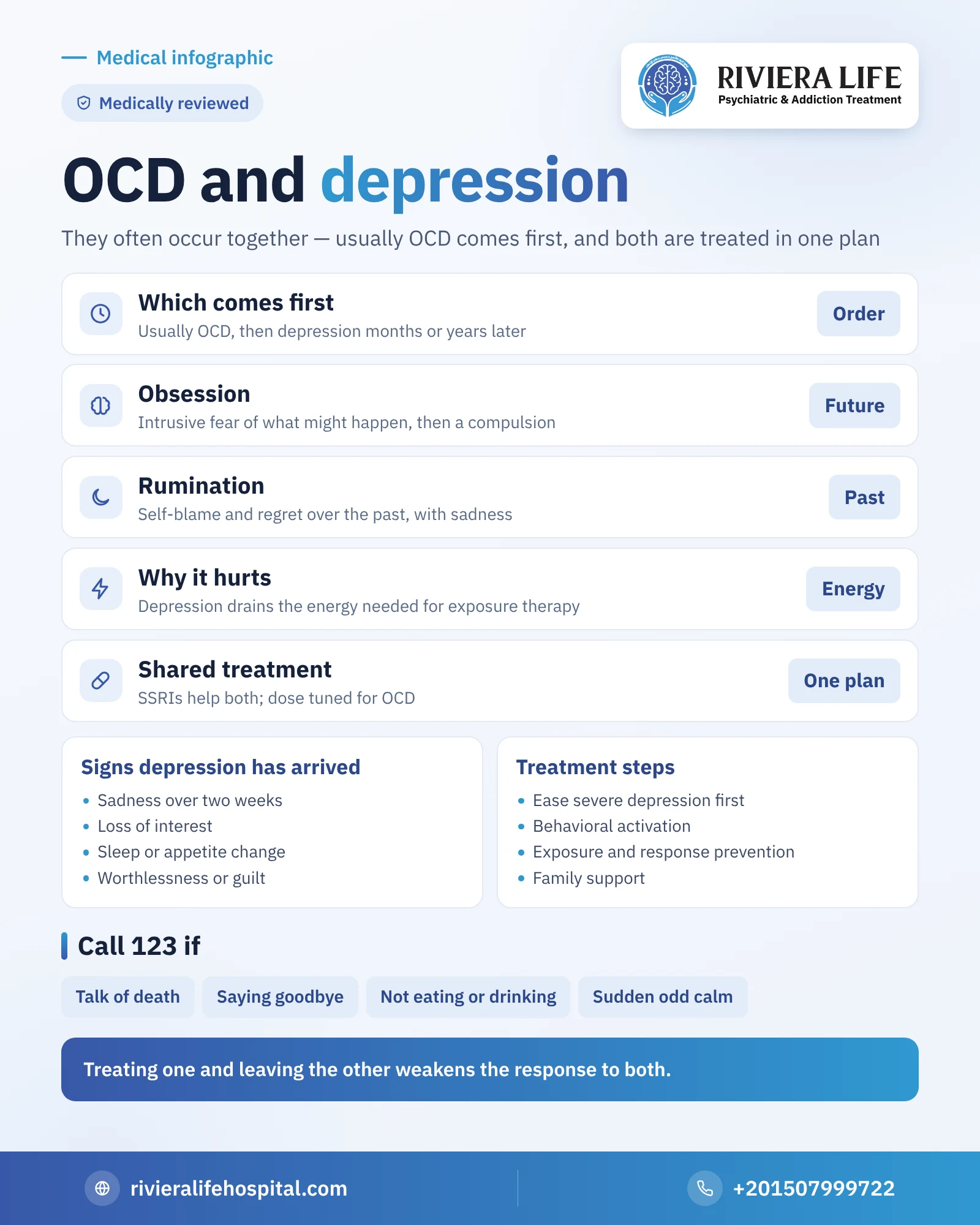
Signs that depression has entered the picture
If someone has known OCD, these changes deserve reporting to the doctor quickly:
- Sadness or emptiness lasting most of the day for more than two weeks.
- Loss of interest in things he used to enjoy, even those unrelated to OCD.
- A clear change in sleep, appetite or weight.
- Slowness, severe fatigue and difficulty starting any activity.
- A feeling of worthlessness or exaggerated guilt.
- Phrases like “there’s no point” or “I’m tired of everything”, or any talk of death.
You can review the full picture in our article on depression symptoms.
How does depression change the picture of OCD?
When the two disorders occur together, symptoms usually get worse, and the sense of hope for improvement decreases. More importantly, depression drains the energy the patient needs to treat OCD; exposure and response prevention sessions require motivation and the ability to tolerate anxiety, and a depressed patient may not find the strength to attend or do the homework. So treatment may seem to be “failing” while the problem is depression that hasn’t yet been treated. Their combination is also linked to a higher risk of suicidal thoughts compared with either alone.
How does the doctor tell them apart?
One question isn’t enough. The psychiatrist listens to the sequence of events: when the repetitive thoughts began, what their content is, what the patient does after them, and when the sadness and loss of pleasure began. He may use a scale for OCD severity and another for depression severity, to follow each separately. He also rules out other disorders that may resemble the picture, such as bipolar disorder, which may begin with episodes of depression, because that changes the choice of medicine completely.
OCD and depression after childbirth
Some mothers go through both disorders together after childbirth: frightening intrusive images of harm that might come to the baby, followed by excessive sterilizing or avoiding holding him, together with sadness, crying, exhaustion and a feeling of being “a bad mother”. Mothers often hide these thoughts for fear of being seen as a danger to their child, so treatment is delayed and depression deepens.
The truth is that these thoughts in OCD are rejected by the mother herself and don’t mean a desire to harm, and there are treatment options suitable for the breastfeeding period that the doctor chooses carefully. The role of the husband and family here is to notice the change early, lighten the burden of care for her, and encourage her to talk to a psychiatrist without blame.
Treating OCD and depression together
The reassuring news is that a large part of treatment is shared:
- Medicines: selective serotonin reuptake inhibitors treat both disorders together, and the doctor adjusts the dose to suit OCD, which often needs longer to respond. Our article on the best medication for depression and anxiety explains how the doctor chooses the medicine.
- Order of steps: if depression is severe, the doctor starts by easing it first, then intensifies behavioral treatment for OCD when the patient’s energy returns.
- Behavioral activation: gradually reintroducing enjoyable and useful activities into the day, a method that supports mood and gives the patient small successes.
- Exposure and response prevention: remains the cornerstone of OCD treatment, taking the patient’s mood into account in the pace of progression.
The full details of treating each are in our articles on OCD treatment and depression treatment.
When does it become urgent?
OCD combined with severe depression calls for extra vigilance from the family.
Seek urgent help immediately if you see
Call an ambulance on 123 or go to the nearest emergency department, and stay with the person until help arrives.
- Talk of death, of wanting to disappear, or of being a burden on others
- Saying goodbye to people or suddenly giving away treasured things
- Refusing to eat or drink, or complete inability to leave bed
- Sudden unexplained calm after a period of severe despair
Our article on OCD and suicide covers these signs in detail, and how to talk to someone you are worried about.
Advice for the family
Don’t interpret lethargy and lack of enthusiasm as laziness or stubbornness; it may be depression. Avoid phrases like “think positive” or “you’re exaggerating”, and replace them with a calm, direct question about how he feels. Encourage him to keep his treatment appointments, and go with him if he needs it. And celebrate small steps with him, such as a day that passed with fewer rituals or an activity he returned to after a break, because a depressed patient doesn’t easily see his progress and needs someone to remind him of it.
Remember that improvement in both conditions comes gradually and sometimes unevenly. At Riviera Life, psychiatry consultants treat both disorders with one integrated plan, with sessions that help the family be a support without taking part in the rituals. For the full picture of depression, see our page on depression.
The link between depression, anxiety and OCD: three overlapping disorders
OCD and depression rarely come alone. In many cases anxiety joins in too, and the patient finds himself between three patterns of suffering: intrusive thoughts and rituals, sadness and loss of pleasure, and constant tension and anticipation of the worst. Although modern medical classification places OCD in a chapter separate from anxiety disorders, there is a clear similarity between them in the fear that feeds the symptoms.
The role of each can be distinguished this way:
- OCD: an intrusive thought followed by an act or ritual to relieve distress.
- Anxiety: general fear of the future or of many situations, without specific rituals necessarily.
- Depression: a drop in mood, energy and motivation lasting two weeks or more.
The three interact: anxiety raises the intensity of obsessions, OCD drains energy so depression creeps in, and depression weakens the ability to resist rituals. That is why the doctor asks about all three sets of symptoms before setting the plan, and medicines from a single class are often used that help more than one of these disorders, as our article on the best medication for depression and anxiety explains.
And if anxiety is the most prominent for you, see the main types of anxiety and its disorders to understand where it meets OCD and where it parts from it.
More from our OCD guide
- OCD: the complete guide
- The harms of OCD
- OCD and panic attacks
- OCD treatment
- OCD and drugs: when the substance turns from a solution into part of the problem
Questions many people ask
Living with OCD for a long time can lead to depression through exhaustion, isolation and a sense of helplessness, which is why depression often appears after OCD. But it isn't inevitable, and early treatment lowers the chance.
Yes, selective serotonin reuptake inhibitors help both disorders, and the doctor adjusts the type, dose and duration to suit the case. Don't start any medicine without a medical assessment.
OCD is usually a fear of something that might happen, followed by an act to neutralize it, while depressive rumination is self-blame and regret over the past with sadness and loss of pleasure. Telling them apart precisely needs a psychiatrist.
It may take longer, because depression drains the energy needed for exposure sessions. But treating depression first or alongside restores the patient's ability to benefit from OCD treatment.
When there is any talk of death or self-harm, refusal to eat or drink, or complete inability to do any activity. In these cases call an ambulance on 123 or go to the emergency department.