Suicidal thoughts, when the thought of ending your life visits you, are a sign of great pain, not of you being bad or weak, and they are treatable; many have been through them and then regained their wish to live. The pain you feel now is real, but it isn’t permanent even if it seems so. And if you are reading because you are worried about someone you love, your being here is an important step. In this article we explain what these thoughts may mean, what to do now, how to ask your loved one safely, and what treatment looks like.
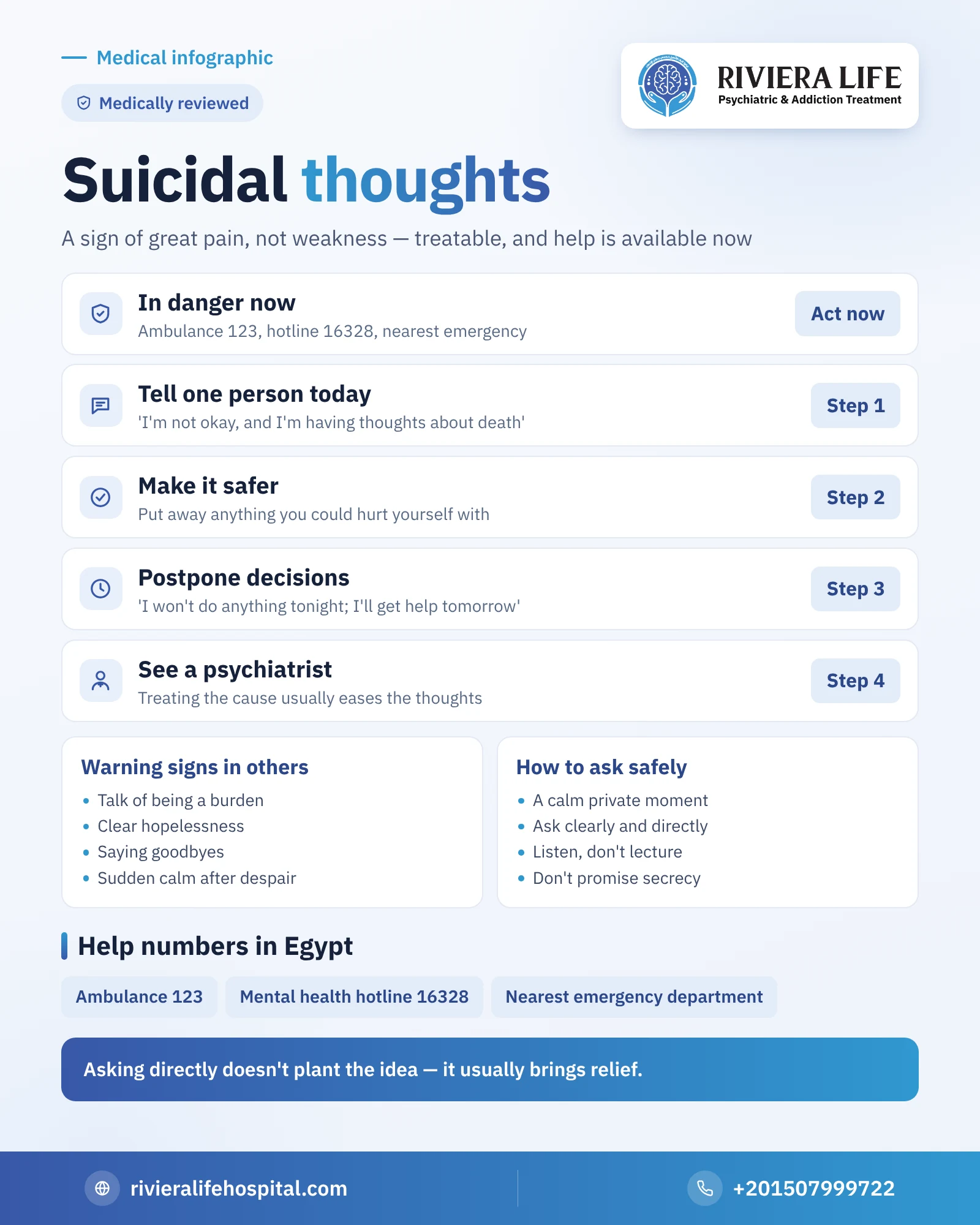
If you are in danger now, get help immediately
You don't have to face this alone. If you are in immediate danger, go to the nearest emergency department now.
- Ambulance: 123
- Mental health hotline: 16328
- The nearest emergency department in any hospital
- Call someone you trust and ask them to stay with you
What do suicidal thoughts mean?
Suicidal thoughts are thoughts about death or about ending life. They take different forms: a passing feeling that “everyone would be better off without me”, a wish not to wake up in the morning, or more urgent and repeated thoughts. All of them deserve to be taken seriously and talked about, even if they seem mild.
Most of the time these thoughts don’t mean that the person really wants to die, but that he wants a pain he sees no way out of to stop. And when this pain finds someone who listens and treatment that eases it, the thoughts usually recede.
Is thinking about suicide a mental illness?
Suicidal thoughts in themselves aren’t a diagnosis, but a symptom; that is, a signal that something hurts badly. They often appear with depression, bipolar disorder, severe anxiety disorders, post-traumatic stress disorder and addiction. They may also appear after a great loss or a sudden crisis in someone who has never had a mental illness before. So the most important question isn’t “is this an illness?”, but “what lies behind these thoughts?”. This is what a psychiatric assessment determines, because treating the cause is what eases them most of the time.
And having these thoughts doesn’t mean weak faith or weak character. It is an experience people from all backgrounds go through, and asking for help because of it is courage, with no shame in it.
Where do these thoughts come from?
These thoughts don’t appear out of nowhere. They are often a symptom of a treatable psychological condition, such as depression, bipolar disorder, post-traumatic stress disorder or addiction. They may appear after a great loss, a financial crisis, a separation, a chronic illness or long isolation.
Importantly, depression itself changes the way of thinking: it makes the future look completely dark, magnifies the feeling of guilt and being a burden, and hides the solutions that exist. That is why we say that what you feel now is the voice of the illness, not the whole truth. And sometimes what the person experiences is a frightening intrusive thought he rejects, as happens in OCD, a subject our article on OCD and suicide explains.
What do you do now if the thoughts are visiting you?
- Tell one person today: a friend, a relative or a doctor. It is enough to say: “I’m not okay, and I’m having thoughts about death”.
- Make your surroundings safer: move away from anything you could hurt yourself with, or ask someone close to keep it away from you.
- Stay away from alcohol and drugs: because they increase impulsivity and deepen sadness.
- Don’t stay alone in difficult moments: go to a place with people, or call someone.
- Postpone any decision: the thoughts intensify then ease. Tell yourself: “I won’t do anything tonight, and I’ll ask for help tomorrow”.
- Ask for an appointment with a psychiatrist: or call the mental health hotline to learn where to start.
A personal safety plan: one sheet that helps you in hard times
Many therapists work with their patients on a written safety plan, and you can start one now and complete it with your doctor:
- The signs that tell you a crisis is approaching, such as insomnia, withdrawal or particular thoughts.
- Things that calm you even a little: a walk, prayer, music or a warm shower.
- People and places you feel safe with.
- Names and numbers of people to call, including 123 and 16328.
- Personal reasons that connect you to life: people you love, or things you still want to see.
Warning signs you notice in someone you love
Many don’t say outright that they are thinking about death, but there are signals worth watching for:
- Talk about death, about being a burden on others or being useless.
- Clear hopelessness, and sentences like “nothing will change”.
- Withdrawal from family, friends and activities.
- A sharp change in sleep or eating, and neglect of appearance.
- Increased drinking or substance use.
- Saying goodbye to people, giving away important belongings, or suddenly putting affairs in order.
- Sudden calm after a period of severe depression without a clear reason.
One sign doesn’t necessarily mean danger, but it is reason enough to ask.
How do you ask your loved one directly and safely?
Many fear that asking will plant the idea in the person’s head. Studies don’t support this; a direct question doesn’t increase the risk, but usually makes the person feel relief that someone has seen his pain.
- Choose a calm time and a private place.
- Start with what you have noticed: “I’ve noticed you’re not sleeping and you’re distant from us these days, and I’m worried about you”.
- Ask clearly: “Are you thinking about ending your life?”. Clarity is better than hinting.
- Listen more than you talk: don’t interrupt, don’t lecture, and don’t say “that’s forbidden” or “others have it worse than you”.
- Thank him for his honesty: and tell him you are with him and that this is treatable.
- Don’t promise secrecy: his safety matters more than the secret, and you may need to involve a doctor or another relative.
What do you do after he tells you?
- If he is in immediate danger, don’t leave him alone, and call an ambulance on 123 or take him to the nearest emergency department.
- Calmly, without confrontation, move away anything he could hurt himself with.
- Help him book an appointment with a psychiatrist, and offer to go with him.
- Follow up with him in the following days with a simple message or call.
- Look after yourself too, and talk to someone you trust, because this is a heavy burden.
You will find more about the family’s role in our article on how the family deals with a psychiatric patient.
What does treatment of suicidal thoughts look like?
Treatment is available and effective, and is built around the person and his circumstances:
- A comprehensive assessment: the psychiatrist talks with you about your feelings and thoughts and what you are going through, without judgment, to understand the level of risk and its cause.
- Treating the cause: such as treating depression, anxiety or addiction, because its improvement usually eases the thoughts. Our article on depression treatment explains the options available.
- Psychotherapy: such as cognitive behavioral therapy and methods that help with tolerating difficult moments and solving problems.
- Medication when needed: determined by the doctor and followed closely, especially in the first weeks.
- A temporary stay: when the risk is high, a stay in a psychiatric hospital provides a safe place under round-the-clock supervision until the condition stabilizes.
- Involving the family: with the patient’s agreement, to be part of the safety plan and follow-up.
After getting through the crisis
The hard days pass, but care doesn’t end with them. The weeks after the crisis, or after leaving hospital, need regular follow-up with the doctor, commitment to treatment, and a calm presence from the family without suffocating monitoring. It helps to review the safety plan from time to time, and to know that the return of some thoughts on a bad day doesn’t mean failure, but a signal to use the plan and contact whoever helps you.
A word for those who feel no one will understand them
Perhaps you have tried to talk before and found no one listening, or were told “strengthen your faith” or “forget it”. This is painful, but it doesn’t mean help doesn’t exist. A psychiatrist hears these thoughts often, and won’t judge you. Recovery doesn’t happen in a day, but it happens.
And if part of your pain is a deep feeling of loneliness, our article on loneliness and social isolation may help you take the first step.
How can Riviera Life help you?
You can call us now on +201507999722 at any hour. Psychiatry consultants receive you in complete confidentiality, assess your condition, and decide with you whether outpatient treatment is enough or you need a short safe stay, involving your family if you wish. The first consultation is free. In case of immediate danger, call an ambulance on 123 or go to the nearest emergency department.
Read also
- Depression symptoms
- OCD and suicide
- Nervous breakdown: what does it mean medically?
- Depression: the complete guide
- Depression in men: the hidden mask of anger, work and substances
Questions many people ask
Not necessarily. These thoughts are a sign of great pain that needs attention, and talking about them and asking for help usually eases them.
No, a direct, calm question doesn't plant the idea; it usually makes the person feel someone cares and opens the door to help.
Call an ambulance on 123 or the mental health hotline on 16328, or go to the nearest emergency department.
For many they recede clearly with treatment of the cause, such as depression, and with psychotherapy, follow-up and a clear safety plan.
His safety matters more than the secret. Tell him gently that you will involve a doctor or a trusted person because you want him to be well.
No. Suicidal thoughts are a symptom of psychological pain or a treatable illness, and don't mean weak faith. Treating psychiatric illness is legitimate and required like any other illness. If you have a religious question, you can contact Egypt's Dar al-Ifta on 107, without letting that delay the psychiatric assessment.