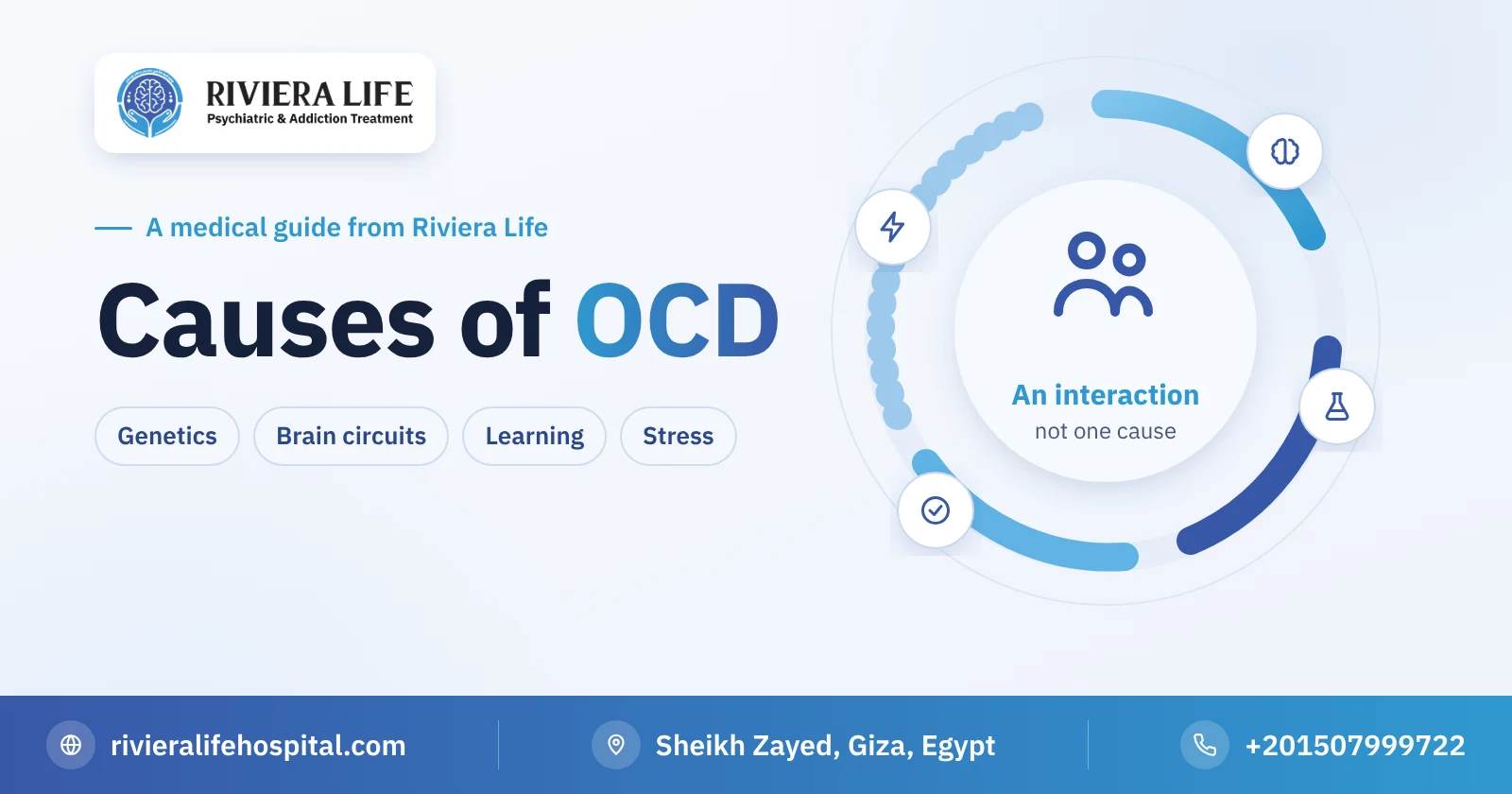
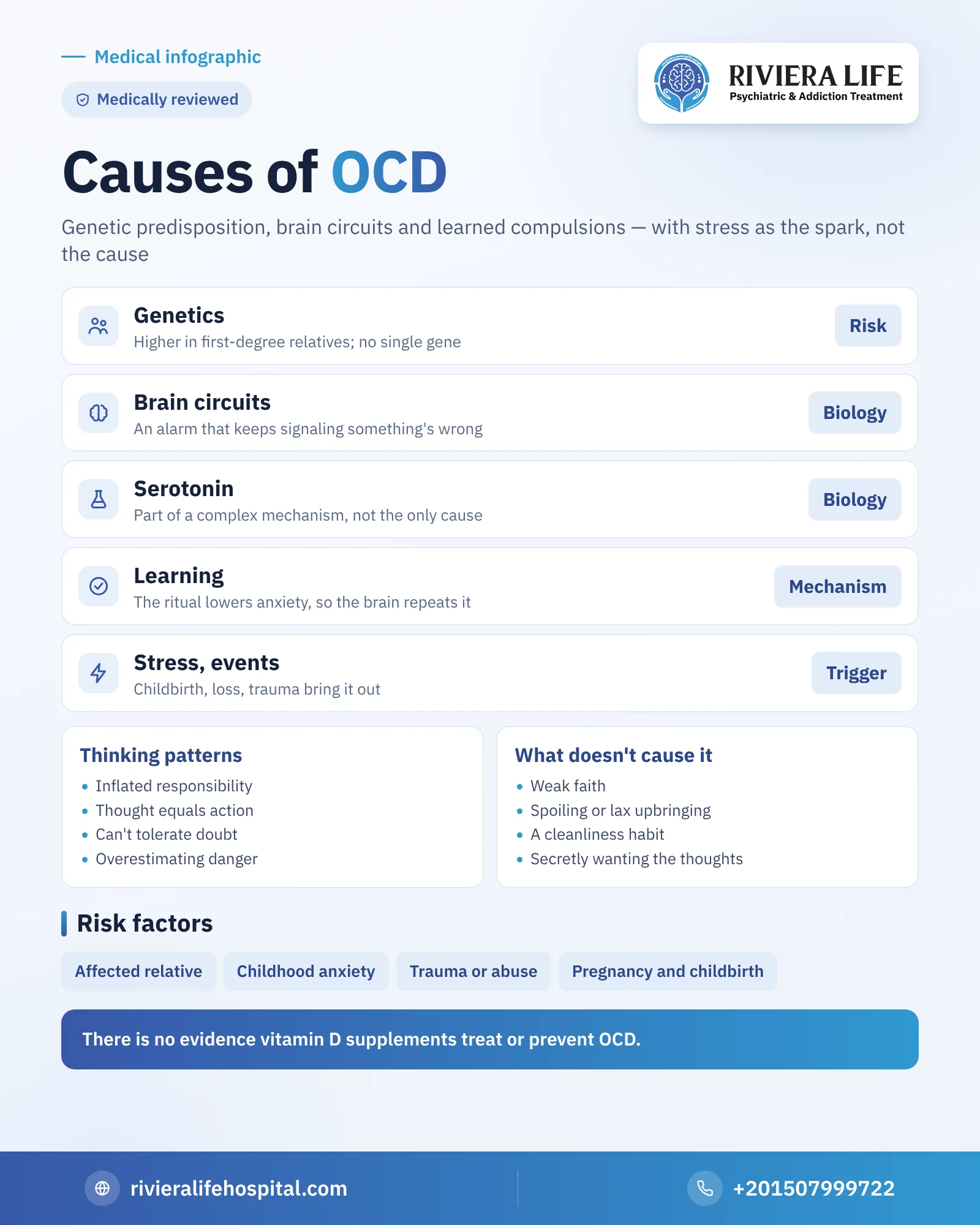
The causes of OCD aren’t limited to a single cause, but are an interaction between several factors: a genetic predisposition that makes some people more vulnerable, a difference in how certain brain circuits work, a way in which the brain learns that the compulsive act “protects”, and then stress or major events that may ignite the disorder in someone with the predisposition. It has nothing to do with weak personality, lack of faith or bad upbringing. This article explains each of these factors in simple language, and sets out the known risk factors and what science says about the possibility of prevention.
Does OCD have a single cause?
Families often ask: “What did we do for our son to get this?”. The scientific answer is that OCD, like most psychiatric disorders, results from a combination of biological, psychological and environmental causes in proportions that differ from person to person. Two people may carry the same genetic predisposition, and one is affected while the other isn’t. And two people may go through the same stress, and OCD continues in one while the other passes through safely. So searching for a “culprit” doesn’t help; what helps is understanding the factors that can be dealt with in treatment.
The genetic factor
OCD tends to recur within families. Someone with an affected first-degree relative, such as a father or brother, has a higher likelihood than others, and this likelihood rises further if the disorder began in the relative in childhood. Twin studies confirm that genes play a real role, but they also confirm they aren’t the whole story. There is no “OCD gene”, but a large group of genes each with a small effect, laying a foundation of susceptibility on which other factors build. Having an affected relative doesn’t mean you will inevitably be affected.
The brain and neural circuits
Brain imaging studies have shown that many people with OCD have different activity in a circuit linking the front of the brain, responsible for judging errors and making decisions, with deeper areas called the basal ganglia, which control habits and automatic actions, and then with the thalamus. It can be likened to an alarm system that sends a “something’s wrong” signal and then doesn’t stop sending it even after the error has been fixed. So the patient washes their hands, but the signal doesn’t switch off, so they go back to wash them again. Interestingly, this activity tends to normalize after successful treatment, whether with medicine or behavioral therapy.
The role of serotonin and neurotransmitters
The idea of serotonin’s role in OCD came from a practical observation: medicines that increase the availability of this substance in the brain ease symptoms in many patients, while other antidepressants that don’t affect it to the same degree don’t help. But scientists today see the picture as wider than a “lack of serotonin”; there is evidence of a role for other neurotransmitters such as glutamate and dopamine. So serotonin is understood as part of a complex mechanism, not a single cause that it is enough to replace.
Infection and immunity in children
In a limited number of children, OCD symptoms appear suddenly and severely within days, sometimes with motor tics, separation anxiety or a decline in handwriting, after an infection with the streptococcal bacteria that cause a sore throat. This is known as PANDAS (PANDAS), and there is a broader concept that includes triggers other than streptococcus. The proposed explanation is that the immune system’s reaction may affect areas of the brain. This field is still under research and debate, but it makes a very sudden onset in a child a reason to tell the pediatrician and the psychiatrist together.
How does the brain learn OCD?
This is the most important idea for understanding why the disorder continues. When the frightening thought intrudes on the mind, the person feels intense anxiety. If they perform the compulsive act, the anxiety drops quickly. This drop works as a reward, so the brain learns a false rule: “If I hadn’t washed, the harm would have happened”. With repetition, the act appears faster and becomes harder to resist.
The same happens with avoidance: someone who avoids touching things never experiences that touching them was safe, so the thought remains untested. This explains why OCD continues for years even after the circumstance it began with has gone, and why behavioral therapy is based on breaking this very cycle, as the article on OCD treatment explains.
Thinking patterns that feed OCD
Everyone has strange thoughts pass through their mind sometimes. The difference in someone with OCD is the meaning they give them. Specialists describe several patterns that turn a passing thought into an obsession:
- Inflated responsibility: the feeling that any harm that might happen will be their fault alone if they don’t prevent it.
- Thought-action fusion: the belief that merely thinking about something bad makes it more likely, or is morally equal to doing it.
- Intolerance of uncertainty: the need for complete, one hundred per cent certainty before feeling reassured.
- Overestimating danger: seeing a tiny likelihood as if it were close and certain.
- Perfectionism: the feeling that any work that isn’t completely perfect is a failure.
These patterns aren’t flaws in personality, but thinking habits that can be modified in cognitive therapy.
Stress and major events: the spark, not the cause
Many patients remember that symptoms began or intensified after a particular event: the death of a relative, marriage, moving to a new job, a serious illness, or psychological trauma. Pregnancy and the period after childbirth are known times for OCD to appear for the first time or worsen, as are periods of epidemics that magnify fears of infection. These events don’t create OCD from nothing, but they raise the level of anxiety and reduce the person’s ability to ignore thoughts, so the latent predisposition appears. This may overlap with post-traumatic stress disorder when the event is traumatic.
The known risk factors
These factors don’t mean being affected is inevitable, but they raise the likelihood:
- A first-degree relative with OCD or motor tics.
- Traits in childhood such as strongly inhibited behavior or excessive anxiety.
- Exposure to severe stress, trauma or abuse in childhood.
- Other disorders such as anxiety, depression or a tic disorder.
- The period around pregnancy and childbirth in women.
- An early onset of symptoms, which is usually linked to a stronger family history.
OCD in turn raises the likelihood of other disorders, the best known being depression, as the article on OCD and depression explains.
What doesn’t cause OCD?
Some widespread beliefs hurt patients more than the symptoms themselves. OCD isn’t the result of weak faith; religious OCD affects religious people specifically because worship matters to them, and religious treatment alone isn’t enough for it. Nor is it the result of “spoiling” or lax upbringing, or of getting used to cleanliness. And it doesn’t mean the person secretly wants the terrifying thoughts that come to them. Understanding this eases the feeling of guilt in the patient and their family, and makes asking for treatment easier.
Can OCD be prevented?
There is no certain way to prevent OCD, because part of its causes are genetic and biological. But early detection changes its course a lot. A child or young person treated at the start of symptoms usually needs less time, and avoids years of disruption. It also helps for the family not to take part in rituals from the beginning, and to teach children that doubt and uncertainty are a normal part of life. To learn the signs that deserve attention, see the article on OCD symptoms.
Vitamin D and OCD: what does research say?
Some observational studies found lower levels of vitamin D in groups of people with OCD. But this type of research records an association and doesn’t prove a cause; low vitamin levels may result from little sun exposure, isolation, poor nutrition or accompanying depression, rather than being a cause of OCD.
The current conclusion is that there isn’t enough evidence that vitamin D deficiency causes OCD, or that taking its supplements treats or prevents it, and medical guidelines don’t recommend it as a treatment for OCD.
What does this mean for you in practice?
- If you get little sun or show signs of deficiency such as fatigue and bone pain, ask your doctor to check the level and correct the deficiency if present, because that benefits your general health.
- Don’t take high doses of supplements on your own, as excess may cause harm.
- Don’t stop psychological or medication treatment in reliance on a dietary supplement.
The proven treatment for OCD is exposure and response prevention and medicines prescribed by the doctor, as in the article on OCD treatment. And if you aren’t sure that what you are going through is OCD in the first place, start with OCD symptoms.
More from the OCD guide
- OCD: the complete guide
- The thought, behavioral and physical symptoms of OCD
- OCD treatment: the main options
- OCD and pathological doubt
- Hoarding disorder: why someone can’t throw things away and how it is treated
- OCD in children: signs by age and the family’s role
Questions many people ask
Genetics plays a clear role, as the likelihood is higher in first-degree relatives of patients. But it isn't direct inheritance, as many who have an affected relative never develop it.
Stress doesn't create the disorder alone, but it is often the spark that brings it out or increases it in someone predisposed. That is why symptoms usually intensify during exams, marriage and childbirth.
Serotonin is part of the picture, as shown by many patients' response to medicines that affect it, but scientists see other neurotransmitters and whole brain circuits taking part in the disorder.
Yes, pregnancy and the period after childbirth are known times for it to appear or worsen, and it usually revolves around fear for the baby. Treatment is available and chosen to suit pregnancy or breastfeeding.
No. Religious OCD is a form of OCD concerning a subject that matters greatly to the person, its causes are the same as the disorder's, and it needs psychological and medication treatment.