Hoarding disorder is a psychiatric disorder in which the person finds it extremely difficult to get rid of things whatever their value, feeling an urgent need to keep them and real distress at the thought of throwing them away, until the rooms fill up and moving inside the home becomes difficult. It differs from an organized person who likes collecting, from ordinary mess, and from neglect. It isn’t laziness or dirtiness, but a known disorder that falls within the obsessive-compulsive spectrum, and it has a dedicated behavioral treatment. In this article: its signs, its causes, how it differs from OCD, and how the family can deal with it without making things worse.
What is hoarding disorder?
The diagnosis rests on three elements together: persistent difficulty getting rid of possessions regardless of their actual value; a feeling of needing to keep them and distress at the thought of throwing them away; and a build-up that fills living spaces until they lose their function, so the kitchen isn’t used for cooking or the bed for sleeping. What marks the disorder is that it causes distress, disrupts life, or exposes the person or those around them to danger.
It usually begins in adolescence or early adulthood, then increases with age until it draws attention in the forties or later. Studies indicate it affects a small proportion of adults, and appears in both men and women.
The signs those around the patient notice
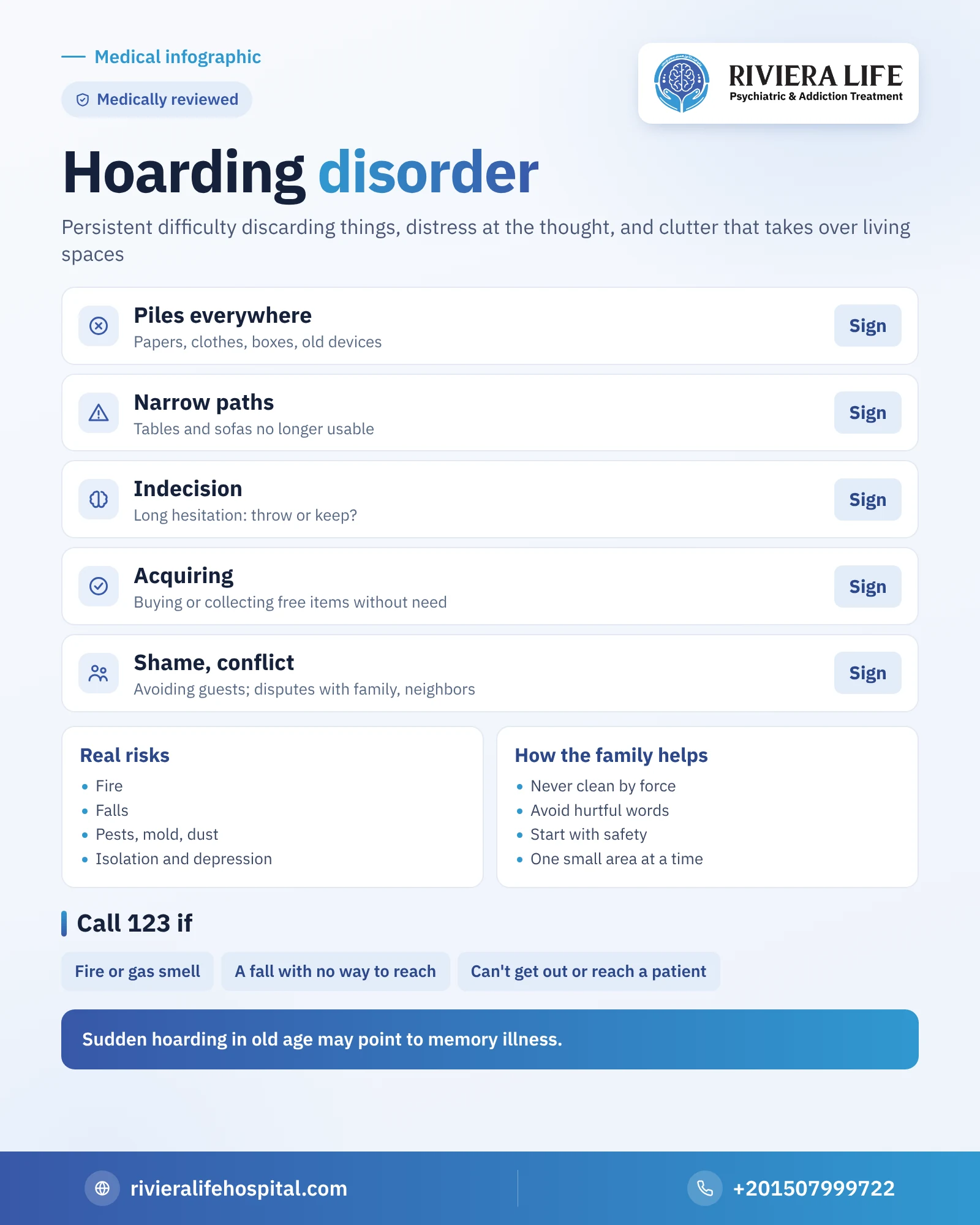
- Piles of newspapers, clothes, containers, old devices and boxes in every room.
- Narrow passages between the piles, and surfaces such as tables and sofas, none of which are used.
- Strong refusal of any attempt to get rid of something, even if it is broken, with arguments such as “I might need it one day”.
- Long hesitation in front of every small decision: throw it or keep it?
- Buying or collecting free things without need, then being unable to organize them.
- Embarrassment about guests coming in, and postponing necessary repairs or visits for fear of the state of things being discovered.
- Disputes with family or neighbors about space, cleanliness and smells.
Hoarding isn’t the same as collecting
Hobbyists collect stamps and books with order, classification and display, and enjoy what they collect. A person with hoarding disorder, however, has things piling up without order, feels weighed down, confused and guilty, and can’t make use of what they have collected.
Why does the person cling to things?
No one has a single explanation, but the picture is made up of several threads:
- Beliefs about things: the person sees emotional value or possible future usefulness in an item, or feels that throwing it away is a loss or a betrayal of a memory.
- Difficulty making decisions and organizing: studies point to difficulties with attention, planning and categorizing things, which explains the long hesitation.
- Genetics: it recurs in some families, and many say that one of their parents used to collect things.
- Difficult events: experiences of loss, trauma or deprivation may precede the onset or increase the severity.
- Accompanying disorders: depression, anxiety and ADHD are common with it.
Hoarding and OCD: what is the difference?
Hoarding was once considered a form of OCD, but today it is an independent diagnosis. In OCD, disturbing thoughts come that push towards rituals, so the patient sometimes throws things away to escape contamination. In hoarding, the wish to keep comes from love of the item and its value, and isn’t felt as an intrusive thought. OCD may accompany hoarding in some cases, so the picture seems mixed, which is why the doctor tells them apart through assessment. You will find more in types of OCD, and can also tell it apart from perfectionism in obsessive-compulsive personality.
| Aspect | Hoarding disorder | OCD |
|---|---|---|
| Source of the drive | The item’s value and the need to keep it | A frightening intrusive thought that pushes towards a ritual |
| Feeling with the act | Relief when keeping and distress when throwing away | Temporary relief followed by the thought returning |
| Perspective | Usually sees it as logical and isn’t bothered by it | Sees it as exaggerated and is tormented by it |
| Visible effect | A home full of things | Repeated washing, checking or arranging |
How is it diagnosed?
The psychiatrist carries out a detailed interview about the history of the build-up and how it affects daily life, and asks how far the person recognizes their problem, as some see the problem as limited and some acknowledge it. They may use photos of the place or a home visit, and rule out other causes of build-up such as dementia, brain injuries, psychotic disorders and severe depression that stops the person from cleaning. So diagnosis needs a specialist examination, and the family’s description alone isn’t enough.
Risks that go beyond mess
- Fire: papers and piles near sources of heat and electricity increase the risk, and obstruct firefighters’ access.
- Falls: narrow passages and cluttered floors are a particular danger for older people.
- Health and hygiene: dust, insects, rodents and mold, and difficulty for paramedics to get in.
- Social life: isolation and disputes with neighbors and the landlord, and shame that prevents asking for help.
- Psychological state: constant distress, depression and a feeling of failure.
Call an ambulance on 123 if
Clutter may turn into a direct danger to the owner of the place and to those who live with them.
- A fire breaks out, or there is a smell of gas or burning inside a hoarded place
- Someone has fallen and can’t get up, or no one can reach them
- It is impossible to get out of the house or to reach a patient to give first aid
Animal hoarding: a special form
Some people with the disorder collect more animals than they can care for, and don’t realize the deterioration in the animals’ health and their own. It needs a double intervention: veterinary care for the animals, and a psychological assessment of the person themselves, because removing the animals alone often repeats.
Treatment: small steps and long patience
The best-studied treatment is cognitive behavioral therapy designed for hoarding, in which the person learns with the therapist over months:
- To understand and review the beliefs that push them to keep things.
- Training in sorting and making decisions with simple rules, step by step.
- Gradual exposure to getting rid of things while tolerating the distress until it eases.
- Limiting the acquisition of new things, and setting a plan to clear the place, sometimes with home visits.
You can read more about cognitive behavioral therapy. As for medicines, the doctor may sometimes prescribe antidepressants from specific classes, especially when there is accompanying depression or anxiety, and their benefit alone in hoarding is limited. Read about antidepressants to understand how they work, and no medicine is started or stopped except under the doctor’s supervision.
How can the family help without spoiling things?
- Don’t clean the home secretly or by force, as this destroys trust, usually leads to the clutter returning faster, and increases tension.
- Avoid hurtful words such as “rubbish” and “filth”, as they see things through different eyes.
- Start with the goal of safety, not tidiness: a clear passage, a fire exit and a place to sleep.
- Agree with them on one small area according to a short schedule, and celebrate the achievement.
- Encourage them to visit a psychiatrist, and go with them if they agree.
When should you ask for specialist help?
Ask for an assessment if moving around the home has become difficult, if fire and fall risks have appeared, if relationships and work have been affected, or if severe sadness accompanies it. The person who needs help may be one of your elderly parents, and sudden clutter at an advanced age may be linked to memory illnesses, so a comprehensive medical assessment is needed, not just a psychological one.
How can Riviera Life help you?
The consultant psychiatrists at Riviera Life assess the hoarding and what accompanies it, and set a treatment plan that respects the patient’s pace and involves the family, in complete confidentiality. The first consultation is free, and you can call +201507999722.
More from the OCD guide
- OCD: a comprehensive guide
- Types of OCD and how each looks
- OCD treatment: the main options
- Kleptomania: how it differs from ordinary theft, and treatment
Questions many people ask
A collector organizes their possessions and enjoys displaying them, and it doesn't disrupt their life. Hoarding disorder is a disorganized build-up that fills living spaces and causes distress or danger.
It used to be considered a form of it, but today it is an independent diagnosis in the diagnostic manual. They may come together in one person, and the doctor tells them apart through assessment.
No. Forced cleaning destroys trust and the clutter usually returns faster. It is better to agree with them on small steps, start with safety first, and involve a therapist.
There is no medicine approved specifically for it. The doctor may prescribe some antidepressants when there is accompanying depression or anxiety, but their benefit alone is limited. Behavioral therapy is the foundation.
When movement inside the home is difficult, exits are blocked, there is a fire or fall risk, hygiene deteriorates, or an older person lives in the place. Then a psychological assessment and practical help are needed.