OCD in children is a real disorder affecting roughly one to three children in every hundred, and it may begin at six or seven, and sometimes earlier. It appears as frightening thoughts that intrude into the child’s head and rituals they repeat to calm down: washing, counting, arranging, or endless questions asking for reassurance.
Many parents think it is stubbornness, being spoiled or “a phase”, and the child themselves hides it out of embarrassment. The good news is that cognitive behavioral therapy designed for children works for most of them, and that the family’s participation is part of the treatment, not a side detail. The diagnosis is made by a child psychiatrist or specialist after an assessment.
What does OCD look like at a child’s age?
A young child doesn’t say “I have obsessive thoughts”. They say their hand is “dirty” even though it is clean, or refuse to put on a sock because “the seam isn’t right”, or wait every night for their mother to repeat the same sentence before sleep in the same order, and if she gets one word wrong she starts again. At younger ages the rituals may be clear while the idea behind them is absent; the child knows they “have to” do it without being able to explain why, and this is normal at this age.
A teenager’s words, on the other hand, come closer to an adult’s: fear of infection, disturbing religious thoughts, thoughts of harming someone they love, or constant doubt that they have made a mistake. These types are detailed in our article on types of OCD.
Signs parents and teachers notice
A single behavior isn’t enough to judge, but several signs together for weeks deserve attention:
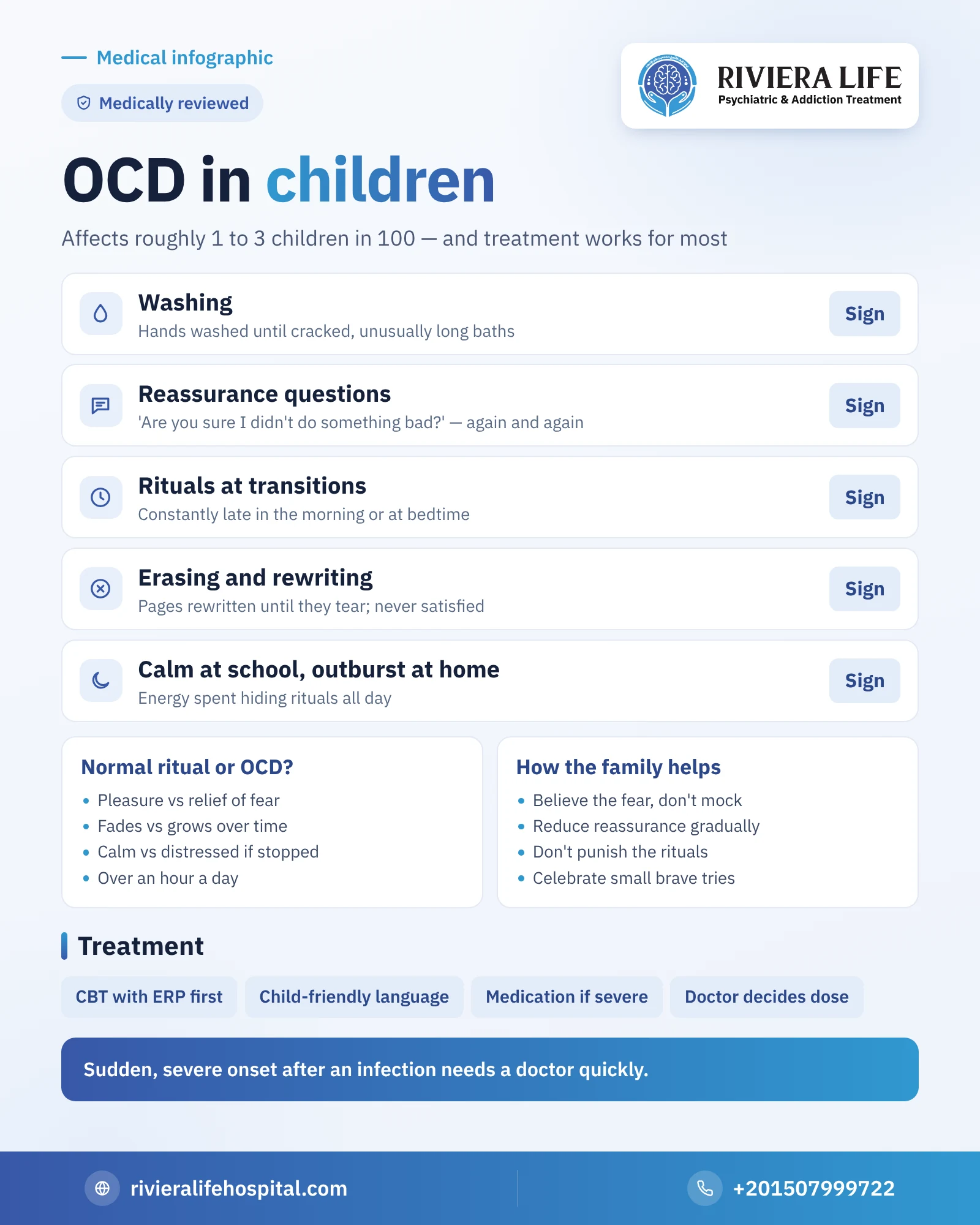
- Repeated hand-washing until the hands crack or redden, or unusually long baths.
- Repeated questions in the same form: “Are you sure I didn’t do something bad?”.
- Constant lateness in the morning or before bed because of rituals that can’t be interrupted.
- Papers erased and rewritten until they tear, and notebooks in which the child is satisfied with no page.
- Fear of touching particular things, or avoiding places at school and home for no understandable reason.
- Suspicious calm at school, then an outburst of anger at home after returning, because the child spends their energy hiding the rituals all day.
- A decline in concentration and grades because the mind is busy with what must be done.
What is the difference between normal rituals and OCD?
Children love routine, and they may go through phases of clinging to a particular cup or one story every night. This is normal development; the child enjoys it and gives it up as they grow. In OCD, though, the ritual relieves fear rather than giving pleasure, it expands instead of settling, it comes with clear distress if prevented, and it takes more than an hour a day or disrupts school, sleep and play. This is the practical measure: does the ritual narrow the child’s life or enrich it?
Why do some children get it?
There is no single cause. Genetics plays a clear role, as the chance of developing it is higher when there is a relative in the family with OCD or anxiety. Differences in the brain circuits responsible for the “danger” signal and habits are involved, and a period of stress, illness or loss may precede the symptoms. The cause isn’t harsh upbringing or excessive spoiling, and it doesn’t happen because the mother “washed too much”. You will find the general picture of the causes in adults in our article on the causes of OCD.
Doctors describe a rare condition in which OCD begins suddenly and severely after an infection, such as strep throat, with sharp changes in behavior, sleep and eating. The evidence for it is still debated, but a sudden, violent onset is reason enough to have the child seen by a doctor quickly.
What accompanies OCD in young children?
OCD rarely comes alone. It may be accompanied by generalized anxiety or separation anxiety, by ADHD, and motor or vocal tics may appear with it, the picture discussed in our article on Tourette syndrome and tic disorders. Over time the child may slide into sadness and withdrawal, so the doctor checks all these conditions so that one isn’t treated while the other is left. And in some children with autism, repetitive behaviors overlap with OCD, so a specialist assessment is needed to tell them apart.
Treatment: what has proven benefit?
The first treatment for children in mild and moderate cases is cognitive behavioral therapy using exposure and response prevention. The child learns to approach what frightens them gradually without performing the ritual, and discovers for themselves that the anxiety rises and then falls on its own. The exercises are presented in children’s language: the OCD is called “the bully” or “the ghost”, and the child and the treatment team face it together. This is an approach the therapist is trained in, and it isn’t advisable to try it at home without supervision.
In severe cases, or when psychotherapy alone isn’t enough, the doctor may add a medicine from the selective serotonin reuptake inhibitor group, a decision, dose and duration the doctor sets and follows, especially in the first weeks to watch for changes in mood and sleep. Parents shouldn’t start or stop the medicine on their own. The treatment options for adults are detailed in our article on OCD treatment.
The family’s role: how do you help without feeding the OCD?
What happens most in homes is what specialists call “family accommodation”: the father repeats the reassuring sentence for the twentieth time, the mother washes things instead of the child, and the whole routine is changed to satisfy the ritual. The parents’ intention is to end the child’s distress, but the result is that the OCD grows stronger because the child never experiences the anxiety passing without a ritual. Some steps that help:
- Believe their fear and don’t mock it, and tell them what they feel is real and that the OCD is the problem, not them.
- Reduce repeated reassurance gradually with a plan agreed with the therapist, as stopping suddenly may unsettle the child.
- Don’t punish them for the rituals, and don’t argue with them when they are late because of them.
- Celebrate small brave attempts, not only complete results.
- Protect sleep, eating and play, as an exhausted child is less able to resist.
School and peers
A child benefits greatly when the teacher or school counselor knows about the diagnosis, with the family’s consent. The child may need extra time in exams, prior permission to go to the toilet, or understanding that rewriting isn’t stubbornness. They also need protection from mockery, because a child who is laughed at hides more and their symptoms increase. If they are bullied, tell the school immediately and don’t ask them to put up with it.
When should you seek help?
Have the child seen by a specialist if the rituals continue for weeks, take up a large part of their day, affect sleep, study and relationships, or if severe sadness or withdrawal appears. In adolescence, pay attention to any talk of hopelessness or self-harm, and don’t treat it as exaggeration. And make sure the assessment covers anxiety, depression and substance use in teenagers, as some teenagers turn to substances to calm their thoughts, and matters can become complicated then.
Seek urgent help immediately if you see
Call an ambulance on 123 or go to the nearest emergency department, and you can contact the mental health hotline on 16328 in case of:
- Thoughts of self-harm or of ending their life
- Refusing to eat or drink, or avoiding the toilet because of rituals
- A sudden, sharp change in behavior after an illness or infection
- Self-injury during rituals, such as severe skin wounds
How can Riviera Life help you?
Riviera Life Hospital in Sheikh Zayed, Giza, is licensed by the Ministry of Health, has fourteen years of experience, consultants in psychiatry and addiction, and complete confidentiality. If you are worried about your child or teenager, you can start with a free first consultation on +201507999722, so we can assess the case and guide you to the path suited to their age.
More from our OCD guide
- OCD: the complete guide
- OCD symptoms: mental and behavioral signs
- Mental illness in children: signs by age
- The psychological, physical and social harms of OCD
- Nail biting: its causes, harms and how to stop in children and adults
Questions many people ask
Yes, it may begin at six or seven and sometimes earlier. In young children it usually appears as clear rituals without an understandable explanation from the child.
Look at distress and time: if the ritual relieves fear rather than giving pleasure, takes more than an hour a day, or disrupts sleep and school, have it seen by a specialist.
Repeated reassurance calms them for moments and then strengthens the OCD. The therapist works out a plan with the parents to reduce it gradually instead of stopping it suddenly.
No. Cognitive behavioral therapy is the first choice in mild and moderate cases, and the doctor adds medication when the condition is severe or the response is poor.
In some children it eases a lot, and in others it continues. Early treatment improves the outcome and protects against school and social problems building up.