The short answer
The treatment of personality disorders relies mainly on long-term psychotherapy, because the problem lies in fixed patterns of thinking, feeling and relating, not in a passing episode. The strongest evidence is available for borderline personality disorder, where methods such as dialectical behavior therapy and mentalization-based therapy have proven effective. There is no approved medicine that treats the personality disorder itself, but medicines may help with accompanying symptoms such as depression, anxiety or impulsivity. Improvement is possible and realistic, especially when the goals are clear and the patient takes part in the plan.
- The foundationRegular psychotherapy for months or more
- MedicineFor accompanying symptoms, not the disorder itself
- HospitalFor crises only, not as the main treatment
A person with a personality disorder often reaches the doctor because of something else: depression, substance use, a crisis in marriage or work, or an attempt at self-harm. And when the diagnosis is mentioned, they or their family may hear it as a final verdict. The medical truth is different: personality disorders are treatable, and improvement in many of them is better than was believed decades ago. This guide explains how this type of disorder is treated, and what can be expected.
Why does the treatment of personality disorders differ from others?
Depression or anxiety usually come in the form of episodes with a beginning and an end, while a personality disorder is a continuous pattern that usually starts in adolescence or early adulthood, and appears in many situations: the way the person sees themselves and others, their dealing with their feelings, their impulsivity, and their relationships. That is why treatment needs longer, and focuses on skills and relationships more than easing a single symptom.
Among the biggest challenges of treatment is that some of those affected don’t see the pattern as a problem, but see the problem in others, or enter treatment in a crisis then leave it when things calm down. That is why the therapist cares at the start about building a stable therapeutic relationship and a clear agreement on the goals.
Assessment before treatment
Diagnosis takes time, because it relies on an extended pattern, not a single interview, and the doctor may use information from the family and structured measures. The assessment also looks for what accompanies the disorder, such as depression, bipolar disorder, post-traumatic stress disorder and substance use, because these conditions change the order of the plan. Sometimes it is a priority to treat addiction or acute depression before working on personality patterns.
Psychotherapy methods
Dialectical behavior therapy
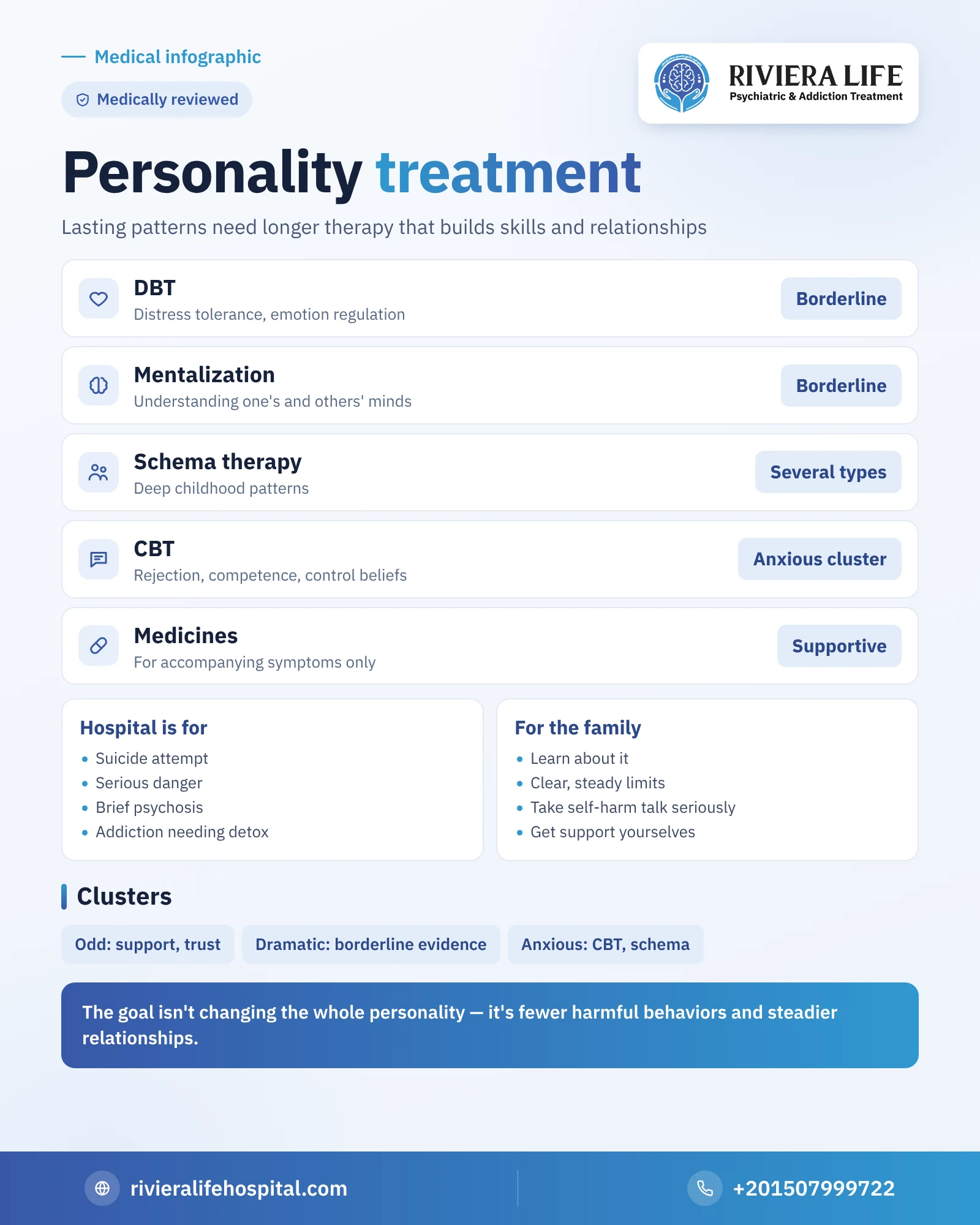
It was originally designed for borderline personality disorder, and teaches skills in four areas: tolerating distress without harmful behavior, regulating emotions, dealing effectively with others, and mindfulness. It usually combines individual sessions and skills training groups, and in studies it has reduced self-harm and repeated hospital admissions.
Mentalization-based therapy
It helps the patient understand their own mental state and the states of others, meaning pausing before jumping to conclusions about people’s intentions, which is often disturbed under emotional pressure. It also has good evidence in borderline personality.
Schema therapy
It works on deep patterns formed in childhood, such as the feeling of abandonment or unworthiness, and how they repeat in present relationships. It is used in borderline personality and other personality disorders, including avoidant and dependent.
Cognitive behavioral therapy
It is especially useful in the anxious cluster of disorders, such as avoidant, dependent and obsessive-compulsive personality, where it works on beliefs about rejection, competence and control, together with gradual exposure to situations the patient avoids.
Treatment according to the clusters of personality disorders
- The odd cluster, such as schizoid and schizotypal personality: treatment focuses on support, building trust and social skills, with follow-up of any psychotic symptoms.
- The dramatic cluster, such as borderline, narcissistic, histrionic and antisocial: the strongest evidence is in borderline, while for narcissistic and antisocial treatment is harder and needs specific, realistic goals. You will find the details in borderline personality treatment and narcissistic personality treatment.
- The anxious cluster, such as avoidant, dependent and obsessive-compulsive: usually responds well to cognitive behavioral therapy and schema therapy.
The role of medicines
There is no approved medicine to treat the personality disorder itself. But the doctor may prescribe medicines for specific symptoms that hinder treatment or increase risk, such as severe depression, anxiety, impulsivity and anger, or quasi-psychotic thoughts under pressure. These medicines are reviewed periodically, piling up many medicines is avoided, and doctors warn against dependence-causing sedatives in those with impulsivity or a history of substance use.
When does the patient need the hospital?
Residence in hospital isn’t a main treatment for personality disorders, and may have the opposite result if it goes on without a goal. Its place is in crises: a suicide attempt, a serious danger to self or others, a temporary psychotic state, or the disorder combined with an addiction needing detox. The goal then is to get through the crisis safely and then return to outpatient or day treatment with a clear plan.
How long does treatment take? And what are the realistic goals?
Structured programs usually extend for months, and may reach a year or more. The goal isn’t to change the personality completely, but to reduce harmful behaviors, improve control of emotions, and make relationships and work more stable. Many borderline personality patients improve with time and treatment to the point that the diagnostic criteria no longer apply to them after years.
The family’s role
- Learn about the disorder, as understanding reduces clashes.
- Set clear, steady limits without threats or humiliation.
- Don’t treat every crisis as manipulation, and don’t ignore any talk of self-harm.
- Take part in family sessions if the treating team offers them.
- Ask for support for yourselves, as living with an untreated personality disorder is exhausting.
How does Riviera Life help you?
At Riviera Life, treatment of personality disorders starts with a careful assessment that determines the pattern and what accompanies it of depression, substance use or crises, then a plan of individual and group psychotherapy is built, with medicines for accompanying symptoms when needed, and family sessions. Residence is used for crises or when the disorder is combined with addiction, then treatment continues as day treatment or in the clinic. You can start by reading the personality disorders guide.
More from the personality disorders guide
- Personality disorders: the complete guide
- Borderline personality treatment
- Narcissistic personality treatment
- Personality disorders and depression
Questions many people ask
Yes, and many of those affected improve with regular psychotherapy, with the strongest evidence available for borderline personality disorder.
There is no approved medicine that treats the disorder itself, but medicines may help with accompanying symptoms such as depression, anxiety and impulsivity.
Structured programs usually extend for months and may reach a year or more, and the goal is to improve feelings, behavior and relationships.