Antisocial personality, medically called antisocial personality disorder, is a long-standing pattern since childhood of disregard for the rights of others: repeated lying, breaking rules and laws, impulsivity, aggression, and a clear absence of remorse after hurting people. The name doesn’t mean the person dislikes mixing with people, as many think, but that they treat society and its rules as if they don’t concern them. This article explains the difference between it and psychopathy, its signs, its roots in conduct disorder in children, its strong link to addiction, how to protect yourself, and what treatment can and can’t do. Only a psychiatrist can make the diagnosis after a careful assessment.
What is antisocial personality?
Antisocial Personality Disorder is one of the dramatic-emotional cluster types in the fifth American diagnostic manual. Its core is that the person sees others as means to achieve what they want, so they lie, exploit and harm without feeling the weight of it. It isn’t diagnosed before the age of eighteen, and doctors require that signs of conduct disorder appeared before the age of fifteen.
Studies estimate its prevalence at roughly less than one to three percent of the general population; it is clearly more common in men, and its rate rises a lot among prison inmates and in addiction treatment centers. To see its place among the ten types, see the personality disorders guide.
Psychopathy and antisocial personality: what is the difference?
The two words are used as if they were one thing, but in truth they overlap rather than match:
- Antisocial personality: an official diagnosis based mainly on visible behavior: breaking laws, lying, aggression and irresponsibility.
- Psychopathy: isn’t a standalone diagnosis in the American manual, but a concept measured with specialized research tools, focusing on the emotional structure: superficial charm, emotional coldness, absence of empathy and guilt, and calculated manipulation.
- The relationship between them: most people who fit the traits of psychopathy meet the criteria for antisocial personality, but only a minority of those with this diagnosis reach the level of psychopathy.
As for “sociopath”, it is a common media word with no agreed medical definition, and some use it to describe someone whose antisocial behavior was formed under the pressure of a harsh environment more than innate coldness.
Signs of antisocial personality
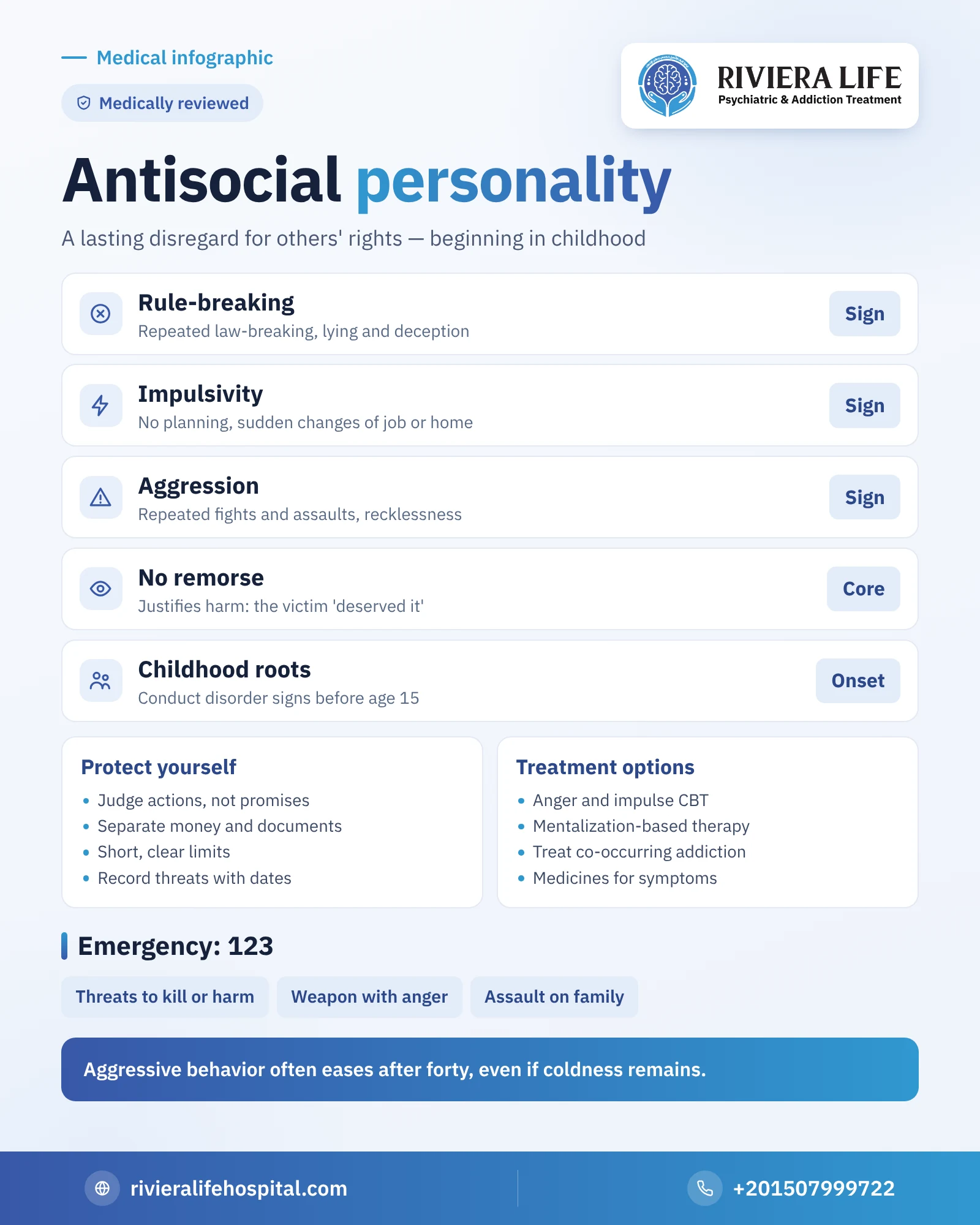
The specialist looks for a stable pattern that shows in at least three of the following signs:
- Repeatedly breaking the law in ways that lead to accountability.
- Repeated lying, impersonation, and deceiving others for profit or pleasure.
- Impulsivity and inability to plan, such as suddenly leaving a job or home.
- Irritability and aggression with repeated fights and assaults.
- Recklessness that disregards their own or others’ safety, such as reckless driving under the influence.
- Chronic irresponsibility at work or in paying debts and maintenance.
- Absence of remorse, or justifying harm by saying the victim “deserved it” or “was naive”.
One sign or a passing situation isn’t enough; a teenager who lied or fought isn’t affected. What is worrying is the pattern repeating for years and in different situations.
The beginning in childhood: conduct disorder
This disorder doesn’t appear suddenly in adulthood. Before it there is usually a history of conduct disorder: a child or teenager who harms animals or younger children, steals, breaks property, runs away from home or school, and bullies others. Not every child with conduct disorder will become antisocial; many improve, especially with early intervention.
Here lies the family’s real opportunity. Parent training programs, family therapy and cooperation with the school achieve much better results in childhood than can be achieved in adulthood. If you notice repeated cruelty without remorse in your child, don’t wait for them to “grow up and come to their senses”.
Why are some people affected?
Genetic factors that appear in twin and adoption studies overlap with environmental factors, most notably neglect and abuse in childhood, violence at home, parenting that swings between harshness and permissiveness, and mixing with deviant peers. Research points to differences in the nervous system’s response to fear and punishment in some of those affected, which may explain why they are less affected by consequences. None of this lifts the person’s responsibility for their actions.
Antisocial personality and addiction: a strong link
This is one of the clearest links in psychiatry. A large proportion of those affected use alcohol or drugs, and many start very early. Impulsivity, sensation-seeking and disregard for consequences all make trying and continuing easier, and stimulants such as cocaine and methamphetamine increase aggression and recklessness. Addiction in turn pushes towards more lying, stealing and violence to secure the drug.
Most important in practice is that addiction treatment in this group needs a strict structure, clear rules and close follow-up, because manipulating the treatment program is possible. That is why one plan that treats addiction and personality together helps, as in the dual diagnosis program.
The risk to others: what you should know
Not everyone affected is violent, but the risk of violence, fraud and exploitation is above average, and much higher with substance use. Those who pay the price most are the closest: a partner subjected to insults and threats, a father and mother drained financially, or children living in an unsafe home. And the charm some show at first is part of the picture, not evidence of innocent intentions.
How do you protect yourself and your family?
- Judge actions, not promises and repeated apologies.
- Separate your money and documents, and don’t sign guarantees or loans in their name.
- Set short, clear limits, and avoid confrontation in moments of anger or after substance use.
- Record threats and assaults with their dates, as you may need them later.
- Prepare a safety plan: a place to go, a person you trust, and the ambulance number.
- Seek psychological support for yourself; living with this pattern leaves real effects.
And if the relative uses substances and refuses treatment, the article on how to deal with a cocaine addict may also help you.
Treating antisocial personality: limits and options
Frankness is necessary here: this is one of the hardest personality disorders to treat, and the person rarely seeks help on their own. They usually come under pressure from the family, work or the courts, or because of addiction or depression. Even so, treatment isn’t useless:
- Cognitive behavioral therapy: structured programs that focus on controlling anger and impulsivity, problem-solving, and thinking about consequences before acting.
- Mentalization-based therapy: trains understanding of what goes on in other people’s minds, and there are indications of its benefit in reducing aggression.
- Treating co-occurring addiction: one of the most effective steps, because stopping use clearly lowers violence and recklessness.
- Medicine: there is no medicine that treats the disorder itself, but the doctor may prescribe medicines for severe aggression, depression, or attention-deficit/hyperactivity disorder if present.
Doctors note that some aggressive and criminal behaviors ease in many people after forty, even if the emotional coldness remains.
When does the situation become an emergency?
Seek urgent help immediately if you see
Call an ambulance on 123 or go to the nearest emergency department, and get away from the place of danger first.
- An explicit threat to kill or to harm the partner or children
- Carrying a weapon or sharp tool with anger or after substance use
- A physical assault on a family member
- Heavy substance use with severe agitation, chest pain or seizures
- Talk about self-harm or ending life
You can also seek guidance from the hotline of the General Secretariat of Mental Health and Addiction Treatment on 16328.
How does Riviera Life help you?
At Riviera Life in Sheikh Zayed, the consultants in psychiatry and addiction treatment start with an assessment that separates the effect of the drug from the personality pattern, then set a plan with a clear structure and round-the-clock medical supervision when admission is needed, with a family program that helps them protect themselves and set limits. The first consultation is free and completely confidential on +201507999722.
More from the personality disorders guide
- Types of personality disorders: the complete guide
- Narcissistic personality: signs and treatment
- Borderline personality: the complete guide
- Histrionic personality: signs and treatment
- Sadistic personality: signs, trait vs disorder, and treatment
- The manipulative personality: its tactics, signs of manipulation and how to protect yourself
- Intermittent explosive disorder: when anger gets out of control
- The toxic personality: signs of toxic behavior and how to protect yourself
Questions many people ask
Psychopathy isn't a standalone diagnosis in the American manual, but most people with its traits meet the criteria for antisocial personality disorder. They are aware of what they do and remain responsible for their actions.
They may bond with people and become attached in their own way, but weak empathy and absence of remorse often make their relationships based on benefit and control, with repeated harm to the closest person.
What calls for assessment is repeated cruelty to animals or children, stealing, vandalism and persistent lying without remorse. Early intervention with the family and school is far more effective than waiting.
Treatment is difficult and its results modest, but structured programs for controlling anger and impulsivity and treating co-occurring addiction reduce harmful behavior in some patients, especially with commitment and long follow-up.
Both share weak empathy, but the narcissist is driven by hunger for admiration and protecting their image, while rule-breaking, impulsivity and aggression without caring about image dominate in the antisocial person.