Schizotypal personality is a stable pattern of oddness in thinking, perception and behavior, accompanied by severe social anxiety and difficulty forming close relationships. The person may believe in supernatural abilities or that passing events are messages directed at them, and appears eccentric to others in dress and speech. It is close to schizophrenia in its genetic roots and some features, but it isn’t schizophrenia and doesn’t mean the person will inevitably develop it. Here we explain its signs, where it meets schizophrenia and where it parts from it, and how treatment helps ease its isolation and anxiety.
What is schizotypal personality?
This pattern is called schizotypal personality disorder in psychiatry, and should not be confused with schizoid personality, which has a similar English name. The American diagnostic manual places it in the first cluster of personality disorders, the cluster described by oddness and introversion, alongside paranoid personality and schizoid personality. The International Classification of Diseases places it within the spectrum of schizophrenia and psychotic disorders, and this alone reveals that it stands in a middle zone between personality disorders and psychosis.
The features usually begin in adolescence or early adulthood, and may be preceded in childhood by isolation, fluctuating school performance and excessive sensitivity to mockery. Its prevalence in the general population is estimated at less than one percent to a few percent approximately, depending on the method of study, and it is slightly more common among males.
Three axes that gather the signs of schizotypal personality
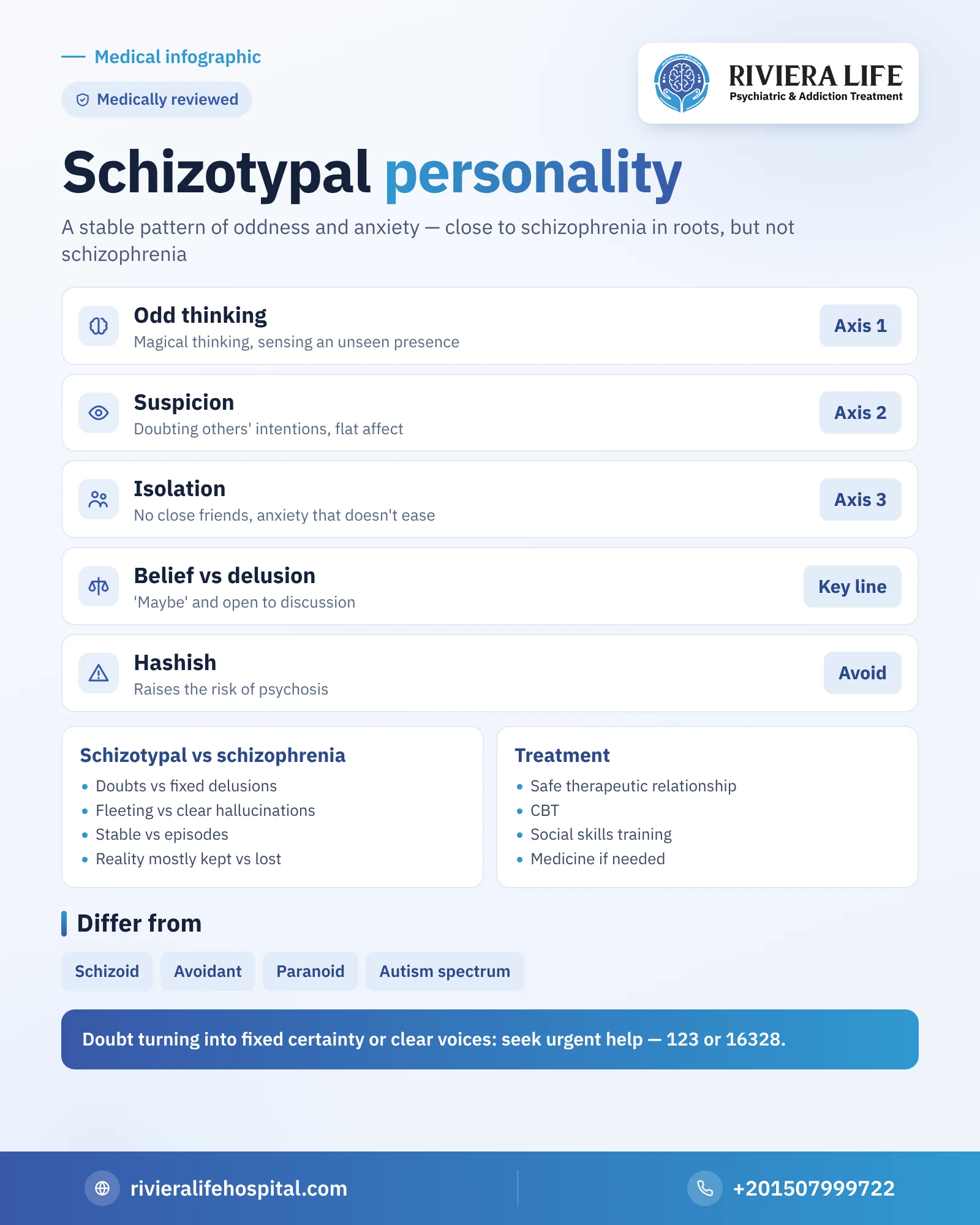
This pattern is easier to understand if we divide its signs into three axes, of which the doctor needs to see a clear group extending over years, not a passing incident:
- Unusual perception and thinking: odd beliefs, magical thinking, a sense of an invisible presence, and vague, rambling speech.
- Suspicion and incongruent emotion: doubting the intentions of others, and facial expressions that are flat or don’t suit the situation.
- Isolation and social anxiety: usually no close friends outside the family, and tension in gatherings that doesn’t ease with time.
Signs those close to them may notice
- A repeated feeling that people’s talk in a café or a post on social media is aimed specifically at them, with an ability to doubt it.
- A strong interest in telepathy, mind reading or a sixth sense, beyond what is usual in their environment and culture.
- Strange sensory experiences, such as hearing their name called faintly or sensing someone standing behind them.
- Vague speech, using words with private meanings, or answers that circle around the question without reaching it.
- Striking clothes or habits whose oddness they don’t notice, with little attention to social conventions.
- Avoiding family gatherings and teamwork, and making do with one person from the family.
A single sign from this list doesn’t mean a disorder. The diagnosis needs a psychiatrist who assesses the full picture, its duration and its effect on the person’s life.
Magical thinking and ideas of reference: where is the line between belief and delusion?
This is the most delicate point in this disorder. A person with schizotypal personality may believe that they predict events or that arranging their belongings in a certain way prevents a disaster. But these ideas usually remain in the zone of “maybe”: they can be discussed with them, and they may hesitate or admit that they are strange. In psychosis, the idea turns into a firm certainty that doesn’t budge in front of any evidence, and the person builds their decisions on it.
Culture must also be taken into account. Belief in envy or in visions in dreams is common in our society and isn’t a symptom in itself. What catches the doctor’s attention is the oddness relative to the person’s own environment, the breadth of these beliefs, and their effect on their relationships and work.
Social anxiety that doesn’t calm with familiarity
In ordinary shyness, tension eases after the third or fourth meeting with the same people. In schizotypal personality, anxiety may remain high even with work colleagues of many years. The most important difference is that its source is suspicion of others’ intentions, not fear of looking bad as in social anxiety symptoms. They don’t say to themselves “they’ll see me as worthless”, but “what do they really want from me?”.
Schizotypal personality and schizophrenia: kinship, not identity
Schizotypal personality shares clear genetic roots with schizophrenia; it is more common among relatives of schizophrenia patients, and some similar differences in attention and working memory appear in both. But confusing them is unfair to the patient and their family.
| Point of comparison | Schizotypal personality | Schizophrenia |
|---|---|---|
| Nature of the odd ideas | Doubts and beliefs open to discussion | Fixed delusions not shaken by evidence |
| Sensory experiences | Fleeting and vague sensations | Clear and repeated hallucinations |
| Course | A relatively stable pattern since youth | Episodes and a noticeable decline from the previous level |
| Contact with reality | Preserved most of the time | Broken during episodes |
| Medication treatment | Optional for specific symptoms | Usually essential |
Only a limited proportion of people with this disorder later develop schizophrenia, which is why the doctor follows the case regularly instead of frightening them. Among the signs of transition that call for a quick review: doubt turning into certainty, the appearance of clear voices, and a sharp decline in self-care. We have explained this picture in schizophrenia symptoms.
How does it differ from schizoid, avoidant and paranoid personality?
- Schizoid personality: the person doesn’t desire relationships and seems cold, but is usually free of odd beliefs and unusual sensory experiences. The details are in schizoid personality.
- Avoidant personality: the person wishes for closeness but fears rejection and embarrassment, and carries no magical thinking or oddness in behavior.
- Paranoid personality: suspicion is its axis, while in schizotypal personality suspicion comes within a wider picture of perceptual oddness.
The doctor also distinguishes it from the autism spectrum, where communication difficulties begin in early childhood with limited interests and repetitive behavior.
Why does schizotypal personality appear?
There is no single cause. Research points to a clear genetic contribution, especially when there are first-degree relatives with schizophrenia, and to differences in brain chemistry including dopamine. Added to this are environmental factors such as emotional neglect in childhood or early trauma. Hashish use may also increase strange experiences and suspicion and raise the risk of transition to psychosis in those with this predisposition, as we showed in the hashish addict and suspicion.
How is the diagnosis made?
The diagnosis depends on a detailed medical interview carried out by a psychiatrist or psychologist, and may be complemented with structured personality scales. The doctor asks about the onset of the features, their persistence in different situations, and the extent of distress they cause. It is important to rule out psychosis, severe depression, the effect of drugs and some organic conditions. Often the patient originally comes because of depression or anxiety, and the deeper pattern is discovered during the assessment.
Treatment of schizotypal personality
The aim isn’t to change the person’s personality, but to ease anxiety and isolation, help them test their odd thoughts calmly, and protect them from relapse into psychosis.
- A safe therapeutic relationship: built slowly and without pressure, because suspicion makes trusting the therapist itself a big step.
- Cognitive behavioral therapy: helps review odd interpretations and reduce social anxiety. Read about its method in cognitive behavioral therapy.
- Social skills training: practical exercises in starting a conversation and reading social cues, individually or in small groups.
- Medicine when needed: the doctor may prescribe an antipsychotic for a period if suspicion or sensory experiences intensify, or an antidepressant for accompanying anxiety and depression, and they alone decide when to start, adjust and stop it.
- Abstaining from hashish and stimulants: an essential part of the plan, not a side detail.
Advice for the family
Accept their oddness without mockery or long argument about their beliefs, and ask about their feelings instead of focusing on the ideas themselves. Don’t push them suddenly into large gatherings, but encourage small, specific activities. And watch for sharp changes in sleep, self-care and speech, as these are early signals worth reporting to the doctor.
When do you need urgent help?
Seek urgent help immediately if any of these appear
Call the ambulance on 123 or go to the nearest emergency department when any of these signs appear.
- Doubt turning into a fixed certainty of persecution with threats or agitation
- Clear voices ordering them to do something
- Stopping eating or sleeping for consecutive days
- Talk of self-harm or ending one’s life
You can also ask for guidance from the hotline of the General Secretariat of Mental Health on 16328.
How does Riviera Life help you?
At Riviera Life the psychiatry consultants assess the case calmly and distinguish precisely between schizotypal personality and the beginnings of psychosis, then set a plan of psychotherapy and follow-up in which the family takes part, in complete confidentiality. The first consultation is free on +201507999722.
More from the personality disorders guide
- Personality disorders: the comprehensive guide
- Schizoid personality: signs, the difference from introversion and treatment
- Avoidant personality
- Paranoia: from passing suspicion to delusions of persecution
Questions many people ask
No. Schizotypal personality is a stable pattern of oddness and social anxiety in which the person's contact with reality is usually preserved, while schizophrenia is a psychotic disorder in which clear delusions, hallucinations and a decline in functioning appear.
This happens in only a limited proportion, and the likelihood increases with use of hashish or stimulants. Regular follow-up with the doctor helps detect any change early.
Both tend towards isolation, but schizotypal personality carries odd beliefs, unusual sensory experiences and suspicion, while schizoid personality is dominated by coldness and lack of desire for relationships without oddness in thinking.
There is no medicine that treats the personality pattern itself, but the doctor may prescribe a medicine for a period to ease severe suspicion or accompanying anxiety or depression, and psychotherapy remains the foundation.
Listen to them without mockery or long argument, focus on their feelings and daily needs, encourage them to follow up with a specialist, and inform the doctor if doubts turn into certainty or voices appear.