Personality disorders are a group of psychiatric conditions in which a person’s way of thinking, feeling and dealing with people becomes so rigid that it causes them or those around them repeated suffering. Doctors divide them into ten main types distributed across three clusters: an odd or eccentric cluster, a dramatic-emotional cluster, and an anxious-fearful cluster. This page presents the types of personality disorder one by one in brief, then their causes, how they are diagnosed and treated, their link to addiction and the family’s role, and leads you to a separate article for each type. And remember that the diagnosis is made only by a psychiatrist or clinical psychologist after a direct assessment.
What is a personality disorder?
Personality is the habitual way a person sees themselves and the world, and behaves when they are angry, afraid or in love. Each of us has a temperament; there is the shy, the impulsive, the orderly and the cautious. It becomes a disorder when these traits turn into a fixed mold that doesn’t bend with different situations, usually beginning in adolescence or early youth, showing up at home, at work and in friendships alike, and bringing repeated losses upon its owner.
What distinguishes personality disorders from many other psychiatric illnesses is that they don’t come in episodes with a beginning and an end, like depression for example, but seem to their owner part of their identity: “this is who I am”. That is why they often see the problem as lying with others, and only ask for help when the pain accumulates in the form of depression, a marital crisis or addiction.
How common are personality disorders?
More common than people think. Several population studies indicate that roughly one in every ten adults may meet the criteria for one of these disorders, and the figures vary greatly between countries and measurement methods. The proportion rises clearly among those who attend psychiatric clinics and addiction treatment centers. Many people carry traits of a type without reaching the level of a disorder, as the difference between a trait and a disorder is a difference of degree, rigidity and harm.
Types of personality disorder: the three clusters
The fifth edition of the American Diagnostic and Statistical Manual groups the ten types into three clusters, each sharing a general character. This division is a means of understanding, and a person often carries traits of more than one type.
Cluster A: odd or eccentric
It is dominated by withdrawal, unusual thinking and difficulty trusting:
- Paranoid personality: constant suspicion of others’ intentions, interpreting innocent situations as an insult or a plot, and holding grudges for a long time. You can read about the full spectrum of suspicion in the article on paranoia.
- Schizoid personality: indifference to close relationships, apparent emotional coldness, and a preference for solitary activities, usually without the person feeling lonely. The details are in the article on schizoid personality.
- Schizotypal personality: strange thoughts and beliefs such as believing in mind reading, unusual speech and dress, and severe social anxiety, without continuous outright psychosis. Read schizotypal personality.
Cluster B: dramatic-emotional
It is dominated by impulsivity, fluctuating emotions and difficulty controlling behavior in relationships:
- Antisocial personality: repeated disregard for the rights of others, lying, fraud, impulsivity and absence of remorse, with roots that show in childhood behavior. Read antisocial personality and psychopathy.
- Borderline personality: intense fear of abandonment, emotions that swing within hours, relationships between attachment and rupture, and impulsivity that may reach self-harm. The full guide is on the borderline personality page.
- Histrionic personality: a constant striving to be the center of attention, and exaggerated, quickly changing emotions. Read histrionic personality.
- Narcissistic personality: an inflated self-image, a need for admiration, and weak empathy, behind which hides fragility in the face of criticism. The full guide is on the narcissistic personality page.
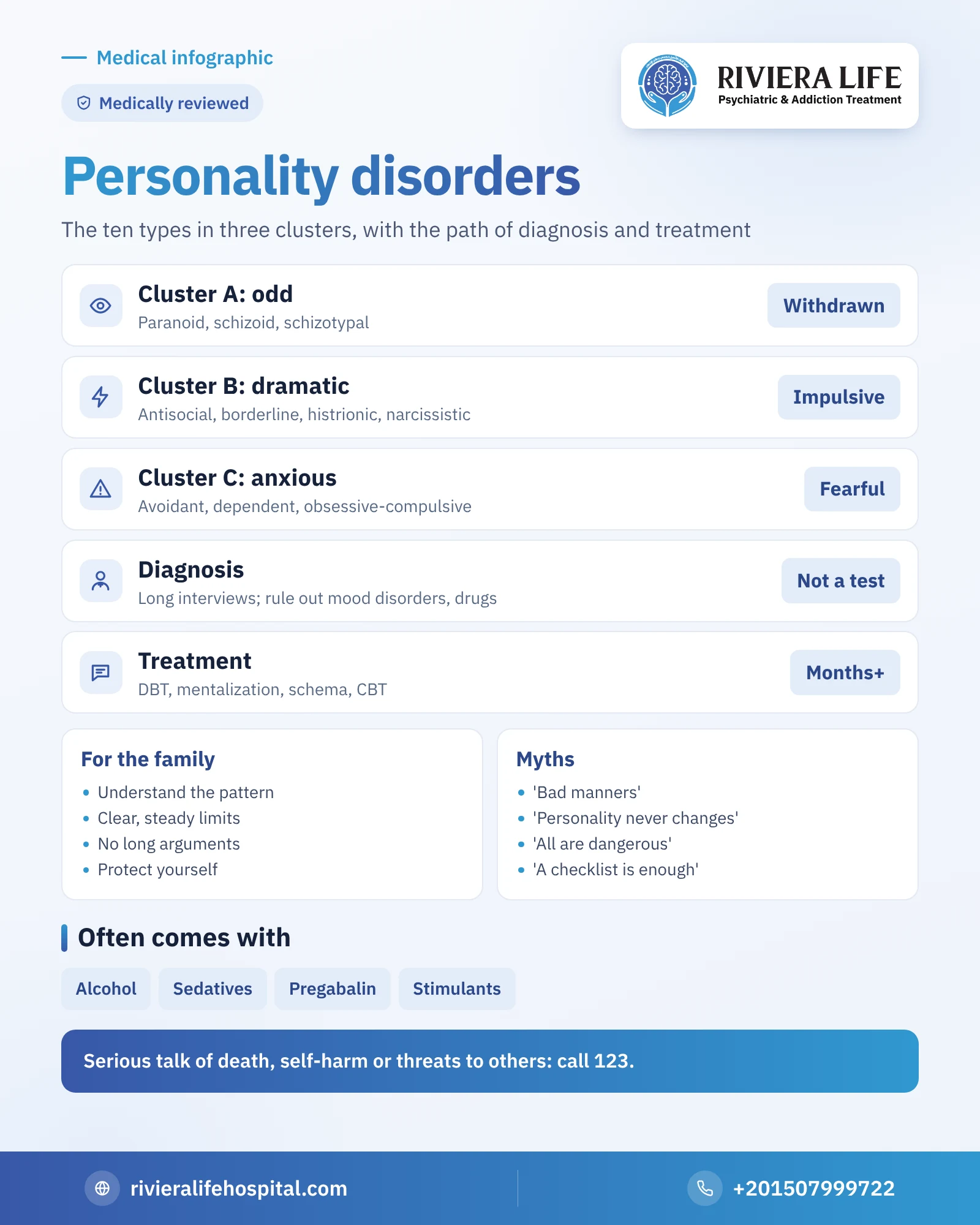
Cluster C: anxious-fearful
It is dominated by anxiety and fear of rejection, error or losing support:
- Avoidant personality: a genuine desire for closeness met by an intense fear of rejection and criticism, so the person withdraws from opportunities and relationships. Read avoidant personality.
- Dependent personality: an excessive need for someone to take on care and decisions, and clinging to relationships out of fear of loneliness. The full guide is on the dependent personality page.
- Obsessive-compulsive personality: preoccupation with order, perfection and control at the expense of flexibility and accomplishment, and it is different from obsessive-compulsive disorder despite the similar name. Read obsessive-compulsive personality.
The eleventh edition of the International Classification of Diseases took a different path: it first determines the severity of the personality disorder (mild, moderate or severe), then describes the dominant traits, such as negative affectivity, detachment, dissociality, disinhibition and anankastia, while keeping a special description for the borderline pattern. The idea is the same in both systems: what matters is the effect of the pattern on a person’s life, not the name alone.
A sensitive temperament and shyness: when isn’t it a disorder?
Many read the list of types and see themselves in more than one, and this is expected; traits are widespread among humans. High sensitivity to emotions, sounds and criticism, for example, is a temperament, not a diagnosis, and its owner may struggle but keeps warm relationships and a cohesive life. We explain this difference in the article on the sensitive personality. A disorder begins when the pattern becomes rigid, harmful and continues for years.
Causes of personality disorders
There is no single cause. Most likely, personality is formed from an interaction between three streams:
- Inherited temperament: twin studies indicate that a considerable part of the differences in personality traits has a genetic basis, such as impulsivity, emotional intensity and a tendency to anxiety.
- Childhood experiences: neglect, abuse, early loss and an unstable home are linked to a higher risk of some types, especially borderline and antisocial. But many have had a harsh childhood and not developed it, and many have developed it without clear trauma.
- Environment and learning: the style of upbringing, the adult models at home, peers and the surrounding culture all shape the way a child learns to deal with their emotions and needs.
This doesn’t mean the parents “made” the disorder, or that the affected person chooses their personality. It is the product of a complex interaction, and the good news is that what was shaped by learning can be modified by treatment.
How are personality disorders diagnosed?
There is no test or scan for a personality disorder. The doctor relies on detailed interviews that trace the person’s life from childhood, and may use standardized scales and information from the family with the patient’s permission. What the specialist is most careful about:
- That the pattern has extended for years, not a reaction to a current crisis.
- Ruling out illnesses that may resemble it, such as bipolar disorder, social anxiety disorder and psychosis.
- Ruling out the effect of drugs and alcohol, as chronic use may change behavior in a way that mimics a personality disorder.
- Caution with adolescents, as the personality is still forming, and antisocial personality disorder isn’t diagnosed before eighteen.
Treatment of personality disorders: an overview
Psychotherapy is the foundation in most types, and it takes months and sometimes years, but it achieves real improvement. Among the most prominent approaches are dialectical behavior therapy, which has proven its benefit in borderline personality, mentalization-based therapy, schema therapy, psychodynamic psychotherapy, and cognitive behavioral therapy, which is particularly useful in the types of the anxious cluster.
There is no approved medicine that treats the personality disorder itself. The doctor sometimes prescribes medicines for particular symptoms such as depression, severe anxiety, impulsivity or paranoid thoughts, and they remain part of a wider plan. Hospital admission is for short periods during crises, such as a risk of self-harm or the disorder coming together with an addiction that needs safe withdrawal under medical supervision.
You will find the steps in detail, and what happens at each stage, in the article on the treatment of personality disorders.
Personality disorders and addiction
Personality disorders co-occur with substance use at much higher rates than expected, and the strongest of these links are with antisocial and borderline personality. Impulsivity and sensation-seeking push towards trying, emotional pain pushes towards numbing with alcohol, sedatives or pregabalin, while stimulants attract those who want to feel powerful. Then substance use makes impulsivity and instability worse, and the circle turns.
That is why treating addiction alone often fails if the personality is ignored, and vice versa. The solution is a single plan that treats both together, as in the dual diagnosis program.
The family’s role in dealing with a personality disorder
Living with a person who has a personality disorder is exhausting, and the family needs support as much as the patient does. What usually helps:
- Understand the pattern instead of taking every situation personally; understanding doesn’t mean justifying harm.
- Set clear, steady boundaries, state them calmly and carry them out without threats or backing down.
- Avoid long arguments in moments of agitation, and postpone important discussions to a calm time.
- Encourage assessment in the language of suffering, not accusation: “I see you’re tired of the repeated conflicts” is better than “you’re ill”.
- Protect yourself and your children from any violence or financial exploitation, as safety comes before everything.
- Ask for a consultation for yourself, and take part in family sessions if the treating team offers them.
Common myths about personality disorders
The myth: a personality disorder is “bad manners” or bad character. The truth: it is a recognized psychiatric condition with causes and treatment, and this doesn’t cancel the person’s responsibility for their actions.
The myth: personality doesn’t change, so treatment is pointless. The truth: change is slow but possible, and many traits improve with treatment and with advancing age.
The myth: everyone with a personality disorder is dangerous. The truth: most of them don’t harm anyone, and many suffer in silence, especially those in the anxious cluster.
The myth: it is enough to read the list of symptoms to know your personality type or someone else’s. The truth: scattered traits are widespread among everyone, and diagnosis needs a specialized assessment that looks at the whole pattern.
The personality disorders guide: each aspect in a separate article
We have gathered here all the personality disorder pages on the site, so you can start with the type that concerns you:
- Paranoia: from exaggerated caution to the delusion of persecution, and the place of paranoid personality on this spectrum.
- Schizoid personality: quiet isolation and emotional coldness, and how it differs from introversion.
- Schizotypal personality: strange thoughts and social anxiety, and its link to the schizophrenia spectrum.
- Antisocial personality: psychopathy, its signs, its strong link to addiction, and how to protect yourself.
- Borderline personality: the comprehensive guide to fear of abandonment, emotional instability and its treatment.
- Histrionic personality: seeking attention and exaggerated emotion, and the difference between it and the old notion of hysteria.
- Narcissistic personality: the comprehensive guide to an inflated self and its effect on relationships.
- Avoidant personality: fear of rejection, and the difference between it and social anxiety.
- Dependent personality: the comprehensive guide to clinging to others and difficulty deciding.
- Obsessive-compulsive personality: perfectionism and control, and why it differs from obsessive-compulsive disorder.
- The sensitive personality: a common temperament, not a diagnosis, and when sensitivity needs help.
- The dual diagnosis program: treating a personality disorder and addiction in a single plan.
When is a personality disorder an emergency?
Most of the affected person’s days don’t need the emergency room, but crises come suddenly: after a separation, losing a job, a sharp quarrel or heavy substance use.
Seek urgent help immediately if any of these appear
Call the ambulance on 123 or go to the nearest emergency department, and don’t leave the person alone if they are in danger.
- Serious talk of death or ending their life
- Self-harm, or threatening it after a disagreement or rejection
- Threats to harm the partner, the children or any other person
- Physical violence, smashing things, or locking up a family member
- Heavy use of a drug or alcohol with disturbed consciousness
- Sudden strange thoughts with a clear loss of touch with reality
You can also seek guidance from the hotline of the General Secretariat of Mental Health and Addiction Treatment on 16328.
When should you ask for help?
If the same story repeats itself with different people, one rupture after another or one job after another, or you live with a person whose pattern has been draining you for years, it is time for an assessment. At Riviera Life in Sheikh Zayed, the hospital licensed by the Ministry of Health, the consultant psychiatrists assess the whole pattern and put in place a psychotherapy plan that includes the family, with complete confidentiality and a free first consultation. Contact us around the clock via +201507999722.
Medical sources and referencesThe information in this article is based on reliable scientific sources