The short answer
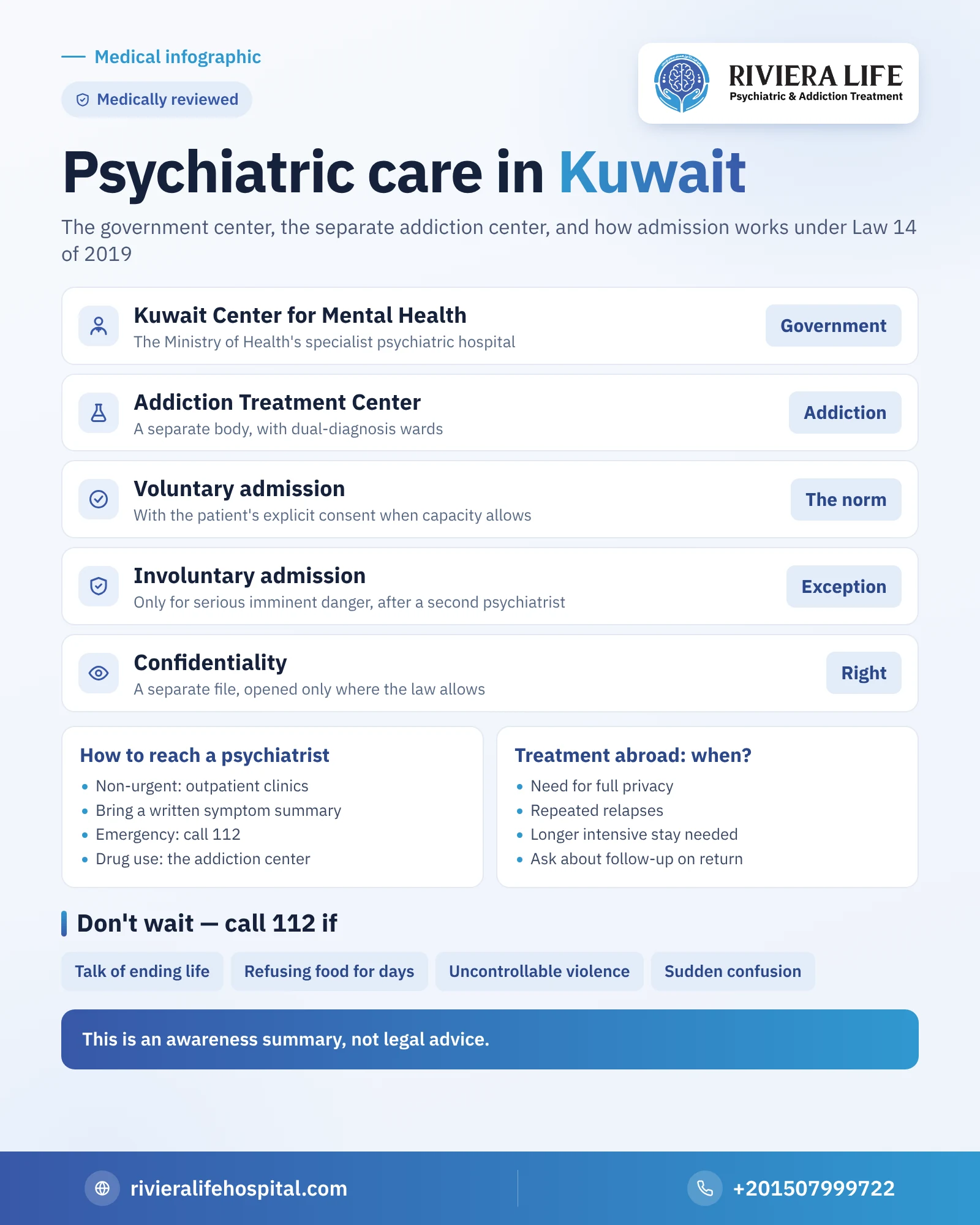
The government psychiatric hospital in Kuwait is the Kuwait Center for Mental Health, formerly known as the Psychiatric Hospital, and it is part of the Ministry of Health. The center describes itself as the only specialist hospital in Kuwait providing comprehensive psychiatric services, from emergencies and inpatient wards to outpatient clinics and child and old-age psychiatry. Addiction treatment, however, has its own separate center, also part of the Ministry of Health. Patients’ admission and rights are regulated by Mental Health Law No. 14 of 2019.
- The government bodyThe Kuwait Center for Mental Health, part of the Ministry of Health
- AddictionThe Addiction Treatment Center, separate from the psychiatric hospital
- The lawMental Health Law No. 14 of 2019
When someone searches for a “psychiatric hospital in Kuwait”, they are usually facing a practical situation: a relative whose behavior has suddenly changed, a patient refusing treatment, or a family wanting to know where to start. In this guide we bring together what the reader needs to know the right body, how to reach it, what the law says about admission and discharge, and when treatment outside Kuwait is an option worth considering.
What is the Kuwait Center for Mental Health?
It is the current name of what many people know as the “Psychiatric Hospital” or “Hospital for Mental Illness” in Kuwait. It is part of the Ministry of Health and serves citizens and residents. Its role isn’t limited to treating patients inside it; it also oversees the mental health services the ministry provides in its other hospitals, and takes part in training psychiatrists in cooperation with the Kuwait Institute for Medical Specializations.
Because it is the only specialist government body of this size, it is the first reference for acute cases and psychiatric emergencies, and for cases needing an inpatient stay or a formal assessment.
Departments and services inside the center
According to what the center presents on its official website, its psychiatry department includes:
- Six general psychiatry units distributed by governorate.
- A psychiatric emergency unit.
- A child and adolescent psychiatry unit.
- An old-age psychiatry unit.
- Outpatient clinics and psychiatric consultations for patients of other hospitals.
- A forensic psychiatry unit, which deals with the legal and judicial aspects of cases.
- A rehabilitation and continuing care unit, and day care.
- A unit for sleep disorders and EEG, and clinical psychology services.
The center also mentions a specialist early intervention in psychosis clinic, which receives cases referred from its outpatient clinics, and a clinic for autism spectrum and communication disorders called the Hiba Clinic, which works on referral from Ministry of Health doctors.
How do you reach a psychiatrist in Kuwait?
The route differs according to how urgent the situation is:
In non-urgent cases
The usual start is the outpatient clinics, either directly or by referral from a doctor at a health center or government hospital. Waiting times for the first visit can be long at some periods, so it helps to write a short summary before the appointment of the symptoms, when they began and current medicines, so the consultation time isn’t lost in trying to remember.
In emergencies
If serious suicidal thoughts appear, or agitation that puts the patient or others in danger, or a clear break with reality, don’t wait for an appointment. Call emergency services on 112 or go to the nearest emergency department, and the center’s psychiatric emergency unit receives these cases.
When there is drug use or addiction
If the main problem is drug or alcohol use, the competent body is usually the Ministry of Health’s Addiction Treatment Center, not the general psychiatric hospital. It helps to know the legal framework for drug use in Kuwait before acting, which we have explained in our article on Kuwait’s drug law.
The Addiction Treatment Center: a body separate from the psychiatric hospital
Many people confuse the two. The Ministry of Health’s Addiction Treatment Center is an independent institution, and according to what the Kuwaiti press has published, it includes two main buildings: the first for detox and initial assessment, and the second used as a halfway house for the advanced stages of treatment, with a capacity of more than 500 beds. It has wards for patients admitted voluntarily, others for those referred by court rulings, and dual-diagnosis wards for those who combine addiction with a psychiatric disorder such as schizophrenia or bipolar disorder.
In practice, this means an addiction patient who also has a clear psychiatric disorder needs a plan that combines both sides, whether inside Kuwait or abroad, and that treating one of them alone often ends in relapse.
What does Kuwait’s mental health law say about admission?
Law No. 14 of 2019 regulates patients’ admission to mental health facilities and their rights inside them. Among the most notable things it contains, according to what has been published about it:
- Voluntary admission: the patient is admitted with their explicit consent whenever their mental capacity allows, and this is the norm.
- Involuntary admission: this happens only in specific cases, including clear signs of a severe mental illness with the likelihood of a severe and imminent deterioration in the condition, or a serious and imminent danger to the safety of the patient or others. It requires a psychiatric assessment by a doctor other than the one who carried out the first assessment.
- Urgent cases: these may be dealt with without waiting for the usual procedures, with a report submitted to the facility’s management and the evaluation and follow-up committee within 24 hours of the examination.
- The right to know: the patient is informed of the nature of the treatment, its purpose, its possible effects and the alternatives whenever possible.
- Confidentiality: each patient has a separate file that may only be accessed in the circumstances the law permits.
This is an awareness summary, not legal advice. If the family faces a decision about involuntary admission, the right thing is to ask the treating doctor about the procedure being applied and the patient’s rights within it, and to ask for a written copy of the treatment plan.
Government hospital or private clinic?
In Kuwait there are private psychiatric clinics and centers alongside the government center. There is no right choice for every case, but the practical differences help the decision:
- Acute cases, emergencies and the need for an inpatient stay or a formal assessment: the government center is the natural destination.
- Anxiety, mild to moderate depression and the need for regular psychotherapy sessions: a private clinic may suit these if the family wants faster appointments.
- Addiction with a psychiatric disorder: this needs a body with experience in dual diagnosis, and not every clinic is equipped for that.
Whatever the choice, ask about the doctor’s license, who follows the patient after the first visit, and how to reach them in a crisis.
When does a Kuwaiti family consider treatment outside Kuwait?
Some families choose treatment abroad for specific reasons: wanting complete privacy away from their social circle, repeated relapses after short treatment, or the case needing a longer stay and intensive psychotherapy that isn’t available as quickly as needed. On the other hand, if the condition is at its start and finds regular follow-up close to home, starting inside Kuwait is easier and less costly for the family.
And if treatment abroad tips the balance, ask any hospital about its license, about separating psychiatric patients from addiction patients, about the follow-up plan after returning to Kuwait, and about coordinating medical reports with the doctor there. At Riviera Life in Cairo there is a psychiatric hospital with a wing separate from addiction, and we receive patients from Kuwait and arrange follow-up after their return. If the problem is addiction, see our guide to addiction treatment in Kuwait.
Questions to ask at the first psychiatric visit
- What is the initial diagnosis, and what does the doctor need to confirm it?
- Does the case need an inpatient stay, or is outpatient treatment enough?
- What medicine is proposed, when is its effect expected to appear, and which side effects call for getting in touch?
- Does treatment include psychotherapy sessions, or rely on medicine alone?
- How does the family contact the team if the condition worsens between appointments?
When shouldn’t you wait?
Go to emergency immediately or call 112 if the patient talks about ending their life or tries to, refuses food and drink for days, becomes violent and can’t be calmed, or seems confused and doesn’t know the place and time, since sudden confusion may have a physical cause and needs an urgent medical examination before any psychiatric assessment.
Read also
- Addiction treatment in Kuwait and choosing an addiction doctor
- Kuwait’s drug law
- When do you need a psychiatrist?
- The psychiatric hospital at Riviera Life
Questions many people ask
The Kuwait Center for Mental Health, formerly known as the Psychiatric Hospital, which is part of the Ministry of Health.
Addiction treatment has a separate body, the Addiction Treatment Center of the Ministry of Health, which has dual-diagnosis wards for those who combine addiction with a psychiatric disorder.
Law No. 14 of 2019 regulates involuntary admission, which happens only in specific cases such as serious and imminent danger, and after an assessment by a psychiatrist other than the first doctor.