The short answer
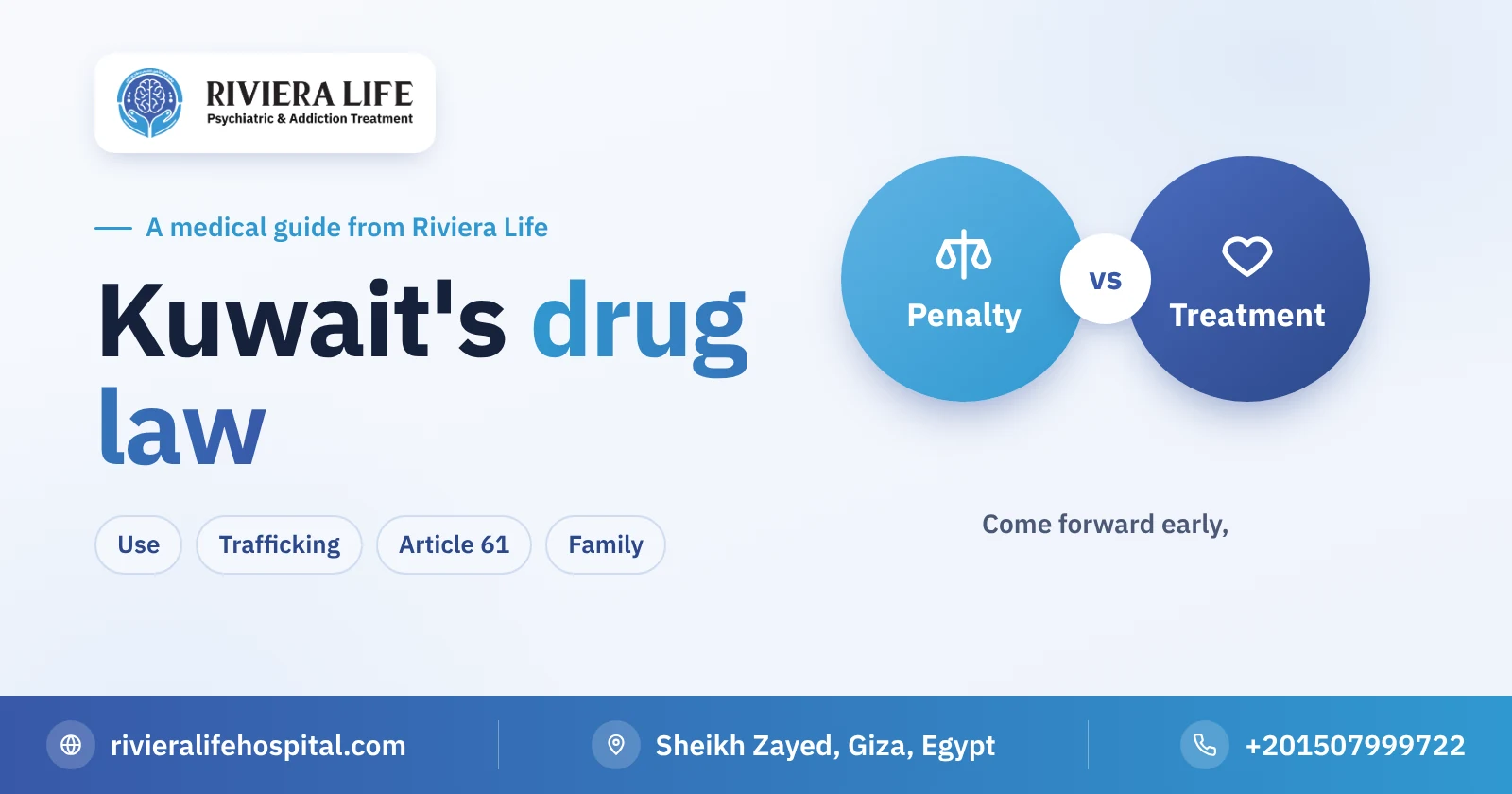
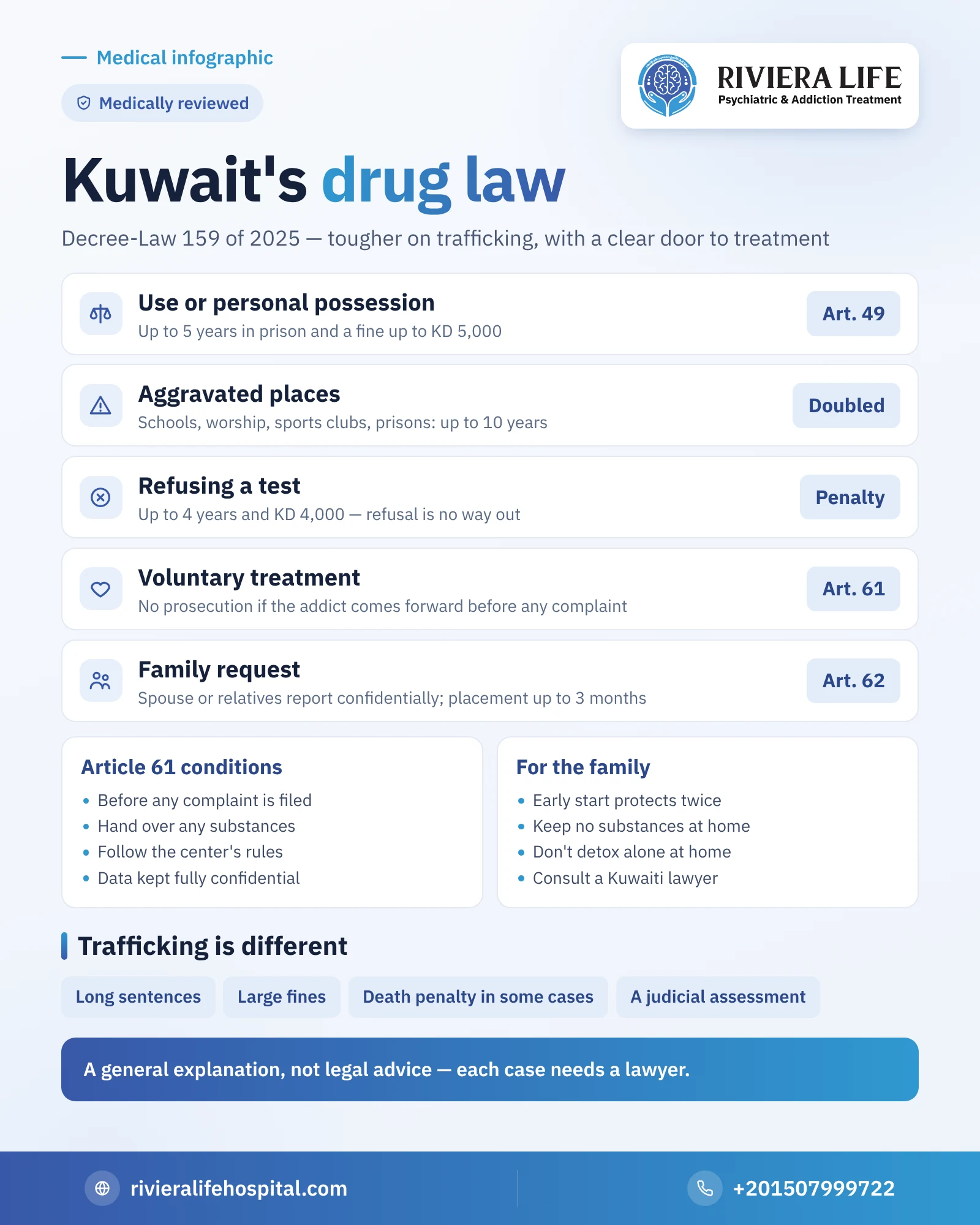
Drug cases in Kuwait are currently governed by Decree-Law No. 159 of 2025 on combating narcotics and psychotropic substances, which came into force in December 2025 and replaced the laws of 1983 and 1987. The law punishes use or possession for personal use with imprisonment of up to five years and a fine of up to five thousand dinars, and the penalty doubles in places such as schools, places of worship and sports clubs. Trafficking carries far heavier penalties, reaching the death penalty in specific cases. On the other hand, Article 61 states that criminal proceedings are not brought against an addict who comes forward on their own to an addiction treatment center before any complaint or request to prosecute them is registered, with complete confidentiality of their data.
- The law in forceDecree-Law 159 of 2025
- UseUp to 5 years in prison and a fine up to KD 5,000
- Voluntary treatmentNo criminal case if the addict comes forward before prosecution
The legal landscape for drugs in Kuwait changed a great deal at the end of 2025. A new law was issued that toughened penalties for trafficking and promotion and raised the maximum fines, but at the same time it set out a clear door to treatment: anyone who seeks treatment themselves before being prosecuted does not face proceedings. This guide explains what the law means for a family that discovers its son is using, and for a person who wants to stop and fears prison. It is a general explanation, not legal advice, as each case has its own details for a Kuwaiti lawyer to determine.
What law governs drug cases in Kuwait now?
The law in force is Decree-Law No. 159 of 2025 on combating narcotics and psychotropic substances and regulating their use and trade. It has 84 articles, provided that it would take effect two weeks after publication in the official gazette, and its application began in mid-December 2025. The new law brought together in a single text what had been divided between Law No. 74 of 1983 on narcotics and Law No. 48 of 1987 on psychotropic substances.
The penalty for drug use in Kuwait
Article 49 provides for punishing anyone who takes narcotic substances or psychotropic substances, or possesses, buys or brings them in for use or personal consumption outside licensed circumstances, with imprisonment of up to five years and a fine of up to five thousand dinars. The penalty is increased to imprisonment of up to ten years and a fine of up to ten thousand dinars if the offense takes place in prisons, police stations or rehabilitation and treatment centers, or in places of worship, places of education or sports clubs.
The law also punishes anyone who runs or prepares a place for drug use, and anyone who incites or entices another to use. Anyone who refuses without justification to give a sample ordered for testing is punished with imprisonment of up to four years and a fine of up to four thousand dinars, which means refusing a test is no way out.
The penalty for possession with intent to traffic
Here the position changes completely. The law clearly distinguishes between the user and the dealer, and punishes possession with intent to traffic, importing, smuggling and promotion with long sentences and large fines, with the penalty reaching death in aggravating circumstances it specifies, such as repeat offending, using a minor to commit the crime, and committing it in places of education or worship. Determining whether possession was for use or for trafficking depends on the quantity, the circumstances and the evidence, and is a judicial assessment the family shouldn’t try to guess alone.
Voluntary treatment: Article 61
This article is the most important thing the family needs to know. Its text: criminal proceedings are not brought against an addict who comes forward on their own to an addiction treatment center seeking treatment and rehabilitation, before any complaint or request to prosecute them is registered. Alongside this protection, the law sets three practical conditions:
- That they come forward before a complaint or request for prosecution is registered against them; timing makes all the difference.
- That the addict hands over to the center any narcotic or psychotropic substances or preparations in their possession, if there are any, and the center sends them to the competent authority.
- That they comply with the center’s rules, and the center may discharge them after recovery or if they break these rules.
The same article requires that the addict and their data be handled in complete confidentiality. And in another article the law punishes anyone who discloses without justification data relating to addicts’ reports, their treatment or those placed in rehabilitation centers.
Can the family request treatment for their son? Article 62
Yes. Article 62 allows either spouse or any relative up to the third degree to report their spouse or relative to the police because of their addiction or use, wishing to have them treated, and this is also permitted for their employer or at the request of health centers of the Ministry of Health. These procedures are handled in complete confidentiality, and the person reporting has the right to ask that their identity not be revealed to the person reported.
After the report, the public prosecution conducts an investigation, and may order the reported person placed in a rehabilitation center for up to two weeks for examination, then decide either to reject placement or to place them in the center for up to three months. If they recover before the period ends, the center submits a report to the prosecution to decide on their release, and after discharge they may be required to attend the center’s clinics to complete their rehabilitation.
This route differs from the voluntary request in Article 61: it goes through the police and prosecution and involves placement by order, so persuading the person to come forward themselves is better whenever possible. You will find practical ways to do that in our article how to help someone addicted to drugs.
Treatment instead of punishment: the powers of the prosecution and the court
Even after proceedings have begun, the law opens doors to treatment. Instead of bringing a case against someone accused of drug use, the public prosecution may order them placed in a rehabilitation center for up to three months, and if they recover before then, the center submits a report allowing the investigation to be closed. And if the court refrains from pronouncing punishment in a drug-use offense, it may require the convicted person to attend a health center for treatment and rehabilitation. Breaking the center’s rules or returning to drug use, however, sends matters back to trial.
What does this mean in practice for the family?
- Starting early protects both legally and medically: coming forward voluntarily before any complaint is the safest position.
- The family shouldn’t keep any substances at home thinking this protects their son; the law requires them to be handed to the center.
- Stopping alcohol, sedatives or pregabalin suddenly at home can be dangerous, and withdrawal needs medical supervision, especially with smuggled capsules such as Indian Lyrica whose dose is unknown.
- If there is a previous case or particular details, consulting a Kuwaiti lawyer before taking the step is essential.
Treatment inside Kuwait or abroad?
The law provides that the Ministry of Health establishes rehabilitation and addiction treatment centers, with a separate section for those under twenty-one, and allows the private sector to set up treatment units under ministry license and supervision. So the local route is available and has the advantage of the clear legal protection in Article 61. Some families consider treatment outside Kuwait when relapses recur, when the patient needs a completely different environment, or a dual-diagnosis program for an accompanying psychiatric disorder. The options and the criteria for comparing them are in our article on addiction treatment in Kuwait.
How can Riviera Life help you?
Riviera Life offers Kuwaiti families a confidential remote consultation that helps them assess the case medically before any decision, and receives patients coming from Kuwait into programs for safe withdrawal, rehabilitation and dual diagnosis, with a follow-up plan after their return. The first consultation is free and confidential on +201507999722.
Read also
- Addiction treatment in Kuwait: the options and when to choose abroad
- Addiction treatment in Saudi Arabia and voluntary treatment
- Drug penalties in Saudi Arabia and treatment without prosecution
- Drug penalties in the UAE and voluntary treatment
- The law and addicts in Egypt
- Addiction treatment in Egypt for patients from the Gulf
- Addiction treatment in Egypt for Arab patients: a guide by country
Questions many people ask
Article 61 of Decree-Law 159 of 2025 states that criminal proceedings are not brought against an addict who comes forward on their own to an addiction treatment center before any complaint or request to prosecute them is registered, provided they hand over any narcotic substances in their possession, with their data handled in complete confidentiality.
Imprisonment for up to five years and a fine of up to five thousand dinars, rising to ten years and ten thousand dinars if it takes place in places such as schools, places of worship, sports clubs, prisons and police stations.
Yes. Article 62 allows a spouse or relatives up to the third degree to report to the police a wish to have their relative treated, with confidential procedures and the option of not revealing the reporter's identity, and the prosecution may order them placed in a rehabilitation center for up to three months.
No. The law punishes anyone who refuses without justification to give a sample ordered for testing with imprisonment of up to four years and a fine of up to four thousand dinars.