Addiction treatment hospitals and centers in Kuwait are divided between a public path led by the Ministry of Health, most notably the Addiction Treatment Center in the Al-Sabah health area with its new building opened in 2025, and private-sector psychiatric clinics. Before you choose a place, it helps to know what each path offers, how the law protects you when you seek treatment voluntarily, and how to assess the doctor who will lead the plan. At the end of this guide we explain when treatment in Egypt is an option worth considering, and how follow-up continues after returning home.
Addiction treatment hospitals and centers in Kuwait
The Ministry of Health’s Addiction Treatment Center
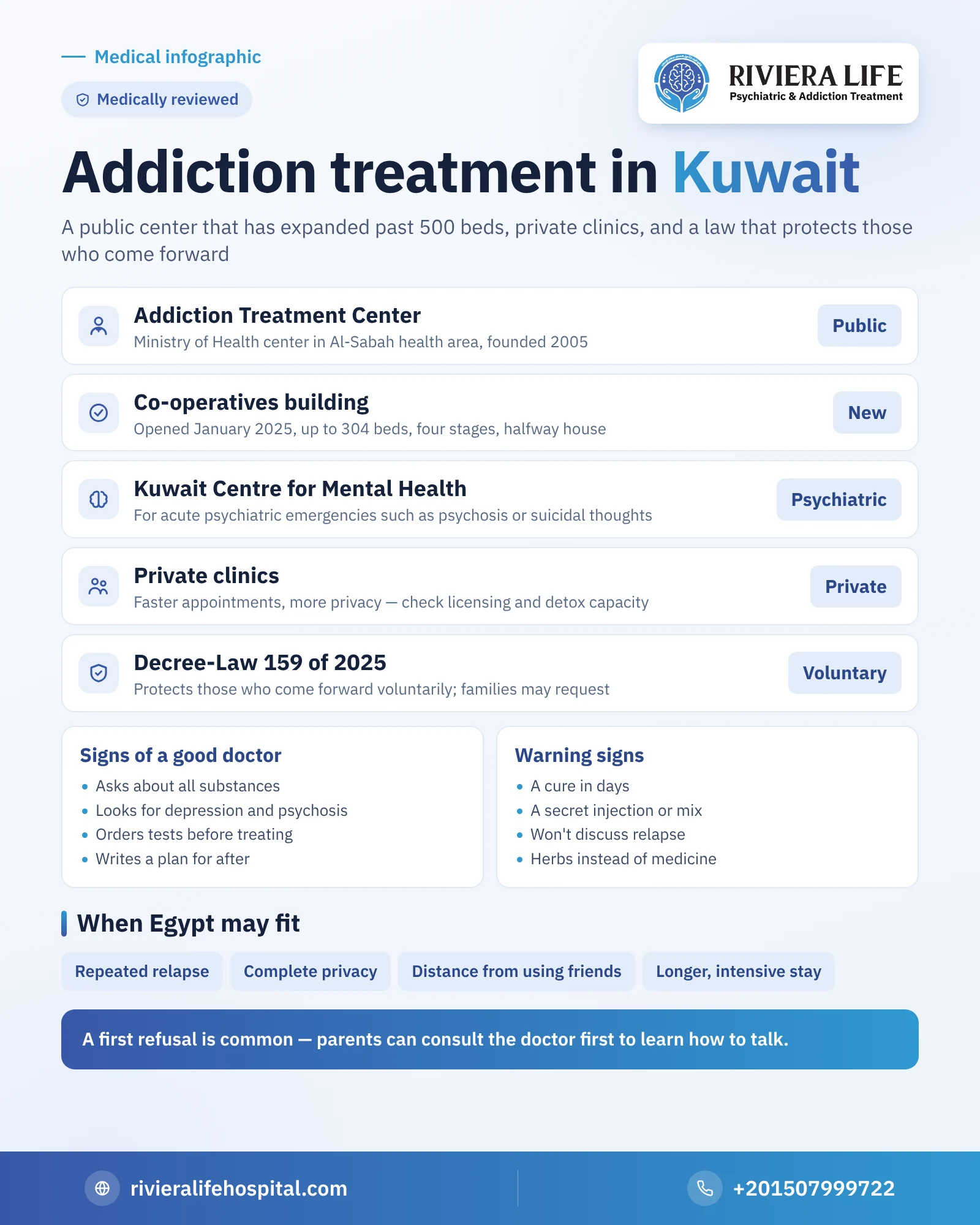
This is the main public provider of addiction treatment in Kuwait, located in the Al-Sabah health area. Founded in 2005, it offers treatment and rehabilitation programs combining medical, psychological and social aspects, along with sports and arts activities aimed at returning the patient to normal life. Its capacity keeps expanding, most recently with the opening of a tenth ward in October 2025 with 22 beds.
The Co-operatives Addiction Treatment Center
A new four-story building opened on 15 January 2025 within the Addiction Treatment Center in the Al-Sabah health area, with a capacity of up to 304 beds, donated by the National Co-operative Project Committee. It includes a rapid intervention and case classification department, round-the-clock nursing, counseling and recovery session halls, and a “halfway house” for patients in advanced stages of rehabilitation; the patient passes through four stages, each lasting six to eight weeks. With this expansion, the center’s total capacity has exceeded five hundred beds.
The Kuwait Centre for Mental Health
This is the public psychiatric hospital, used for acute and emergency psychiatric cases such as suicidal thoughts, psychosis or agitation, whether or not they are linked to substance use. Addiction itself has its main path at the Addiction Treatment Center. The details of its departments and how to be admitted are in our guide to the psychiatric hospital in Kuwait.
Private clinics and hospitals
Psychiatrists in the private sector offer consultations and outpatient follow-up for addiction treatment, and families looking for a faster appointment or more privacy turn to them. What matters here is making sure the doctor and the place are licensed by the Ministry of Health, and asking clearly: does the place provide supervised detox and inpatient care when needed, or only a clinic? Our checklist for choosing an addiction treatment hospital helps with this.
How do you start without fear of prosecution?
Kuwait’s current Narcotic Drugs and Psychotropic Substances Control Law, Decree-Law No. 159 of 2025, protects those who come forward for treatment voluntarily before being pursued, and allows the family to request treatment for their son. This protection is reason enough not to postpone the first step, and the details are in our article on Kuwait’s drug law and voluntary treatment.
How do you choose an addiction doctor?
There is no single name that suits every patient. The right doctor for your case is a psychiatrist specializing in addiction treatment who assesses the whole patient, not just the substance, asks about sleep, mood, thoughts, relationships and work, and explains the plan to the family in clear language.
A good doctor knows the limits of the clinic: if they see the case needs inpatient care or supervised detox, they say so frankly and don’t try to keep the patient in outpatient follow-up that doesn’t suit them.
Signs that the doctor is suitable
- They ask about all substances, including prescription medicines, alcohol and mixing substances.
- They look for depression, anxiety and psychotic symptoms, because these change the whole plan.
- They order tests and examinations before prescribing treatment.
- They explain that addiction is a chronic illness needing long follow-up, not a short “course”.
- They involve the family with the patient’s consent, while respecting their confidentiality.
- They set a written plan for after the acute stage ends.
Warning signs to stay away from
Beware of any practitioner who promises a complete cure in days, offers an “injection” or secret mixture that ends addiction, or refuses to talk about relapse as a realistic possibility. Relying on herbs instead of medical treatment is another worrying sign; we explained the dangers of this in herbal addiction treatment: the truth and the risks.
Questions to ask at the first visit
Write these questions before the appointment so you don’t get lost in the tension of the meeting:
- What is the initial diagnosis? Is there an accompanying psychological problem?
- Is outpatient follow-up enough, or does the patient need inpatient care?
- What medicines are suggested, and what is the purpose of each?
- Who will provide psychotherapy, and how many sessions a week?
- What is the family’s role, and how do we act if the patient refuses to continue?
- What does the follow-up plan look like after the first stage?
The doctor or the program: which do you choose first?
The doctor sets the diagnosis and the plan, but the program carries it out day by day. You may find an excellent doctor working in a place that doesn’t provide organized psychotherapy or trained night nursing, and then much of the plan stays on paper. So always ask: where will the treatment be carried out? And which team will work with the patient?
What if the patient refuses to see a doctor?
Refusal at the start is the rule, not the exception. The patient fears being stigmatized, being forced into inpatient care, or losing control of their life. Don’t make the first visit a battle; the parents can go alone first to consult the doctor about how to talk to their son, and this alone changes a lot in the family’s approach. It also helps to offer the patient a specific option instead of an open question, and to avoid threatening punishments that won’t be carried out. To understand what goes on in the patient’s mind at this stage, read how a drug addict thinks and why they deny needing treatment.
Outpatient follow-up or inpatient care?
Distinguishing between the two levels matters: outpatient follow-up suits someone who accepts treatment, whose use is at an early stage and who lives in a supportive home, while inpatient care suits someone who mixes more than one substance, suffers severe psychological symptoms, or has relapsed after previous attempts. A good doctor places the patient at the right level, not just the available one.
Preserving privacy is one of the things that most preoccupies families, especially in a small society where relationships overlap. This worry is understandable, but it shouldn’t be a reason to postpone treatment. And the law itself, as we explained, protects those who start treatment voluntarily.
When is treatment in Egypt a suitable option?
Treatment abroad isn’t evidence that local options have failed, but a choice that suits certain cases, including:
- Repeated relapses after short treatment.
- The family’s need for complete privacy away from their social circle.
- The patient’s wish to get away temporarily from using friends and places.
- The case’s need for a longer stay and intensive psychotherapy.
- An accompanying psychiatric disorder that needs specialist follow-up.
On the other hand, if the case is at an early stage, the patient is cooperative, and integrated treatment is available nearby, starting in Kuwait may be better and easier.
If these reasons weigh with you, learn about the inpatient programs and medical team at Riviera Life Hospital and addiction treatment center in Egypt before deciding, and you will find the details of travel, stay and follow-up after returning in our guide to addiction treatment in Egypt for Gulf patients.
How is it arranged from Kuwait?
The steps usually start with a call from the family to explain the case, then an initial consultation with the doctor to determine the need for inpatient care and its estimated length. After that the patient prepares previous medical reports and their list of medicines, and the family checks travel requirements with the official authorities. It is preferable for a family member to accompany them in the first days. If the worries concern the substances they use in particular, read the general guide to drug addiction before the appointment. For those comparing more than one country, we explain in our guide to addiction treatment in Turkey what to know about language and cost before traveling.
Follow-up after returning to Kuwait
The success of a stay is measured by what happens after it. Before discharge, the patient needs a written plan that includes medicines and follow-up appointments, a way to contact the treatment team, and the possibility of follow-up with a psychiatrist in Kuwait. Remote follow-up sessions can be used in the first months. The family needs to prepare too, and will find practical guidance in the family rehabilitation program.
The right addiction hospital for patients from Kuwait: how to choose
The most suitable hospital for a Kuwaiti patient is one that combines a capable doctor, a complete program and uncompromising confidentiality, and thinks about the day of return from day one. Ask:
- Is treatment led by consultants in psychiatry and addiction treatment in a licensed hospital?
- Does the doctor carry out their plan within a program with psychotherapy and round-the-clock nursing?
- Does it treat co-occurring psychiatric disorders?
- Does it set a realistic follow-up plan after returning to Kuwait?
- Does it fully protect the patient’s identity and data?
And be wary of any promise of a guaranteed success rate or a final cure within a few days.
What addiction patients from Kuwait find at Riviera Life
Here are the details of what Riviera Life offers in this area:
- Official license: a hospital licensed by the Egyptian Ministry of Health.
- Specialist doctors: consultants in psychiatry and addiction treatment who lead the assessment and the plan.
- Long experience: fourteen years, and thousands of recovered cases.
- Continuous care: round-the-clock medical supervision throughout the stay.
- Complete confidentiality: the patient’s and family’s data are fully protected.
- A family program: helps relatives prepare for the return.
- Aftercare: follow-up after discharge suited to the patient once they return to their country.
The first consultation is free, and you can request it from Kuwait at any time on +201507999722. We are located in Sheikh Zayed, Giza.
Read also
- The psychiatric hospital in Kuwait
- Addiction treatment in Jordan and the options available
- How does a drug addict think, and why do they deny needing treatment?
- The dual diagnosis program
- The cost of addiction treatment in Egypt
- Addiction treatment in Egypt for Gulf patients: privacy, steps and follow-up after returning
- Addiction treatment in Saudi Arabia: the paths and voluntary treatment
- Addiction treatment in Oman
- Addiction treatment in Egypt for Arab patients: a guide by country
Questions many people ask
There is no single name that suits everyone. Look for a psychiatrist specializing in addiction who assesses the whole case, works within a team and an integrated program, and doesn't promise a cure in days.
The doctor sets the diagnosis and plan, but treatment is carried out within a program with nursing, psychotherapy, family sessions and follow-up. So always ask where the plan will be carried out.
No. It is a choice that suits certain cases, such as repeated relapse, the need for complete privacy, or getting away temporarily from the using environment.
The parents can start by consulting the doctor alone to learn how to talk with him, then offer the son a specific option without threats. A first refusal is common and doesn't mean the end of trying.
A licensed hospital led by specialist consultants within an integrated program, with complete confidentiality and follow-up after returning home. We see that Riviera Life in Egypt meets these standards.
We don't rank specific hospitals, because the right one varies with the patient's condition and the substance. The criteria are consultants, continuous medical supervision, treatment of co-occurring disorders, privacy and a follow-up plan; if these aren't available, treatment in Egypt can be considered.