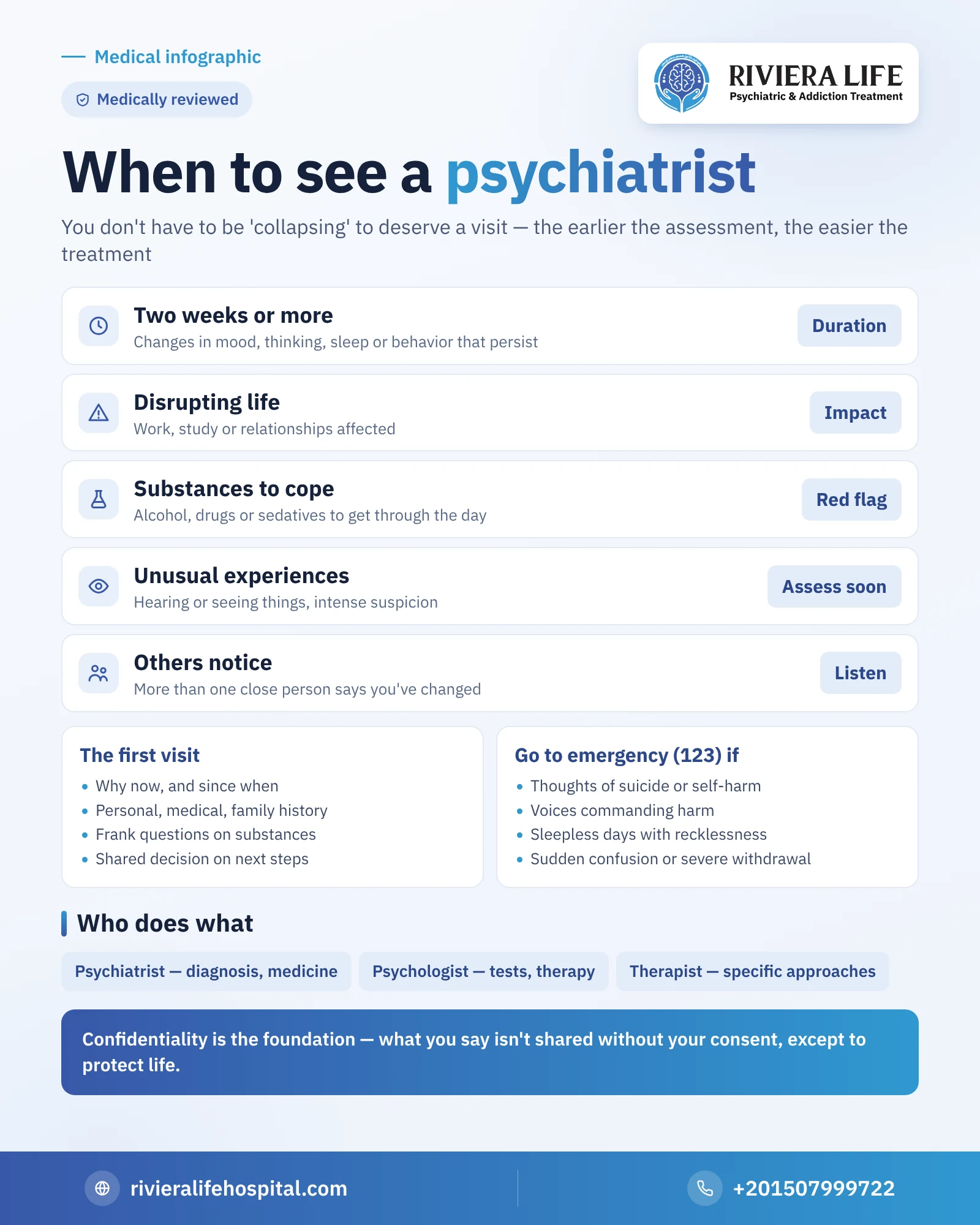
When do you need a psychiatrist? When a change in your mood, thinking, sleep or behavior lasts more than about two weeks and starts to disrupt your work, study or relationships, when you turn to drugs or sedatives to get through your day, or when thoughts of harming yourself appear. You don’t need to be “collapsing” to deserve a visit; the earlier the assessment, the easier the treatment. In this article we set out the signs that say the time has come, the difference between a psychiatrist, a psychologist and a therapist, what happens at the first visit, how to prepare for it, the limits of confidentiality, and when it is an emergency.
Signs that say the time has come
You don’t need a prior diagnosis. It is enough to notice one or more of these signs persistently:
- Sadness, emptiness or a loss of pleasure that lasts most of the day for more than two weeks.
- Anxiety or fear that is hard to control, or sudden episodes of palpitations and breathlessness.
- A clear change in sleep: persistent insomnia, too much sleep, or days with little sleep and abnormal energy.
- Disturbing thoughts that repeat against your will, or rituals that consume your time.
- Difficulty concentrating that affects your work or study.
- Relying on alcohol, drugs or sedatives to calm yourself.
- Hearing or seeing things others don’t, or intense suspicion of people without evidence.
- Recurrent physical symptoms, such as headaches, stomach pains and exhaustion, for which doctors have ruled out a physical cause.
- More than one person close to you telling you that you’ve changed.
The person with the signs may be someone close to you who doesn’t see that they need help. In that case, our article on the behavior of someone with a mental illness helps you know what to notice and how to persuade them to be assessed.
When shouldn’t you wait? Emergencies
Seek urgent help immediately if you see
Don't wait for a clinic appointment. Call an ambulance on 123, the mental health hotline on 16328, or go to the nearest emergency department.
- Thoughts of suicide or self-harm, or talk of death
- Voices commanding the person to harm themselves or others
- Days without sleep with severe recklessness or rapid, disjointed speech
- Sudden confusion or not knowing the place and time
- Threats of violence or losing control of anger
- Severe withdrawal symptoms from alcohol or sedatives, such as seizures
Psychiatrist, psychologist or therapist?
Many people confuse these professions, and the difference between them determines whom you go to first:
| Specialist | Training | What do they offer? |
|---|---|---|
| Psychiatrist | A medical doctor specialized in psychiatry | Diagnosis, prescribing medicines, ordering tests, deciding on the need for an inpatient stay, and may provide psychotherapy |
| Clinical psychologist | Studied psychology with clinical training | Psychological tests and scales, psychotherapy of various types; doesn’t prescribe medicines |
| Therapist or counselor | Specialized training in a particular therapeutic approach | Psychotherapy sessions, family counseling or addiction treatment, usually within a team led by a doctor |
When should you start with a psychiatrist specifically? With severe symptoms, thoughts of harm, psychotic symptoms, sharp mood swings, addiction, when you haven’t improved with psychotherapy alone, or when a physical cause needs to be ruled out. In integrated centers everyone works as one team: the doctor starts with the assessment, then defines each specialist’s role.
What happens at the first visit?
The first visit is more a conversation than an examination, and usually takes longer than later visits. There are no machines that read your thoughts, and nothing will be imposed on you. You usually go through these stages:
- The reason for the visit: what brought you now, when the symptoms began, and how they affect your life.
- Personal history: childhood, education, work, relationships and current pressures.
- Medical and family history: physical illnesses and current medicines, and any mental illness or addiction in the family.
- Substances: frank questions about smoking, alcohol, drugs and sedatives, without judgment.
- Safety assessment: a direct question about thoughts of self-harm, a routine question the doctor asks everyone.
- The next step: the doctor may order tests to rule out physical causes, or psychological scales, then explain their understanding and the treatment options, and the decision is made together with you.
You don’t necessarily leave the first visit with a final diagnosis or a prescription. Sometimes the doctor needs more than one meeting to see the full picture.
How should you prepare for the visit?
- Write down the symptoms you notice, when they began, and what makes them worse or better.
- Prepare a list of all the medicines and supplements you take, and any recent tests.
- Ask your family about the family history if you don’t know it.
- Be frank about substances and alcohol; the doctor needs the information to protect you, not to judge you.
- Write down your questions in advance: what is the likely diagnosis? What are the treatment options? How long will improvement take?
- You can bring someone you trust, especially if you are nervous or find it hard to remember details.
Is what I say confidential?
Yes. Confidentiality is the foundation of the relationship between patient and psychiatrist, and what you say isn’t passed on to your family or work without your consent. The only medically recognized exception is a real, immediate danger to your life or someone else’s, and even then the aim is protection, and the doctor tries to involve you in the decision. With teenagers, the doctor discusses with the family and the teenager together the limits of what is shared.
How do you choose the right doctor?
A comfortable relationship with the doctor is part of the treatment itself; a patient who trusts their doctor speaks frankly and sticks to the plan. When choosing, pay attention to these points:
- That they are a doctor specialized in psychiatry, working in a licensed place.
- That they listen to you and explain the diagnosis and options in language you understand, and answer your questions without impatience.
- That they involve you in decisions, especially about starting or changing medicines.
- That they work with psychologists and therapists if you need psychotherapy alongside medicine.
- That they don’t promise you a guaranteed cure in days; real improvement takes time and follow-up.
And if you don’t feel comfortable after several visits, you have the right to ask for a second opinion, without stopping treatment suddenly.
Outpatient clinic or inpatient stay?
Most cases are treated in the outpatient clinic with regular sessions. An inpatient stay is usually needed when there is a risk to safety, psychotic symptoms or severe mania, a need for safe withdrawal from drugs or sedatives, or when outpatient treatment has failed. If you are comparing places, our article on psychiatric hospital prices in Egypt may help you understand what determines the cost and how to choose.
And if the doctor decides the case needs an inpatient stay, learn about what the Riviera Life psychiatric hospital offers before deciding.
What if you’re hesitant or afraid?
Hesitation is natural, and often comes from false images of psychiatry, such as that medicines change your personality or that the doctor will judge you. We corrected the best-known ones in our article on myths about mental illness. You can start with a smaller step: an inquiry call, or a single consultation in which you hear the doctor’s opinion and then decide.
And if your symptoms are mainly physical and doctors have ruled out a physical cause, read our article on psychosomatic disorders; the answer may be there.
And if what holds you back is embarrassment or distance, you might start with an online psychiatrist consultation, and some women prefer a female psychiatrist for the first visit.
How can Riviera Life help you?
At Riviera Life in Sheikh Zayed, you start with a free first consultation with a consultant psychiatrist, in complete confidentiality and without obligation. The team includes psychiatrists, psychologists and therapists working together, with the possibility of an inpatient stay under round-the-clock medical supervision for cases that need it. To book or inquire: +201507999722.
And if the case needs an inpatient stay, read about psychiatric hospitals in Egypt and how to choose between them.
Read also
- Mental illnesses: symptoms, types and treatment
- Cognitive behavioral therapy
- Myths about mental illness
- The behavior of someone with a mental illness
- Mental illness in older people: signs, causes and treatment
- Caring for someone with dementia: a practical guide for carers
- Psychological tests: types and free tests
Questions many people ask
A psychiatrist is a medical doctor who diagnoses, prescribes medicines and orders tests, while a psychologist carries out psychological tests and provides talking therapy but doesn't prescribe medicines.
Not necessarily. Some cases need psychotherapy only, and sometimes the doctor needs more than one meeting or tests before any decision, which is made together with you.
Yes for adults. Confidentiality is the basis of the therapeutic relationship, and information isn't shared without your consent, except when there is a real, immediate danger to life.
It is usually longer than later visits because it covers your personal, medical and family history and an assessment of your current state; its length varies from place to place.
With thoughts of suicide or harm, voices commanding harm, sudden confusion, or severe agitation, call an ambulance on 123 or go to the nearest emergency department.