The harms of snuff are no less than those of other tobacco products, even though many think of it as a habit lighter than smoking. Snuff is a fine tobacco powder inhaled through the nose or placed in the mouth, and Arab and Asian societies have known it for a long time. It delivers nicotine to the blood quickly through the vessel-rich lining of the nose, causes addiction like the others, harms the nose, sinuses and sense of smell, and health authorities classify smokeless tobacco in general among causes of cancer. Here we explain what snuff is, what has been proven about its harms and what is still unsettled, why people become attached to it, and how to quit it.
What is snuff?
Snuff is made from ground tobacco leaves that may be fermented and scented with additives such as menthol, herbs or aromatic oils. There are several types:
- Dry snuff: a fine powder sniffed through the nose, known in some countries as “sa’ut”.
- Moist snuff: a moist powder placed between the lip and gum, closer to toombak, which our article on toombak explains.
- Scented and modern types: some sold in smart packaging with flavors that attract young people.
Names differ from country to country, so ask about the contents if you aren’t sure: everything that contains tobacco or nicotine is covered by what follows in this article.
How does nicotine act when inhaled through the nose?
The nasal lining is thin and rich in capillaries, so nicotine is absorbed from it quickly and reaches the brain within minutes. The rapid absorption is what creates the habit: a mild high and alertness, then a dip that pushes toward another dose. Over time the user needs more times during the day, and feels tension, headache and difficulty concentrating if it is delayed.
And because snuff is silent, with no smoke and hardly any smell, some use it in places where smoking is banned, so the number of times increases without those around them, or they themselves, noticing.
What does it do to the nose, sinuses and sense of smell?
The nose is the first receiving line, and it bears the irritation of the powder directly. Among the common complaints of regular users:
- Nasal dryness, crusting of its lining and chronic congestion.
- Repeated nosebleeds and internal sores.
- Frequent sneezing, runny nose, blockage and sinus headaches.
- A weaker sense of smell, which may be followed by weaker taste.
- A dry throat and cough because the powder drips into the pharynx.
Some of these changes improve after stopping, but severe loss of smell may not return completely in those who used it for years, and the duration of use seems to play a role.
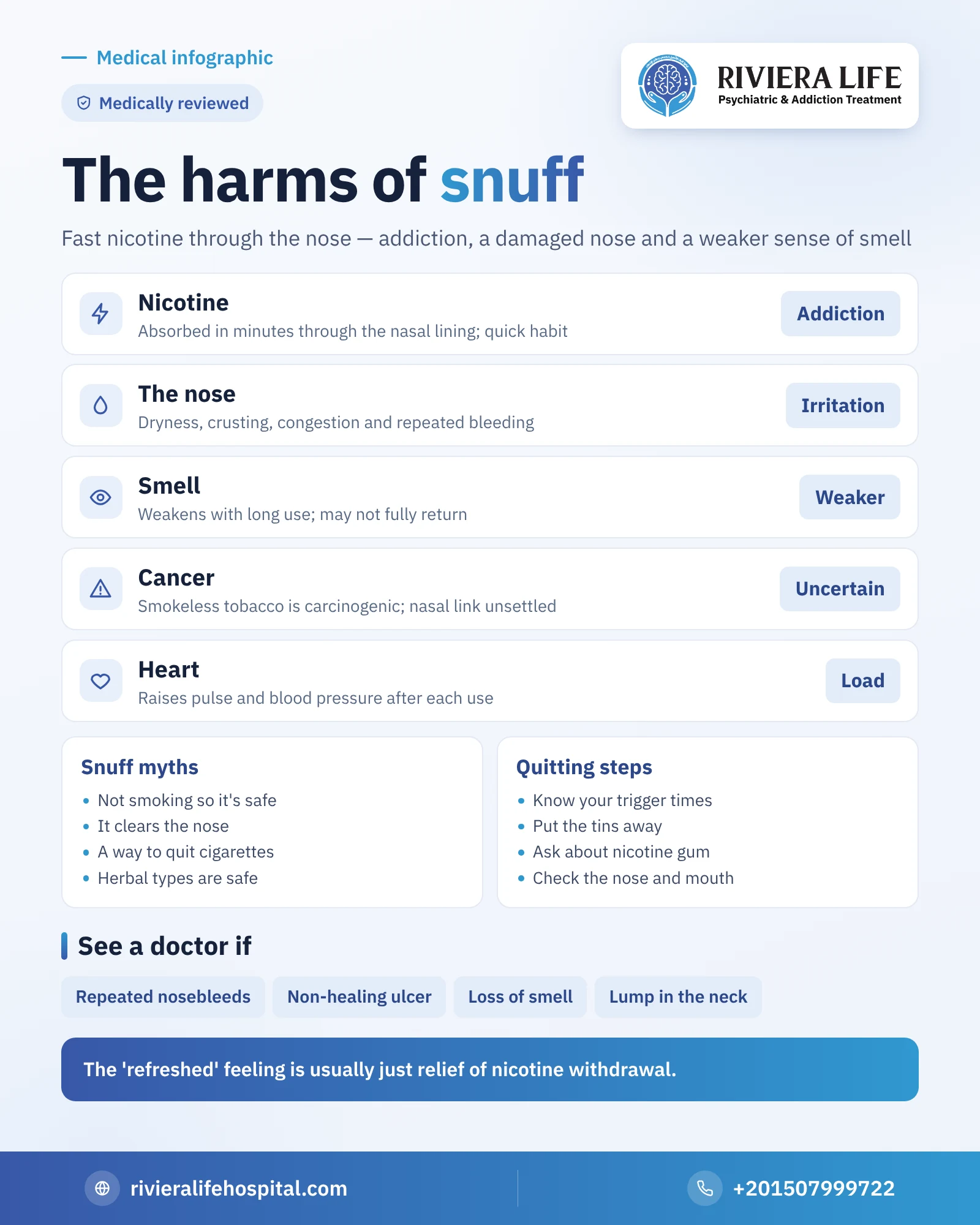
Snuff and cancer: what is proven and what is unsettled?
Precision is needed here. Health authorities, including the International Agency for Research on Cancer, include smokeless tobacco in general among carcinogenic substances, and link it to cancer of the mouth, esophagus and pancreas. This link is clearest for products placed in the mouth, such as toombak and chewing tobacco.
As for snuff sniffed through the nose specifically, studies on cancer of the nose and sinuses are fewer, older and sometimes conflicting, and we can’t give an exact figure. But the absence of conclusive evidence for a particular type of cancer doesn’t mean safety: the powder contains tobacco-specific nitrosamines, which are known carcinogens, it stays in contact with nasal tissue, and part of it is swallowed with mucus. So it is safest to regard it as a harmful tobacco product.
Harms beyond the nose
- Heart and blood vessels: nicotine temporarily raises blood pressure and pulse after each use, and with chronic addiction the load on the heart increases.
- Pregnancy: nicotine in any form may harm the fetus, and snuff should be avoided during pregnancy and breastfeeding.
- Teeth and gums: the mouth is affected when the moist type is used, or when part of the powder drops into the throat and mouth.
- Children: tins and powder within their reach may cause nicotine poisoning if swallowed, so keep them away.
Why do people become attached to snuff?
Many reasons recur: a habit a young man inherits from his father, grandfather or work friends, the ease of hiding it, an impression that it cleans the nose, opens the chest or stimulates the mind, and its low price compared with cigarettes. The truth is that the feeling of “refreshment” is usually the disappearance of nicotine withdrawal symptoms, not a real benefit. Some young people turn to it as an alternative to cigarettes in a society that doesn’t accept smoking, so they swap one addiction for another.
Does it differ from cigarettes in addiction?
In principle, the brain deals with nicotine in the same way whatever its source. The rise may be faster with a cigarette, but snuff gives a repeated flow throughout the day, and many of its users use it dozens of times a day without counting it as addiction. If you feel uneasy, irritable or unable to concentrate when your tin runs out, reach for it as soon as you wake, or use snuff despite nose problems and bleeding, these are signs of dependence explained in our article on nicotine addiction.
Snuff myths
- “It isn’t smoking, so it’s safe”: the harm moves from the lungs to the nose, mouth and heart, and the addiction remains.
- “It cleans the nose and head”: it irritates and dries the nose, and may increase congestion.
- “A way to quit cigarettes”: no health authority has approved it as a quitting medicine, and it is better to consult the doctor about approved nicotine replacements.
- “Herbal types without tobacco are safe”: they may contain irritants, and tobacco is added to some without clear labeling.
How do you quit snuff?
Quitting it resembles the plan for quitting smoking in principle, with particularities of the habit:
- Identify the times you use it: after waking, with tea, while driving or working, and prepare an alternative for each situation.
- Put the tins away from home, work and the car, as having them in your pocket brings the habit back automatically.
- Tolerate nasal dryness temporarily: the doctor or pharmacist may prescribe suitable nasal moisturizers after stopping; don’t use drops without advice.
- Ask about nicotine replacements: such as the gum explained in our article on nicotine gum; the doctor decides what suits you and how to use it.
- Ask for a check of the nose and mouth if bleeding, an ulcer, a patch or weak smell persists after stopping.
And if you want to know what happens in your body after stopping and how long nicotine stays in it, our article on how long nicotine stays in the body has useful details.
What changes after stopping?
Within days to weeks, withdrawal symptoms ease, the nose starts to recover from dryness and irritation, and bleeding decreases for many. Smell may improve gradually over months, to degrees that vary from person to person. And every day without nicotine lightens the load on the heart and blood pressure. Don’t expect the craving to disappear suddenly; it comes in waves that get shorter and weaker over time if it doesn’t win each time.
When do you need a doctor?
See an ear, nose and throat doctor or a dentist if you have repeated nosebleeds, a sore in the nose or mouth that doesn’t heal within two or three weeks, a one-sided blockage that doesn’t go away, a clear loss of smell, white or red patches in the mouth, or a lump in the neck. These signs mustn’t be neglected, and early detection changes the outcome a lot.
How can Riviera Life help you?
If you have tried more than once and gone back, if snuff is part of multiple nicotine use such as cigarettes and shisha, or if anxiety or depression lives alongside it, an assessment by Riviera Life’s psychiatry and addiction consultants helps you set one plan covering everything you use. The hospital is licensed by the Ministry of Health with fourteen years of experience, and the first consultation is free and confidential around the clock on +201507999722; our center is in Sheikh Zayed, Giza.
More from our smoking and nicotine guide
- Toombak: what it is and its harms to the mouth
- Nicotine addiction: symptoms, withdrawal and harms
- Quitting smoking: a practical plan
- The harms of shisha
- Smoking and nicotine: the complete guide
Questions many people ask
There is no smoke, but it delivers nicotine quickly, causes addiction and harms the nose and the sense of smell, so it isn't considered a safe alternative.
Health authorities link smokeless tobacco to cancer of the mouth, esophagus and pancreas; as for nasal cancer from snuff specifically, the evidence is weaker and unsettled, and it remains a harmful product.
It may weaken it with long use and chronic irritation, and smell may improve partly after stopping, but it doesn't return completely for everyone.
Dry snuff is sniffed through the nose, while toombak is placed in the mouth between the lip and gum, and both are addictive smokeless tobacco.
Identify the times you use it, put the tins away and prepare an alternative, ask the doctor about nicotine replacements, and see him if bleeding, an ulcer or weak smell persists.