The causes of social phobia are many and can’t be traced to a single factor. What research reveals is that a genetic predisposition, a reserved temperament since childhood and a brain highly sensitive to signals of rejection may meet painful experiences such as bullying or public embarrassment, and the fears begin. But what explains the fear lasting for years is something else: mental and behavioral habits the person adopts to protect themselves, which feed the fear instead of extinguishing it. This article explains both sides together: how the fears begin, how they persist over time, and who is most vulnerable.
Genetics: does social phobia run in families?
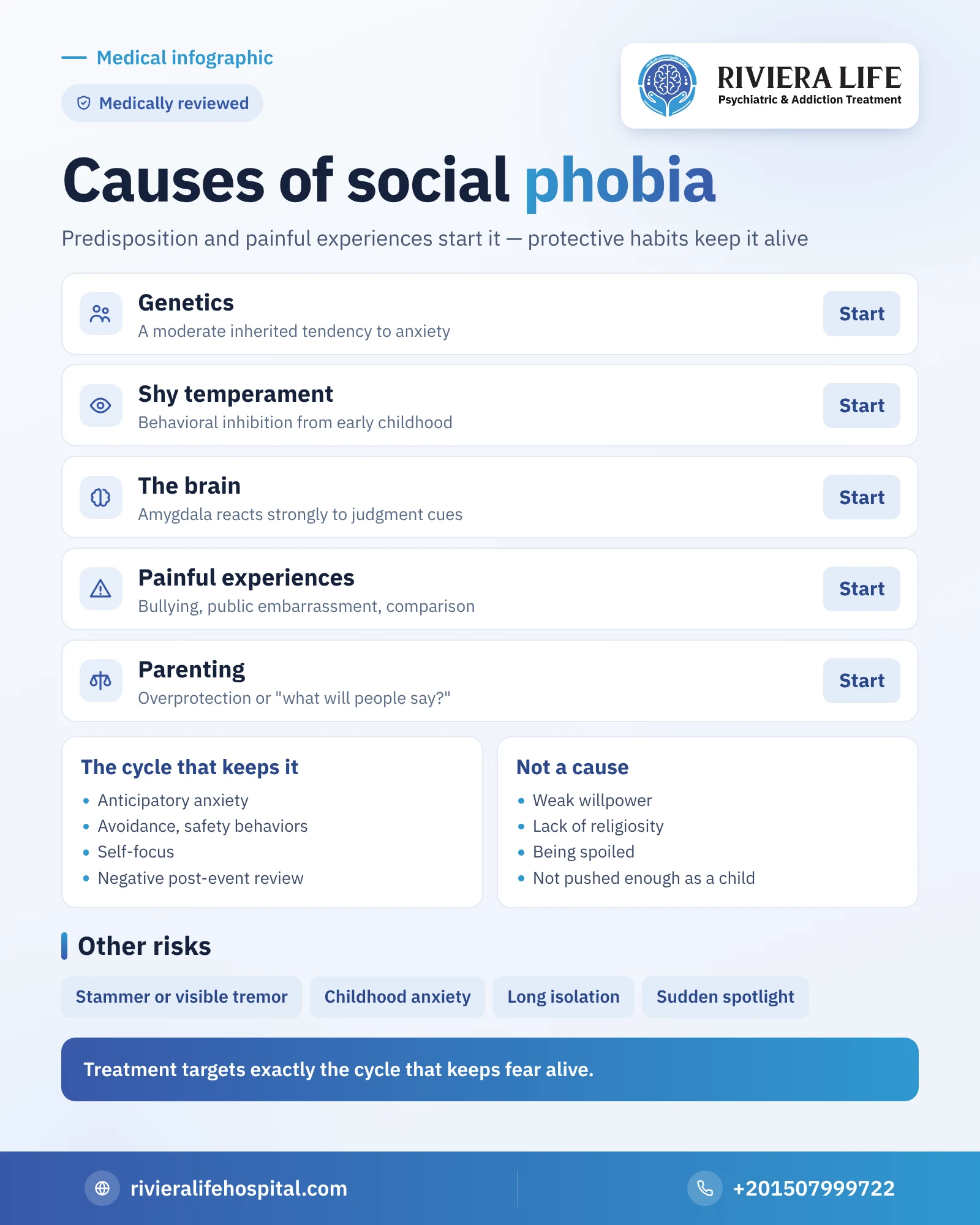
Yes, to some extent. First-degree relatives of someone with social phobia are more likely to develop it than others, and twin studies point to a roughly moderate genetic contribution. But what is inherited isn’t the illness itself, but a general tendency to anxiety and reserve. The son of a father with the phobia may never develop it, and someone with no similar case in their family may develop it. The part that is hard to separate is that the family also passes on patterns of dealing with people; a child who sees his father avoid guests learns that guests are something worrying.
A reserved temperament from early on
Researchers note that some children meet everything new with caution: they hide behind their mother when a guest comes in, and need a long time before they play with children they don’t know. This temperament, called behavioral inhibition, isn’t an illness, and many who have it grow up without any disorder. But it raises the likelihood of social phobia appearing later, especially if combined with other factors mentioned below.
What happens in the brain?
Imaging studies indicate that the amygdala, the area that picks up threat signals, responds more strongly in many people with social phobia when they see angry or critical faces, or when they expect to be evaluated. Meanwhile, the frontal areas that calm this response appear less efficient at controlling it. The disorder is also linked to changes in serotonin and dopamine systems, which partly explains its response to medicines that act on serotonin. These findings describe associations, not a complete story, and no test or scan diagnoses social phobia.
Painful social experiences
Many patients remember a particular moment: the whole class laughing when he made a mistake reading aloud, a teacher mocking his accent in front of everyone, or bullying that lasted years in middle school. These situations teach the brain a harsh lesson: that appearing in front of people brings pain. There needn’t be a major trauma; sometimes small situations accumulate, such as constant comparison with a high-achieving cousin, until a conviction forms that the person is less than others. On the other hand, not everyone who has been bullied develops the phobia, as the experience usually meets an existing predisposition.
Parenting style
Two parenting patterns have been linked to increased risk. The first is overprotection: parents who speak for the child everywhere and spare them any situation in which they might get tense, so they don’t gain the experience that they are capable of acting. The second is constant criticism and excessive concern with others’ opinions, when the phrase “what will people say about us?” is present in every decision. A child who grows up in this atmosphere learns that people’s eyes are a permanent court. This doesn’t mean blaming parents; most act out of love, and adjustment is possible at any time.
Adolescence: why do most cases begin then?
In adolescence many things change together: the body changes quickly, peers’ views become a measure of worth, and the social brain becomes highly sensitive to acceptance and rejection. Social media adds a new layer, where life is displayed in idealized form and every post is measured by the number of likes. That is why doctors aren’t surprised that social phobia usually appears between roughly eight and fifteen, though it may sometimes begin at an older age, for example after a promotion that imposes new tasks in front of people.
The way of thinking: the self-image from outside
The best-known cognitive model of social phobia describes what happens in the situation: as soon as the person enters the room their attention turns inward, and they paint in their mind a picture of themselves as they think others see them, an exaggerated picture, with a completely red face and a broken voice. Then they treat this picture as if it were real. Added to it are firm beliefs such as “I must always appear confident” or “if they know I’m nervous they’ll despise me”. These thoughts don’t disappear with logic alone, but they change when tested in reality.
The cycle that keeps fear alive
Here is the reason the phobia continues even years after the first experience has passed. The cycle goes like this:
- Anticipatory anxiety: days of imagining failure before the situation.
- Avoidance or safety behaviors: either staying away, or attending with tricks to hide the tension.
- Self-focus: watching the body instead of following the conversation, so performance seems weaker.
- Negative review after the situation: magnifying small mistakes and forgetting what went well.
- Confirming the fear: the outcome looks like new evidence that the fears are right, so anxiety grows for next time.
Importantly, this cycle is exactly what treatment targets, as we explain in our article on social phobia treatment.
Other factors that raise the risk
- A visible condition the person fears people will comment on, such as a stammer, a hand tremor or a facial scar.
- A history of other anxiety disorders in childhood, such as separation anxiety or selective mutism.
- Long isolation that deprives the person of practicing social skills, as happened to many during lockdown periods.
- Life changes that suddenly put the person in the spotlight, such as moving to a new school or country or a leadership position.
Alcohol and substances: cause or consequence?
The relationship runs in both directions. The phobia usually precedes drinking and substance problems, because the person discovers that alcohol or bango eases tension before meetings. But regular use turns around to increase anxiety in the following days, and weakens confidence in the ability to face situations without a substance. Excessive caffeine and energy drinks may also increase physical symptoms such as trembling and palpitations, so the situation seems more threatening.
Can the risk be reduced in children?
There is no recipe that fully prevents social phobia, but some habits ease the effect of risk factors. A reserved child benefits from calm encouragement to repeated small experiences, such as asking the shopkeeper for something themselves, rather than being excused from them or pushed roughly. Dealing seriously with bullying at school, not mocking the child in front of others, and talking about mistakes as a normal part of learning all reduce the feeling that eyes are judging them. And when signs appear of fear that disrupts study or friendships, early assessment is better than waiting for them to “grow up and forget”.
What doesn’t cause social phobia?
Explanations circulate that increase the sufferer’s distress instead of helping them. Social phobia isn’t evidence of weak will, nor of lack of religiosity, nor of being “spoiled” or of bad character. Nor is it the result of the person not having been forced enough to face people when young; harshly pushing someone into situations without support may increase fear.
And the sufferer doesn’t choose their feelings, and many of them make a huge daily effort no one sees to attend a lecture or a meeting. Understanding this eases guilt, and opens the way to seeking treatment instead of years of self-blame. And when the doctor asks about childhood and experiences, they aren’t looking for someone to accuse, but for threads that help draw up a plan that suits you.
How can Riviera Life help you?
Understanding the causes isn’t a goal in itself, but it determines where treatment starts. In the first assessment, free and confidential, the consultant psychiatrist looks with you for the factors specific to you, and for any accompanying depression or substance use, then proposes a plan that targets the cycle keeping your fear alive.
More from our social phobia guide
- Social phobia: the complete guide
- Social phobia symptoms
- Types of social phobia
- Social phobia treatment
Questions many people ask
Genetics has a roughly moderate role; it passes on a tendency to anxiety and shyness, not the illness itself, and interacts with experiences and environment.
Bullying and repeated embarrassment are known risk factors, especially in those with an existing predisposition, but it isn't the only cause and doesn't inevitably lead to it.
Because avoidance, safety behaviors and negative review after situations stop the person discovering that their fears are exaggerated, so the fear remains.
It may raise the risk because it deprives the child of experiences in which they succeed on their own, but it is one factor among many, and can be adjusted at any age.
Usually the phobia comes before use, but regular use increases anxiety in the following days and deepens reliance on the substance to bear situations.