Social anxiety disorder can be treated, and many patients regain their ability to work, study and have relationships after months of regular treatment. The first choice in approved guidelines is cognitive behavioral therapy designed specifically for this disorder, and medicine, most commonly serotonin reuptake inhibitors, is added when symptoms are severe or psychotherapy isn’t enough. Alongside them are self-help steps that are useful at home, provided they complement treatment rather than replace it when the condition is moderate or severe. This article explains the plan from assessment to relapse prevention, then helps you choose a place of treatment.
The start: an assessment that shapes the plan
Before any session or medicine, the doctor needs a clear picture: which situations are frightening? Is the fear limited to performing in front of an audience, or does it extend to most encounters? Is there accompanying depression or panic attacks? Does the patient drink alcohol or use a substance to endure situations? These answers distinguish a short plan for performance anxiety from a longer plan for the broad picture, as we explain in our article on the types of social anxiety. It helps for the patient to set concrete goals from the start, such as “asking a question in a lecture” or “going to a job interview”, rather than a general goal like “becoming confident”.
If you aren’t yet sure that what you have is social anxiety and not ordinary shyness, start with our guide to social anxiety, then our article on social anxiety symptoms.
Cognitive behavioral therapy designed for social anxiety
The approved British guidelines recommend individual therapy based on models developed specifically for this disorder, usually around fourteen sessions over about four months. It is an active therapy with experiments and homework, and among its most important components are:
Mapping your personal cycle
The patient and therapist draw a map of what happens to them: the thoughts before the situation, the physical symptoms, the tricks they resort to, and the review that follows. Seeing the cycle on paper makes it understandable and breakable.
Behavioral experiments
Instead of arguing with the thought “everyone will notice my voice shaking”, the patient tests it: they speak in a real situation once with safety behaviors and once without, then compare. Many discover they came across better when they stopped hiding.
Shifting attention outward
Training to follow the conversation and people’s faces instead of monitoring the body. A video recording of a short talk may be used, so the patient sees themselves from outside and compares the picture with what they imagined.
Gradual exposure and dealing with the post-event review
A ladder of situations the patient climbs gradually, while learning to stop the painful review after each encounter and replace it with a balanced assessment of what actually happened.
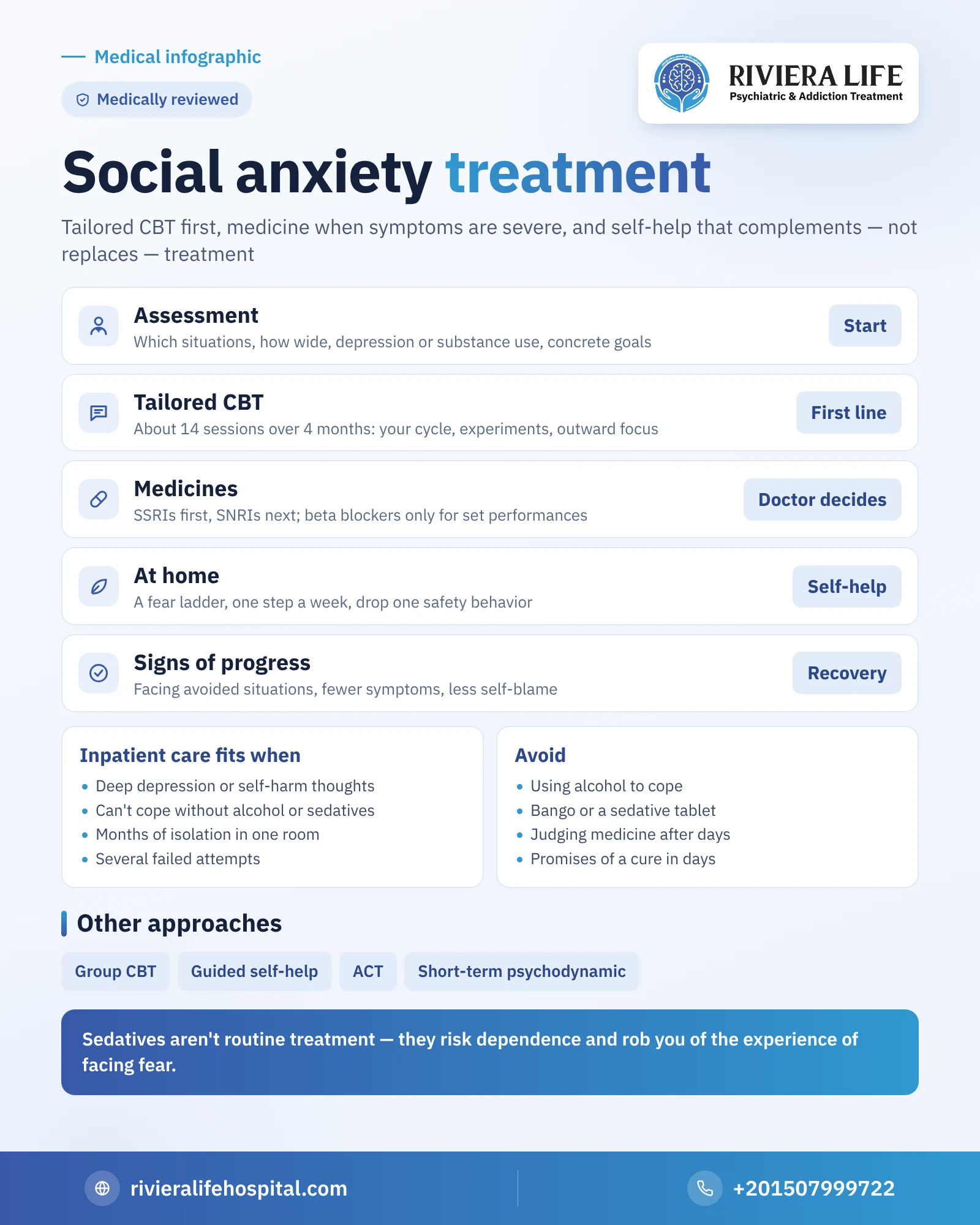
Other psychological approaches
- Group cognitive behavioral therapy: a small group training together, which is itself a social situation suitable for exposure, though guidelines prefer individual therapy when available.
- Guided self-help: a book or online program based on cognitive behavioral therapy with follow-up from a professional, an option for those hesitant about individual therapy.
- Acceptance and commitment therapy: trains you to let the fear be there and move toward what matters to you despite it.
- Short-term psychodynamic therapy: may be offered to those who don’t want cognitive behavioral therapy, and its evidence is weaker.
To learn about these approaches in the context of anxiety disorders in general, see our article on anxiety treatment.
Medicines: when are they used, and what classes?
The decision on medicine, its type and duration belongs to the psychiatrist alone. The main classes:
- Selective serotonin reuptake inhibitors: the first medicine choice. They aren’t addictive, but their effect builds over weeks, so they shouldn’t be judged after days.
- Serotonin and noradrenaline reuptake inhibitors: an alternative when the patient doesn’t respond to or can’t tolerate the first class.
- Monoamine oxidase inhibitors: a later option in selected cases, under specialist supervision with precise dietary and medication instructions.
- Beta blockers: some doctors may prescribe them before a specific performance situation to ease trembling and palpitations, but they don’t treat the anxiety itself, and don’t suit some patients such as those with asthma.
Sedatives from the benzodiazepine family aren’t considered routine treatment, because of the risk of dependence and because they may deprive the patient of the experience of facing fear on which improvement depends. After improvement, doctors usually advise continuing the medicine for at least about six months, then reducing it gradually under the doctor’s supervision.
Steps that help you at home
Self-help based on the principles of cognitive behavioral therapy really is useful, especially in mild cases or between sessions. Here are practical steps:
- Write your fear ladder: ten situations ordered from easiest to hardest, such as asking a shop assistant about a price, then calling a restaurant, then sharing an opinion in a meeting.
- Climb one step a week: repeat the situation until it becomes less distressing before moving on, and don’t wait for the tension to disappear completely.
- Drop one trick: leave your phone in your pocket, or look at the person talking to you, and notice what actually happens.
- Turn your attention to others: focus on what the other person is saying and the details of the place instead of monitoring your face and voice.
- Stop the post-meeting trial: write three things that went well for every thing you see as embarrassing.
- Calm your body: slow breathing before the situation, regular sleep, daily movement and less caffeine.
Avoid making alcohol, bango or a sedative tablet your way of coping with situations; that path starts with quick relief and ends in dependence and worse anxiety. If several weeks of serious effort pass without improvement, or the symptoms have disrupted your life from the start, self-help alone isn’t enough.
How can the family help?
The most useful thing the family offers is to encourage practice without pressure, and to gradually stop doing tasks on the patient’s behalf, in agreement with them and their therapist. Celebrating a small step, such as a call they made themselves, makes a bigger difference than general advice.
When does the patient need a program inside the hospital?
Inpatient care isn’t the usual path in social anxiety; the outpatient clinic is enough for most patients. The calculation changes in three situations: social anxiety accompanied by deep depression and thoughts of self-harm; someone who can no longer get through the day without alcohol or sedatives and needs to withdraw from them under medical supervision, as in the alcohol addiction treatment program; or isolation that has lasted months inside a single room despite more than one attempt at treatment. In these situations an inpatient program provides safety and daily sessions that shorten the road.
Signs of recovery from social anxiety: how do you know you are improving?
Recovery here doesn’t mean the dread of social situations disappears completely, as no one is free of it. It means the dread shrinks to a size you can tolerate, and your fears no longer decide what you do. Improvement usually appears gradually and in uneven stages, and may include small setbacks that don’t mean treatment has failed; what matters is the general direction over weeks and months.
Signs of improvement the therapist looks for:
- Accepting situations you used to avoid, such as a phone call or speaking in a meeting.
- Fewer physical symptoms such as trembling and palpitations, and faster recovery from them.
- Fewer thoughts predicting rejection before the situation and less self-criticism after it.
- Gradually giving up safety behaviors, such as staring at your phone or memorizing what to say word for word.
- No longer needing alcohol or sedatives to enter social occasions.
- The return of the desire to build relationships and friendships and take up work and study opportunities.
The doctor measures this with repeated interviews and approved symptom scales, so don’t rely on your feeling alone. If things stall for many weeks, review your plan with your therapist; that may mean adjusting cognitive behavioral therapy or the medicine. To track what you were going through at the start, go back to the page on social anxiety symptoms.
The right hospital for social anxiety treatment: how to choose
The most suitable hospital for someone with social anxiety isn’t the biggest or best known, but the one that has what this condition in particular needs: therapists who apply the cognitive behavioral therapy designed for social anxiety with its experiments and exercises, doctors who don’t rush to sedatives, and a team that picks up what hides behind the fear, such as depression or substance use. Before you decide, put these questions to any provider:
- Will you actually practice real situations with your therapist, or will the sessions be limited to talking?
- Does the team distinguish between performance anxiety, the broad picture and avoidant personality before setting the plan?
- What is their position on sedatives, and do they have experience in withdrawing them gradually for those used to them?
- Is drinking, bango or accompanying depression treated within the same plan, not by referral elsewhere?
- Can you start with a call or a message, and is your visit kept away from any third party?
- Who will follow up with you after the sessions end, and how will you deal with new situations?
Any promise to get rid of social anxiety in days, or of a guaranteed result in advance, is a sign to look elsewhere.
How Riviera Life meets these standards in social anxiety treatment
Riviera Life applies these standards as follows:
- Ministry of Health license: an officially approved facility for psychiatry and addiction treatment.
- Fourteen years of experience: a long journey with anxiety disorders and addiction, and thousands of cases that have recovered.
- A team of consultants: consultants in psychiatry and addiction treatment precisely identify the type of social anxiety and choose medicine carefully when needed.
- One plan for dual diagnosis: treating the fear and withdrawing from alcohol, sedatives or bango go together.
- Medical care that doesn’t stop: round-the-clock supervision throughout the stay for those who need it.
- Complete privacy: full confidentiality for those worried that someone will learn of their first step.
- The family is part of treatment: a family program that teaches encouragement instead of overprotection, and aftercare after discharge.
Start with a free first consultation, and call us at any time, night or day, on +201507999722. The hospital is located in Sheikh Zayed, Giza.
More from our social anxiety guide
- Social anxiety: the complete guide
- Social anxiety symptoms
- The causes of social anxiety
- The types of social anxiety
- Social anxiety and addiction: when the temporary fix becomes a second problem
- Social anxiety test: instant result
Questions many people ask
Self-help based on cognitive behavioral therapy helps in mild cases and between sessions, but it complements specialist treatment rather than replacing it in moderate and severe cases.
Tailored cognitive behavioral therapy usually lasts about four months, and if a medicine is used it usually continues for several months after improvement, then is reduced gradually.
The serotonin reuptake inhibitors mainly used aren't addictive, but sedatives may cause dependence, which is why they aren't a routine treatment for social anxiety.
A doctor may prescribe beta blockers to ease trembling and palpitations before a specific performance situation, but they don't treat the anxiety itself and don't suit every patient, so don't take them without consultation.
Tailored cognitive behavioral therapy, careful prescribing and treatment of accompanying depression or substance use. Riviera Life in Sheikh Zayed meets these standards: licensed by the Ministry of Health, with specialist consultants and round-the-clock supervision.