Anxiety disorders aren’t a single type. When talking about the types of anxiety, the fifth edition of the American Diagnostic and Statistical Manual and the eleventh revision of the International Classification of Diseases list seven main disorders: generalized anxiety, panic, agoraphobia, specific phobia, social anxiety, separation anxiety and selective mutism. What separates them is the focus of fear: what the person fears, when, and what they avoid. Alongside them is anxiety caused by a substance or an organic illness. This article explains each type in simple language, clarifies why OCD and PTSD left this group, and then offers a comparison table.
How are anxiety disorders classified today?
These disorders share two elements: excessive fear or anxiety out of proportion to the actual danger, and avoidance behavior through which the person tries to protect themselves. For any of them to be diagnosed, it must cause clear distress or disruption of life, and not be better explained by a substance or another illness. Classification isn’t an academic luxury; treatment changes with the type, and the right exposure for a panic patient differs from the right exposure for a patient with a fear of injections. The accurate diagnosis is made by a doctor or psychologist, and the following description is for information, not self-diagnosis.
1. Generalized anxiety disorder
This is “multi-topic” anxiety. The person moves from worrying about the children’s health to work to money to the country’s news, and finds it hard to stop this stream. It continues most days for at least six months, accompanied by muscle tension, tiredness, insomnia, difficulty concentrating and irritability. Many describe themselves as “anxious by nature” and don’t realize it is a treatable condition. This picture is more common in women, and may intensify with hormonal changes, as we explain in the article on excessive nervousness in women.
2. Panic disorder
It is based on sudden panic attacks that recur without a clear cause and peak within minutes. But the attack alone isn’t enough for diagnosis; what distinguishes the disorder is what comes after: a month or more of constant fear of the next attack, or changing behavior to avoid it, such as giving up exercise because palpitations are a reminder of the attack. Many patients move between emergency departments before reaching the diagnosis.
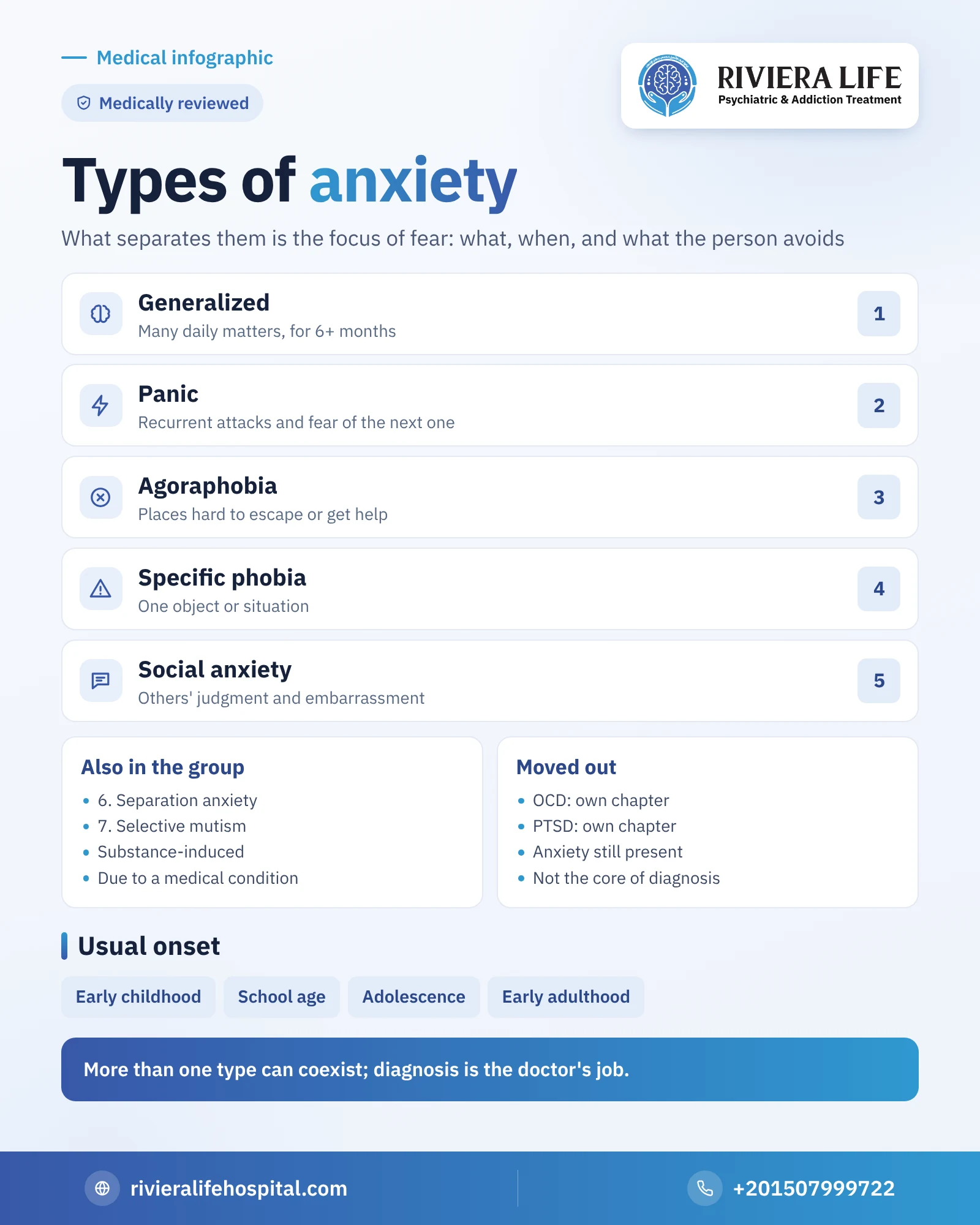
3. Agoraphobia
Its name is a little misleading, as it doesn’t mean fear of open spaces only. Its focus is fear of being in a place from which it is hard to get out or to get help if something embarrassing or frightening happens. This usually includes two or more of: public transport, open spaces such as car parks, enclosed places such as shops and cinemas, queues and crowds, and leaving the house alone. In severe cases the person may stay at home for years. It is often linked to panic disorder, but may appear without it.
4. Specific phobia
An intense, immediate fear of a particular object or situation, which the person usually realizes is exaggerated but can’t control. Doctors divide it into categories:
- Animals: dogs, cats, insects or snakes.
- The natural environment: heights, water or storms.
- Blood, injections and injuries: which may cause real fainting due to a drop in blood pressure, unlike the other types.
- Situations: planes, lifts or confined spaces.
- Other categories: such as fear of vomiting or choking.
It is one of the most common types of anxiety, and one of those that respond best to exposure treatment.
5. Social anxiety disorder
Its focus is fear of how others see you: being judged, embarrassed, or people noticing your face blushing or your voice trembling. It appears when talking to strangers, eating in front of others, or speaking in a meeting. It isn’t ordinary shyness, but a fear that makes the person turn down a promotion because it requires a presentation. This type has its own page on our site, social anxiety, which explains its patterns and treatment.
6. Separation anxiety disorder
Excessive fear of being apart from the people the affected person is attached to, with constant worry that something bad will happen to them. In a child it shows as refusing to go to school or sleep away from their parents, nightmares about loss, and physical complaints at separation. What many overlook is that it can affect adults too, such as a mother who calls her university son many times a day and doesn’t calm down until he answers.
7. Selective mutism
It mostly affects children, and usually starts in the preschool years. The child speaks fluently at home, but is completely silent at school or in front of strangers for at least a month. It isn’t stubbornness or weak language, but anxiety that paralyzes the ability to speak in particular situations, and it is often linked to social anxiety. Pressuring the child to speak usually makes the problem worse.
Other types: anxiety caused by a substance or illness
The classification adds two more types when anxiety is a direct result of another cause. The first is anxiety caused by a substance or medicine: during stimulant use or excessive caffeine, or during withdrawal from alcohol or withdrawal from benzodiazepines. The second is anxiety caused by a medical condition such as an overactive thyroid. Treating both starts with dealing with the cause itself, and the details of these factors are in the article on the causes of anxiety.
Why did OCD and PTSD leave the list?
In older classifications, OCD and post-traumatic stress disorder were counted among the anxiety disorders. With the fifth edition of the American manual, each got its own chapter. OCD is distinguished by intrusive thoughts and repeated compulsive acts, and is linked to brain circuits and treatments with their own specifics. PTSD requires a traumatic event, and its symptoms include flashbacks, nightmares and hypervigilance. Anxiety remains present in both, but it isn’t the core of the diagnosis.
A quick comparison of the seven types
| Type | Focus of fear | What the person usually avoids |
|---|---|---|
| Generalized anxiety | Multiple daily matters | Uncertainty and decisions |
| Panic | The attack itself and its physical symptoms | Exertion and places where an attack happened |
| Agoraphobia | Being unable to get out or get help | Transport, crowds and going out alone |
| Specific phobia | A particular object or situation | That thing specifically |
| Social anxiety | Others’ evaluation and embarrassment | Speaking, eating and presenting in front of people |
| Separation anxiety | Separation and losing loved ones | Being away from family and sleeping alone |
| Selective mutism | Speaking in particular situations | Talking at school or with strangers |
When does each type usually start?
Each type has an age at which it usually appears, which helps parents pay attention at the right time. Separation anxiety and selective mutism appear in early childhood, and specific phobia often starts at school age. Social anxiety usually emerges in adolescence, when peers’ opinions matter more.
Panic disorder and agoraphobia usually appear in late adolescence and early adulthood, while generalized anxiety may start at almost any age, even in midlife. These are general patterns, not fixed rules; symptoms appearing at an unusual age don’t rule out the diagnosis, but they push the doctor to look more carefully for an organic or medication cause.
Can more than one type coexist?
Yes, and this is common. A person may have generalized anxiety and panic attacks together, or social anxiety with depression. That is why the doctor asks precise questions about the onset of each symptom and what triggers it, to determine the main disorder and what accompanies it. The good thing is that cognitive behavioral therapy and the core medicines help most types, with exposure exercises adjusted for each type, as we explain in the article on anxiety treatment.
Reactive anxiety: when anxiety is a response to an event
Reactive anxiety isn’t an independent diagnosis in the American and international manuals, but a common description of anxiety that appears after a specific stressful situation: losing a job, divorce, a relative’s illness, moving to a new country. The person understands the reason for their anxiety, and it usually eases as the situation passes or they gradually adapt to it.
It differs from the seven types in having a clear trigger and timing linked to it, while generalized anxiety continues without a particular cause.
See a doctor if any of the following happens:
- The anxiety continues more than six months after the cause has gone.
- It disrupts work, study or sleep.
- It is accompanied by panic attacks or increasing avoidance.
It may then be diagnosed as adjustment disorder with anxiety, which responds well to short psychotherapy, and learning slow breathing, regulating sleep and talking with a trusted person about the situation help. If thoughts of self-harm appear, urgent help must be sought. For more on the triggers read the psychological and physical causes of anxiety, and for treatment options see treating anxiety with cognitive therapy and medication.
More from the anxiety guide
- Anxiety: the complete guide
- Anxiety symptoms
- The causes of anxiety
- Anxiety treatment
- Separation anxiety: when it is normal and how parents deal with children and adults
- Exam anxiety: symptoms, a study routine and steps for exam day
- Fear of marriage: causes, symptoms and how it differs from hesitation
- Cherophobia: fear of happiness, its causes and how to overcome it
- Agoraphobia: fear of places that are hard to escape and how it is treated
Questions many people ask
Specific phobia, generalized anxiety disorder and social anxiety are among the most common types, and rates vary between studies and countries.
A panic attack is a sudden wave of fear that may happen to anyone once in their life. In panic disorder the attacks recur and the person lives in constant fear of the next attack or changes their behavior to avoid it.
It used to be classified that way, but in modern classifications it has become an independent disorder with its own chapter, although anxiety is part of its symptoms.
Yes, although it is best known in children, it may affect adults as excessive worry about a spouse or children and great difficulty being apart from them.
The basis is roughly the same, cognitive behavioral therapy and medication when needed, but the details of exposure and the plan differ by type, which is why accurate diagnosis matters.