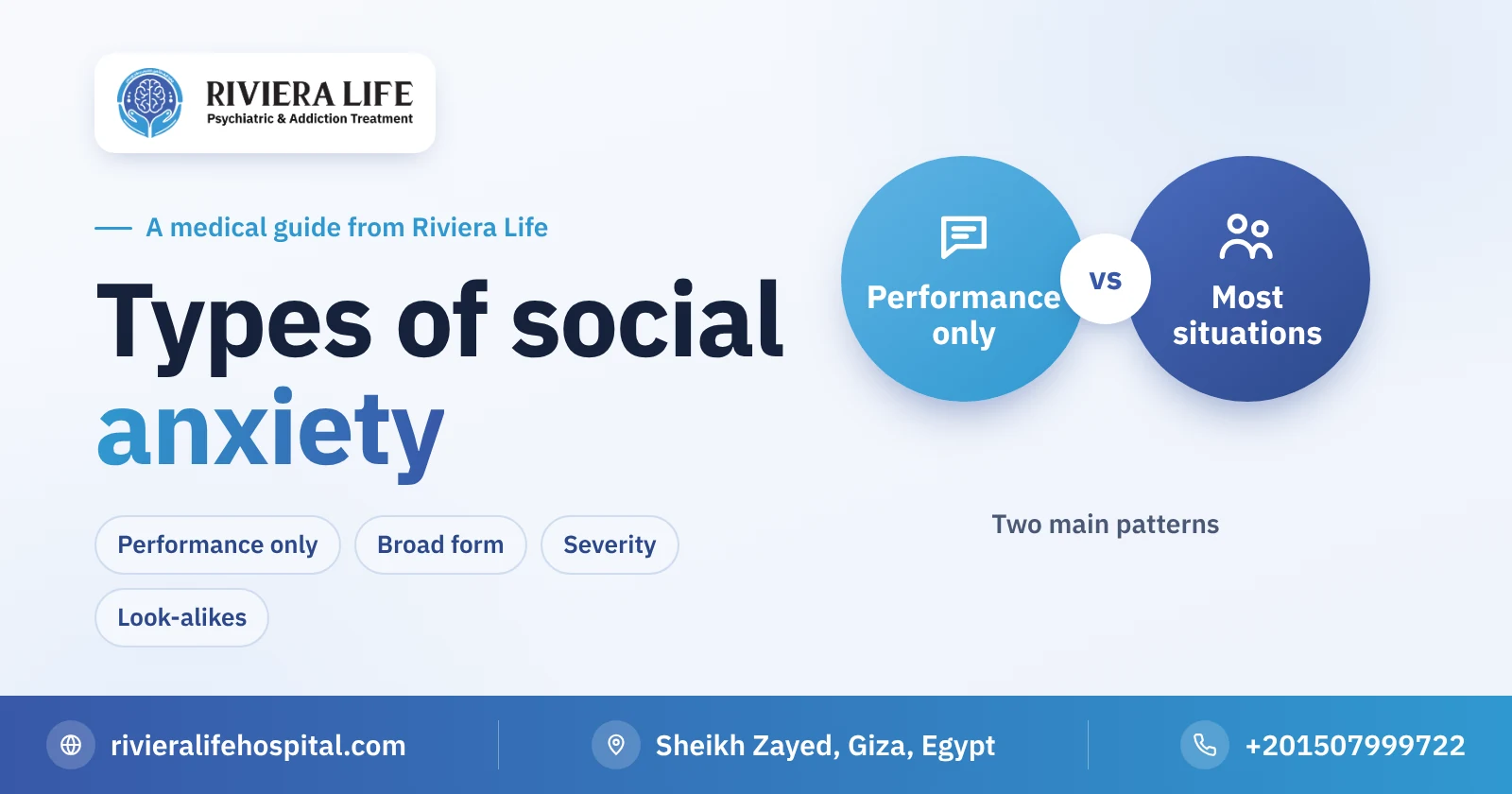
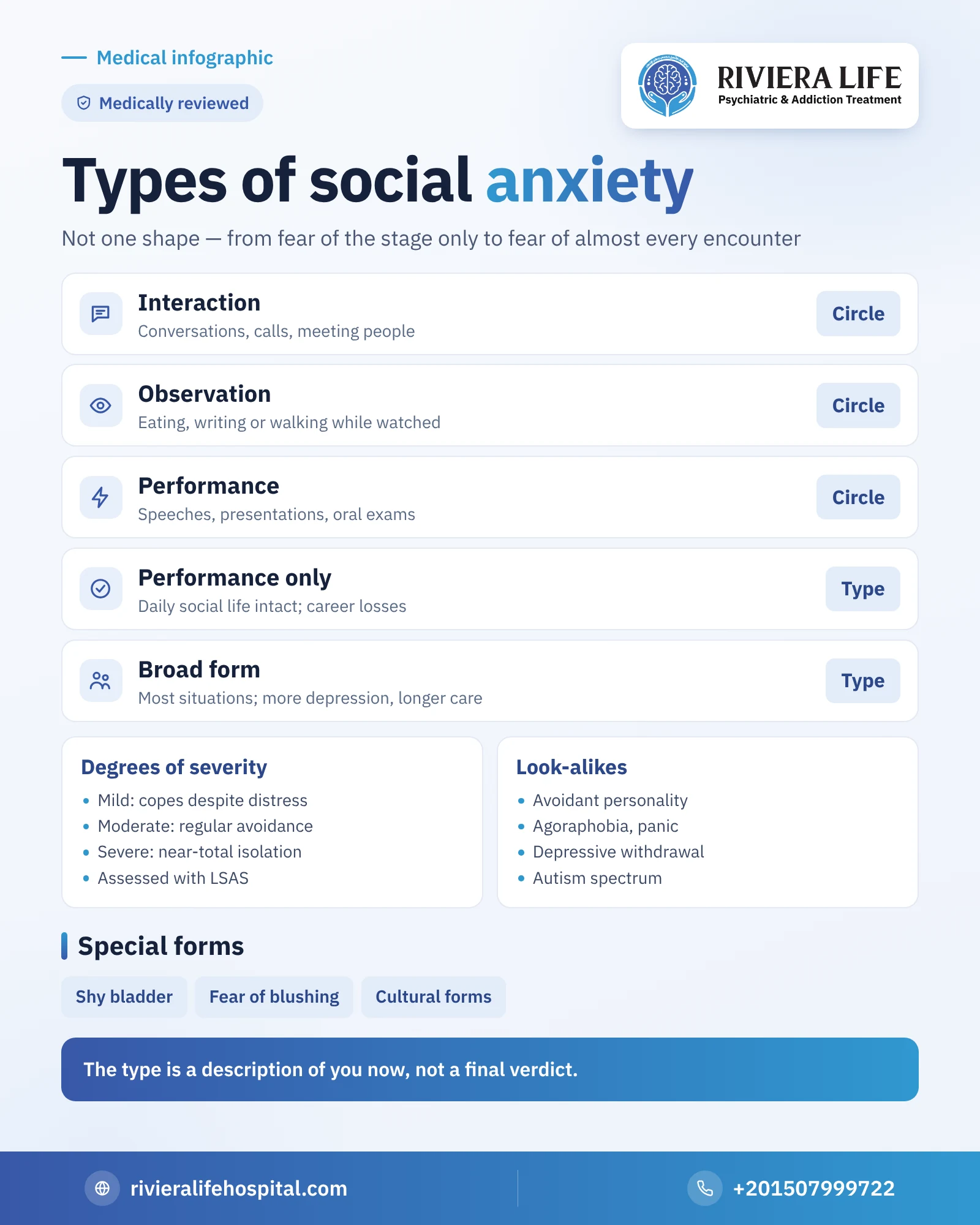
There are several types of social anxiety, as it doesn’t have one shape. There are those who only fear standing in front of an audience and live the rest of their social life with ease, and those whose fear extends to almost every encounter, from a phone call to greeting the neighbors. Doctors distinguish between these two patterns, estimate the severity of the fear as mild, moderate or severe, and distinguish social anxiety from disorders close to it. The following classifications are simplified for explanation, and the precise diagnosis is made by a doctor or psychologist after assessment.
How do doctors classify social anxiety today?
The fifth edition of the American Diagnostic and Statistical Manual of Mental Disorders, and the eleventh revision of the International Classification of Diseases, include social phobia among anxiety disorders under the name “social anxiety disorder”. Neither divides it into many types as you may read on some websites. Almost the only official thing is the “performance only” specifier in the American manual. Other descriptions in circulation, such as “generalized” or degrees of severity, are tools doctors and researchers use to describe the condition more precisely, not independent diagnoses.
Three circles of feared situations
Before talking about types, it helps to know that social situations usually fall into three circles, and a person may fear one circle or all three:
- Interaction: conversation with others, getting to know people, phone calls, appointments, and expressing a differing opinion.
- Observation: eating, drinking, writing or walking while someone watches.
- Performance: public speaking, presentations, oral exams, and singing or playing music in front of an audience.
Type one: performance-only anxiety
Here the fear is limited to speaking or performing in front of an audience. A young doctor deals with her patients and colleagues easily, but trembles and stammers when asked to present a case at the department meeting. A musician plays comfortably in rehearsal and freezes in front of the audience. When this fear disrupts study or career, and continues for long months, the doctor sets the diagnosis with the “performance only” specifier. People with this pattern are usually less prone to depression and isolation, because their daily social life is intact, but their professional losses may be great.
Type two: broad social anxiety
The fourth edition of the American manual called it “generalized”, and many doctors still use the description. Here the fear covers most of the circles of interaction, observation and performance together. The person avoids crowded lifts so they don’t have to greet anyone, arrives late at work so as not to meet colleagues in the corridor, and orders food through the app to avoid talking to an employee. This pattern usually starts early, is more linked to depression and substance use, and needs a longer treatment plan.
Degrees of severity: mild, moderate and severe
Diagnostic criteria don’t set official severity grades for social anxiety, but doctors estimate it through the interview and approved scales, the best known being the Liebowitz Social Anxiety Scale (LSAS). The following description is approximate:
Mild
Clear tension in specific situations, with the ability to face them despite distress. Avoidance is limited, and life goes on almost normally, though with greater effort.
Moderate
Regular avoidance of a number of situations, and a noticeable effect on study or work, such as declining to stand for a position or not taking part in lectures, with increasing reliance on safety behaviors.
Severe
Fear extending to most situations, almost complete isolation, and stopping work or study, often accompanied by depression or dependence on alcohol or sedatives. This degree deserves urgent assessment, and may need an intensive program.
Special forms you may see
- Shy bladder: inability to urinate in public toilets when others are nearby. Some researchers consider it a form of social anxiety, and others a separate problem.
- Fear of blushing: in some people the whole fear centers on the face going red and others noticing it.
- Cultural forms: in some Asian cultures the fear turns towards bothering or harming others through one’s gaze or body odor, rather than towards being embarrassed, and the American manual refers to this form when discussing cultural factors.
Close disorders that need distinguishing
An important part of diagnosis is the doctor ruling out conditions that resemble social anxiety on the surface:
- Avoidant personality disorder: a pattern extending since early adulthood of feeling inadequate and intense sensitivity to rejection. It overlaps a lot with the broad form of social anxiety, and both may be diagnosed together.
- Selective mutism: a child unable to speak in particular situations, often accompanied by social anxiety.
- Agoraphobia and panic disorder: the fear in them is of being unable to escape or of the attack itself, not of people’s evaluation. The details of the difference are in the article on types of anxiety.
- Body dysmorphic disorder: the person avoids people because of preoccupation with a flaw they see in their appearance.
- Withdrawal in depression: the depressed person moves away from people because they have lost desire and energy, not out of fear of their judgment, although the two may come together, as we explain in the depression guide.
- Autism spectrum: the social difficulty in it concerns understanding the rules of communication, not the fear of evaluation alone.
A quick comparison table
| Condition | Focus of the fear or difficulty | Example |
|---|---|---|
| Performance-only anxiety | Evaluation while speaking or presenting | A student freezing in an oral exam |
| Broad social anxiety | Evaluation in most situations | Avoiding greetings, calls and restaurants |
| Avoidant personality | A constant feeling of inadequacy and fear of rejection | Avoiding close relationships for many years |
| Agoraphobia | Difficulty escaping or getting help | Avoiding transport and markets |
| Depressive withdrawal | Loss of desire and energy | Staying in the room without feeling fear |
How does the doctor arrive at this description?
One question isn’t enough. The doctor asks the patient to describe specific recent situations: where they were, who was present, what they feared would happen, and what they did to protect themselves. Then they ask about the age at which the fear began, and about situations that don’t cause anxiety, because these define the range precisely. The patient may fill in an approved questionnaire to estimate severity, which is repeated after weeks of treatment to measure improvement.
Does the form differ between children and adults?
The criteria are almost the same, but the picture differs. A child may not realize their fear is exaggerated, so doctors don’t require this realization in them, and they express their fear by crying, freezing or refusing school, and the anxiety must appear with peers, not only with adults.
An adult usually knows their fear is bigger than the situation, and lives a conflict between their wish to take part and their fear of it. In older people social anxiety may appear in a new form linked to weak hearing, hand tremor or a change in appearance, so the person fears these changes will be noticed, and here the doctor needs to distinguish between fear proportionate to a health condition and excessive fear that deserves treatment.
Why does identifying the type matter?
Because the plan changes with it. Performance-only anxiety may improve with fewer sessions focused on exposure to public speaking, and the doctor may discuss with the patient using a medicine to ease physical symptoms in specific situations. The broad form usually needs longer cognitive behavioral therapy, and the doctor may add a medicine taken regularly, with attention to accompanying depression or substance use. The details of each option are in the article on social anxiety treatment.
Does the type change over time?
Yes, sometimes. The fear may start limited to oral exams at university, then widen to include work meetings and family occasions if avoidance continues without treatment. The reverse is also true: with treatment the broad form may shrink to limited tension in a few situations that can be lived with. That is why the classification isn’t a final verdict, but a description of your condition now. If you want to know the signs pointing to each pattern, see the article on social anxiety symptoms.
More from the social anxiety guide
- Social anxiety: the complete guide
- Social anxiety symptoms
- The causes of social anxiety
- Social anxiety treatment
Questions many people ask
Official classifications don't divide it into many types, but doctors distinguish in practice between anxiety limited to performing in front of an audience and a broader form covering most situations.
It is intense fear limited to speaking or performing in front of people, such as public speaking, a presentation or an oral exam, with relative ease in other social situations.
They overlap a lot, but avoidant personality is a deeper, longer-standing pattern of feeling inadequate and sensitive to rejection, and both may be diagnosed together in the same person.
They estimate it from the interview and the extent of avoidance and its effect on life, and may use approved scales that are repeated during treatment to follow improvement.
This may happen if avoidance continues for years without treatment, and early treatment reduces this likelihood.