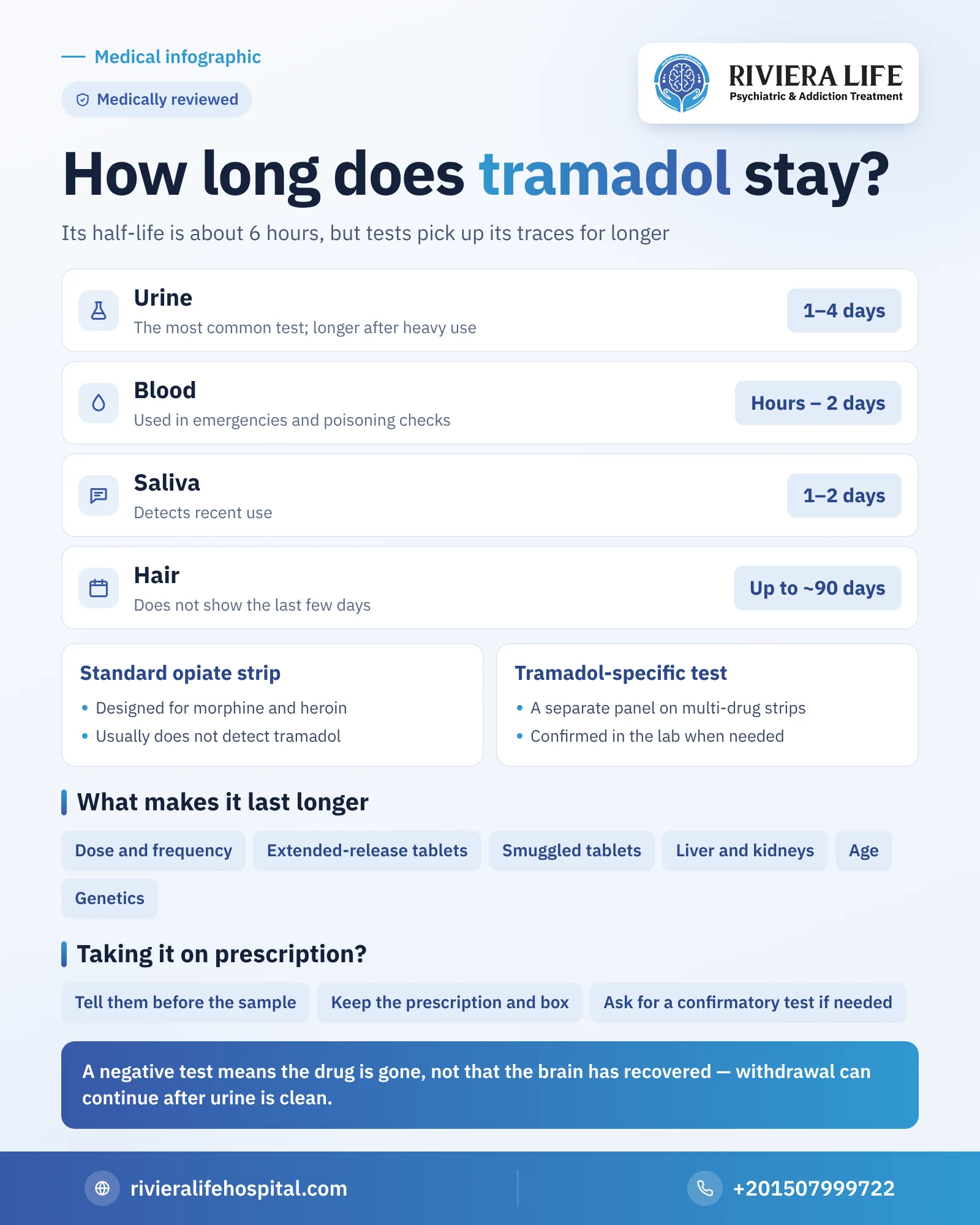
How long tramadol stays in your system depends on which sample is tested. In urine it is usually detectable for about one to four days after the last dose; in blood and saliva the window is shorter, roughly one to two days; and a hair test can reveal use for weeks, up to around 90 days.
These are approximate figures. They shift with the dose, how often the drug is taken, the type of tablet, and how well the liver and kidneys are working. One point many people miss: the standard opiate strip usually does not detect tramadol at all — a dedicated tramadol test is needed. This article explains how the body clears tramadol, how long it shows up in each type of test, and why results differ from one person to another.
How does the body get rid of tramadol?
Once swallowed, tramadol is absorbed from the gut and reaches the bloodstream within one to two hours. The liver then breaks it down into several compounds, the most important being an active metabolite responsible for much of its pain-relieving effect. The kidneys finally excrete tramadol and its metabolites in urine. Because the liver and kidneys are the main exit route, any weakness in either organ slows the process and keeps the drug in the body for longer.
What is the half-life of tramadol?
Half-life is the time the body needs to clear half of the amount of a substance present in the blood. For tramadol it is around six hours in a healthy adult, slightly longer for its active metabolite, and longer again in older people and in those with liver or kidney disease. The body generally needs about five half-lives to eliminate most of a drug — roughly a day and a half to two days. Sensitive tests, however, pick up far smaller traces, which is why the urine detection window stretches beyond that.
How long tramadol stays in your system by test type
| Sample | Approximate detection window | Typically used for |
|---|---|---|
| Urine | One to four days, sometimes longer after heavy use | The most common test at work and in treatment |
| Blood | A few hours to about two days | Emergency care and poisoning assessment |
| Saliva | About one to two days | Detecting recent use |
| Hair | Up to about 90 days | Showing a pattern of use over several months |
These windows are estimates, not a guarantee for anyone: laboratories differ in how sensitive their equipment is, and people differ in how quickly they clear the drug.
When does tramadol stop showing up on a drug test?
With occasional use, tramadol usually stops showing up in a urine test about four days after the last dose, and in blood and saliva after roughly two days. After high doses, daily use over a long period, or extended-release tablets, the urine window can stretch to five days or a little more. Hair testing is the exception, as it may reveal use for around 90 days.
There is a third situation in which tramadol is missed even though it is present: when a standard opiate strip is used. In most cases that strip does not recognize tramadol, so the result is a false negative unless a tramadol-specific test is requested.
Does tramadol show up on a standard drug test?
This is where many people get it wrong. The classic “opiates” strip was designed mainly to detect morphine, codeine and heroin, and tramadol is chemically different enough to slip past it most of the time. That is why laboratories, and many multi-panel strips, include a separate tramadol panel. If the aim is to find out whether someone is using tramadol, that specific test has to be requested; otherwise a negative result may not reflect reality.
Screening tests versus confirmatory tests
A rapid test, whether a strip or a laboratory analyzer, relies on an immune-based reaction that gives a result within minutes. It is not infallible: rarely, it can give a false positive because of cross-reaction with other substances, or a false negative when the amount is small. Its result is therefore considered preliminary. A confirmatory test is carried out in the laboratory using chromatography and mass spectrometry, identifies the substance with high accuracy, and is usually requested when important decisions at work, in court or in treatment depend on the result.
Factors that lengthen or shorten how long tramadol stays in your body
- Dose and frequency: daily use of large amounts builds up in the body, so it lingers longer than a single dose.
- Tablet type: extended-release tablets release the drug over many hours, which extends the detection window.
- Smuggled tablets: their strength is unknown and they may contain far more tramadol than people assume.
- Liver and kidneys: weakness in either one slows elimination.
- Age: older adults clear tramadol more slowly.
- Genetics: the activity of the liver enzymes that convert tramadol varies from person to person.
- Other medications: some drugs slow these enzymes and change the level of tramadol in the blood.
Drug testing in an emergency
When someone arrives at the emergency department with a seizure, deep drowsiness or unexplained agitation, doctors often request quick blood and urine tests. The goal here is not to prove drug use but to identify the substances involved so the right treatment can be chosen. Finding tramadol alerts the team to the risk of repeated seizures and serotonin syndrome, and finding pregabalin or sedatives alongside it raises concern about breathing.
Because test results can take time, what helps doctors most in the first minutes is a companion who can tell them what the patient took, ideally bringing any blister packs or boxes found. Don’t hide anything out of fear of the consequences; accurate information in an emergency can shorten the path to the right treatment.
Is there a way to flush tramadol out of your system faster?
Online and in some pharmacies you will find recipes and drinks that promise to “cleanse the body” in a day. There is no medical evidence that any of them safely speeds up the elimination of tramadol, and some can strain the kidneys or upset the body’s salt balance. Modern laboratories also check the integrity of the sample itself, so a diluted or tampered sample is detected and treated as an unacceptable result. The only real route is time and stopping the drug — preferably under medical supervision.
If you take tramadol on prescription
If you take tramadol on a valid prescription, a positive result is expected. Keep your prescription and the medicine box, and tell whoever is requesting the test, or the doctor in charge, before the sample is taken. Don’t leave out any other medication you are taking either, because the full list helps interpret the result accurately. And if you have been taking it for a long time and feel you can no longer stop, it may be a good moment to review the warning signs in our article on tramadol addiction symptoms.
Tramadol leaving your body does not mean dependence is over
A urine test may come back negative after four or five days while the person is still in the middle of withdrawal: unable to sleep, sweating, anxious and craving the drug. A test measures whether the substance is present, not the state of a brain that has adapted to it. That is why treatment decisions are never based on a negative result alone. What happens in the days and weeks after stopping is explained in detail in our article on tramadol withdrawal symptoms.
Families should also know that tolerance drops quickly after stopping. If someone goes back to their old dose after a few days without it, they risk a seizure or poisoning — especially if it is combined with pregabalin or sedatives. To understand what tramadol does to the body over the long term, see our article on the harmful effects of tramadol.
How is drug testing used during treatment?
In treatment programs, regular tests are carried out in agreement with the patient, and their purpose is to help, not to catch anyone out. They reassure the team and the family that things are stable, reveal any relapse early before it grows, and give the patient tangible evidence with which to rebuild trust at home. They usually cover tramadol and the substances most often mixed with it, such as pregabalin, hashish and sedatives. You can read about every stage of the plan in our article on tramadol addiction treatment.
If you are looking for the bigger picture on how long other opioids such as morphine and codeine stay in the body, see our article on opioid detection times.
Can you detox your body from tramadol quickly?
This question comes up often from people with a test coming up, or from those who want to stop as fast as possible. The honest answer is that there is no guaranteed, safe shortcut. Products marketed as “detox cleansers” have no medical evidence behind them; what actually determines how fast tramadol leaves the body is how the liver and kidneys work, how much was taken and for how long.
Here are the most common beliefs compared with what doctors know:
- Belief: drinking large amounts of water washes the drug out. Reality: excessive water can disturb blood salt levels and does not change the drug’s half-life.
- Belief: herbs and supplements burn the drug off. Reality: no reliable studies show this, and some of them put extra strain on the liver.
- Belief: stopping suddenly is the fastest solution. Reality: it can trigger withdrawal, with its symptoms and possible seizures.
The medical answer is detox under the supervision of a specialist team that eases symptoms, watches for danger signs and puts a plan in place for life after stopping. You will find the details in tramadol addiction treatment, and what to expect while stopping in tramadol withdrawal symptoms.
More from our tramadol guide
- Tramadol: the complete guide
- Tramadol withdrawal symptoms
- Signs of tramadol addiction
- Tramadol vs Tamol: what is the difference?
Questions many people ask
Usually for about one to four days after the last dose. The window can be longer after daily use of large amounts or with extended-release tablets.
Usually not, because the standard opiate strip is designed for morphine, codeine and heroin. Tramadol needs its own test, and many multi-panel strips include a separate tramadol panel.
A hair test can reveal use over a period of up to about 90 days, but it usually does not capture the last few days before the sample is taken.
About six hours in a healthy adult. It is slightly longer for its active metabolite and longer again in older people and in those with liver or kidney disease.
Tell whoever requested the test, or the doctor in charge, before the sample is taken, and keep your prescription and the medicine box. A confirmatory laboratory test can be requested if needed.
No. Tamol is a brand name that contains tramadol itself, so the same detection windows apply in urine, blood, saliva and hair. The only difference comes with extended-release forms, which may lengthen the window slightly.