Dealing with someone addicted to tramadol starts with realizing that they rarely look the way families imagine. Many of them work, pray and talk sensibly, but they disappear a few hours after their last pill, their irritability turns into fights, or they talk about a “painkiller” a doctor once prescribed. That is why families get lost between denial and anger.
This article is for those who are sure, or nearly sure: how to deal with someone who takes tramadol every day without getting pulled into a cycle of quarrels, which mistakes threaten their safety, and how to move toward treatment. If you are looking for a general guide to persuading anyone with an addiction to get treatment, it is in how to help someone with an addiction; here, the details are specific to tramadol.
What sets someone addicted to tramadol apart?
Tramadol is an opioid-based painkiller used medically to treat moderate to severe pain, and this medical reputation is the first thing the person with the problem hides behind. They may start with a pill after an injury or back pain, and then the medicine becomes a way to get through the day, to keep going at work or to escape anxiety — or it is taken because of a common, mistaken belief about its sexual effect.
Over time tolerance rises, so the number of pills grows, and then the purpose shifts from seeking pleasure to avoiding symptoms. That is why families notice a sharp temper, shrinking patience and a constant need for money more than any obvious “high”. You will find the precise signs in our article on tramadol addiction symptoms.
The most dangerous mistake: stopping suddenly at home
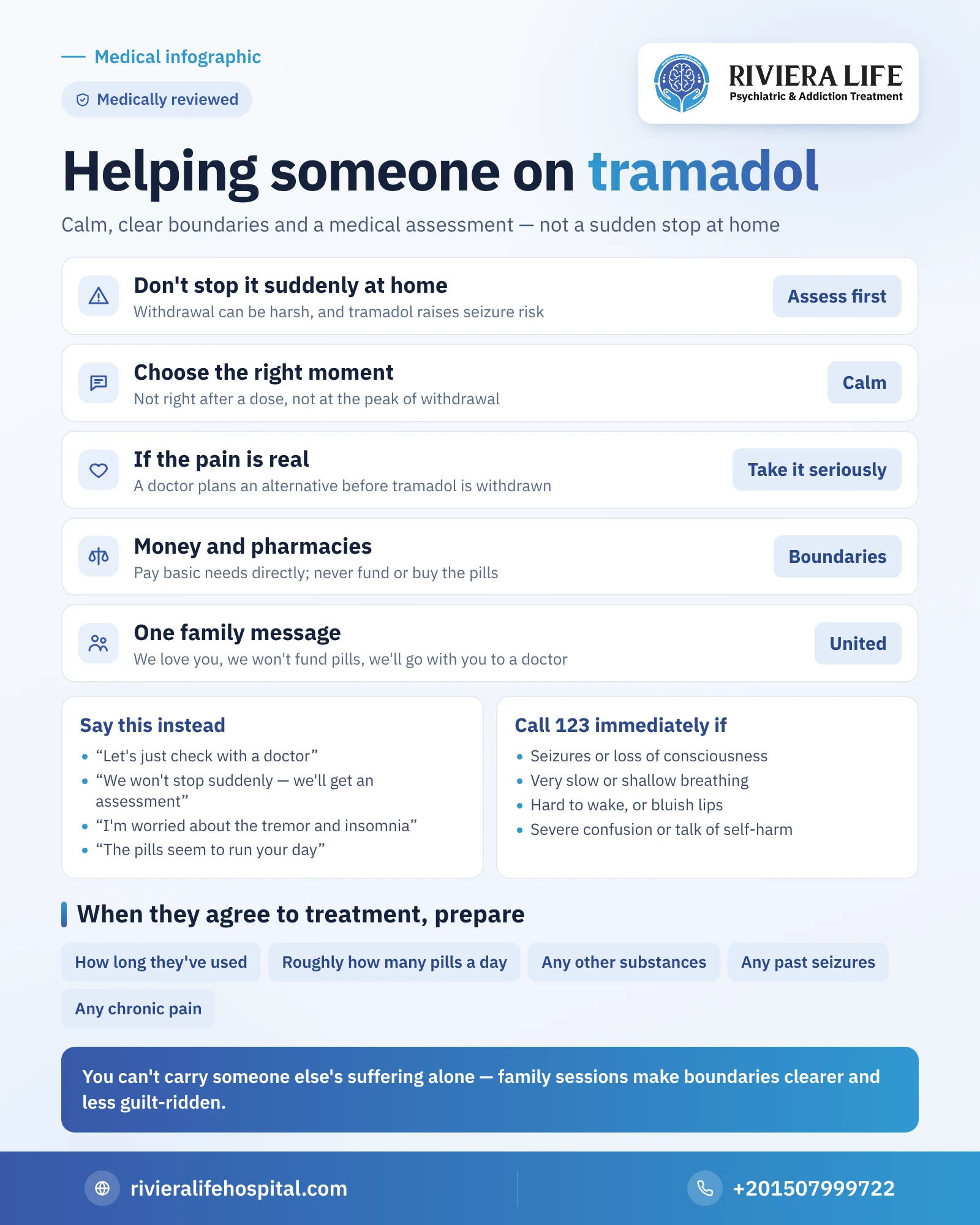
The first thing many families do after discovering the problem is confiscate the pills and announce “no more from today”. With tramadol in particular, this is dangerous. Stopping suddenly after dependence can cause unpleasant withdrawal — aches, insomnia, anxiety, diarrhea and tremor — and in some cases unusual symptoms such as pins and needles, numbness and panic attacks.
Even more dangerous, tramadol itself raises the risk of seizures, especially at high doses or when mixed with other substances, and a seizure is an emergency that can’t be managed in a bedroom. So the right decision is for the person to be assessed medically before any stop. In tramadol withdrawal symptoms you will find the details of what to expect and how it passes.
How do you start the conversation?
Choose a time when they haven’t just taken a pill and aren’t at the peak of withdrawal. The worst is to raise the subject a few hours after the last dose, when they are angry and in pain — and just as bad to raise it while they are under the influence and drowsy. Sit down, keep your voice low and say what you have seen: the change in their sleep, missing work, the money that disappears, the temper that frightens the children.
Instead of accusing them of addiction, ask them how they see their own relationship with the pills, and whether they have tried to stop and couldn’t; some admit it when they don’t feel cornered. And if they say the medicine is “a doctor’s prescription”, don’t argue about it — just ask them to take the matter to a specialist psychiatrist who can review whether they need it.
Phrases that bring them closer, and phrases that push them away
| Instead of | Try saying |
|---|---|
| It’s just a painkiller, don’t exaggerate | I just want us to check with a doctor that it isn’t harming you |
| I’ll throw all your pills away tonight | We won’t stop suddenly; we’ll go for an assessment that keeps you safe |
| If you loved us, you’d quit | I’m worried about the tremor and the insomnia, and I want to understand what’s happening to you |
| You’ve become an addict | I’ve noticed the pills seem to be running your day |
And if the pain is real?
Some people taking tramadol really did start it for chronic back, joint or nerve pain, and this complicates things, because the pain doesn’t go away when the pills end. Don’t ask them to bear the pain alone, and don’t belittle it. What is needed is for a doctor to assess the cause of the pain and set an alternative treatment plan when tramadol is withdrawn; other painkillers, physiotherapy and certain medicines for nerve pain are options the doctor decides on according to the case. The rule remains that any painkiller is started, changed or stopped by the doctor’s decision, not by family trial and error.
Mother, wife, brother: every role has its limits
A mother tends to rescue: she pays, makes excuses and covers up. A wife is worn down by suspicion and expenses. A brother may limit himself to threats. What helps is for everyone to agree on one message: we love you, we won’t fund the pills, and we’ll go with you to a doctor. It is better for the serious conversation to be led by one person — the closest and calmest — rather than everyone taking turns to blame them in the same sitting. And if the wife is facing violence or threats, her safety and that of the people with her comes before everything else.
Money and pharmacies: practical boundaries
Don’t fund the pills or take on debts for buying them, but don’t leave them without basic spending money either. Pay for essential needs directly, and avoid going to the pharmacy yourself to buy for them “so they don’t turn to the street”, as that makes you the official supplier. If they have a prescription — or more than one, from several doctors — ask calmly which doctors are prescribing for them, because multiple prescriptions are a warning sign. Keep any other strong painkillers or medicines in the house locked away, out of their reach.
Mixing with other substances: what should worry you?
Many people combine tramadol with Captagon to stay awake, or with pregabalin, hashish and alcohol to calm down. These mixes raise the risk of seizures, depressed breathing and heart rhythm problems, and they are a common reason for ending up in the emergency department. If they tell you about it, don’t punish them for being honest, and pass it on to the doctor later. Read about the dangers of mixing drugs to understand why a real assessment is needed.
When should you call an ambulance?
Call an ambulance immediately (123 in Egypt) if you see
Tramadol can cause seizures or dangerously slow breathing, especially when mixed or taken in large amounts.
- Seizures or violent shaking with loss of consciousness
- Very slow or shallow breathing, or breathing that stops for a while
- Difficulty waking, or severe drowsiness that doesn’t pass
- Bluish lips or cold skin
- Severe confusion or talk of self-harm
In these moments, protect their safety first and ask about the details afterwards. Our article on drug overdose explains what every household should know.
If they refuse, or promise and then go back
A promise to “cut down” is not treatment, and the first days after the promise are the most dangerous, because they reduce the dose without a plan. Stay calm, offer the medical assessment again every time they are calmer, and gradually stop everything that makes it easier for them to carry on: no cash, no excuses made on their behalf at work, no covering up their mistakes. If they are a danger to themselves or others, there is a legal and medical route explained in involuntary addiction treatment. And the family can book a consultation before they agree, to understand the options.
When they agree to treatment
Act the same day. Prepare information for the doctor about how long they have been using, roughly how many pills a day, whether they have been mixed with other substances, whether there have been seizures before, and whether they have real chronic pain that needs a medical alternative. Treatment begins with an assessment, then a planned withdrawal under supervision, followed by psychotherapy and a relapse-prevention plan, as our article on tramadol addiction treatment explains; the supporting medicines are detailed in medications for tramadol addiction.
Look after yourself too
You can’t carry someone else’s suffering alone. Set hours when you don’t discuss the subject, find someone to lean on, and try not to live waiting for phone calls. Specialist family sessions make personal boundaries clearer and less guilt-ridden. At Riviera Life, many cases begin with a free, confidential family session before the patient decides, followed by a family program during and after treatment. To get in touch: +201507999722.
More from our tramadol guide
- Tramadol: the complete guide
- Tramadol addiction symptoms
- Tramadol addiction treatment
- Tramadol withdrawal symptoms
Questions many people ask
This should not be done at home without a medical assessment. Stopping suddenly can cause unpleasant withdrawal, and tramadol itself raises the risk of seizures. A doctor's assessment comes first.
Don't argue about the prescription itself; ask them to present the case to a psychiatrist or a pain doctor who can review the real need for the medicine and set a safe alternative if necessary.
No. Funding the pills keeps them in the cycle and makes you a partner in it continuing. Pay for their basic needs directly, and look for a prompt medical assessment.
Seizures, very slow breathing, difficulty waking, bluish lips or severe confusion. Call an ambulance on 123 without delay.
The family can start a consultation on its own to understand the options, but treatment itself works better when the patient accepts it. There are specific legal and medical routes in cases of danger to self or others.