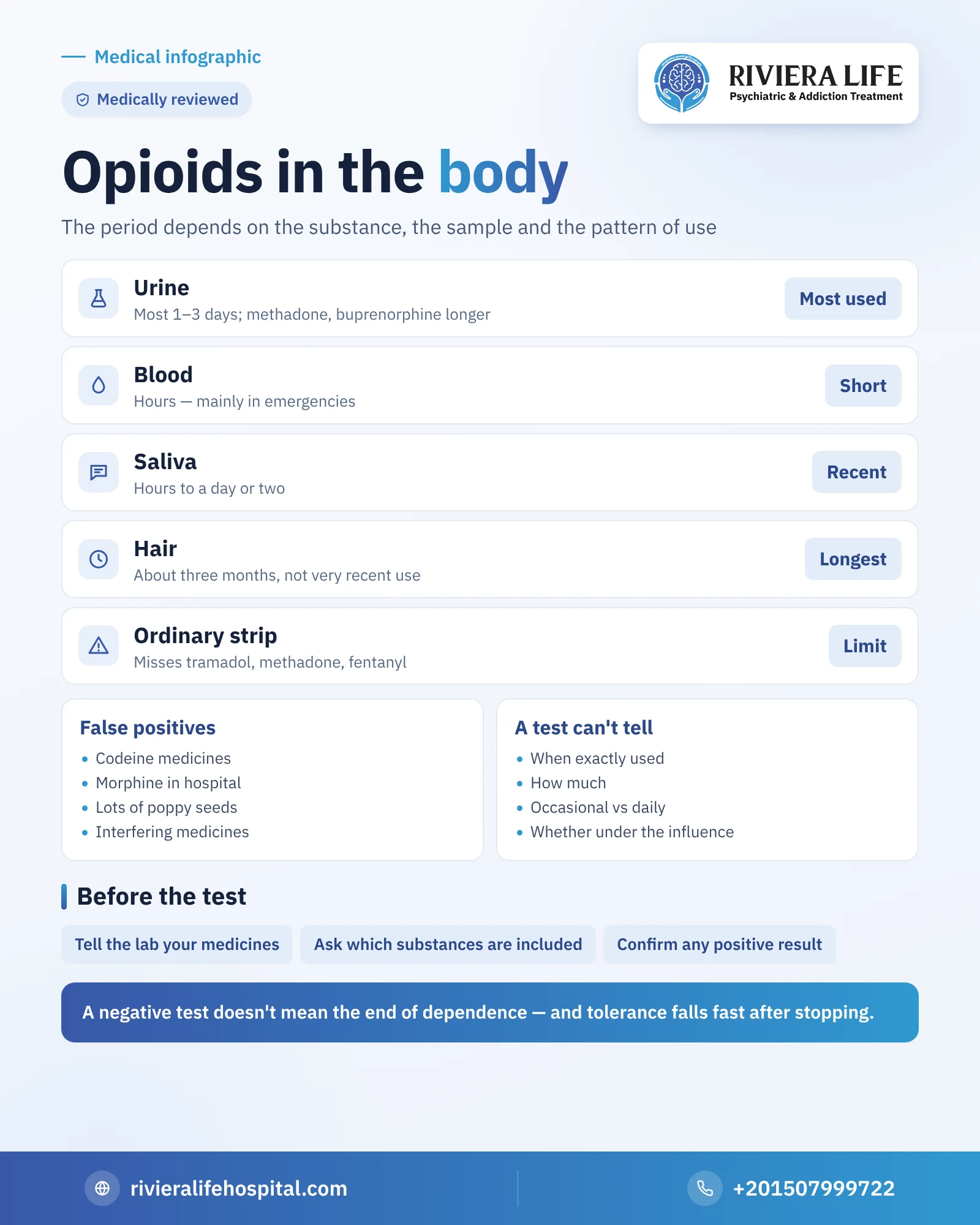
How long opioids stay in the body differs according to the substance and the type of sample: most show in a urine test from about one to three days after the last use, while long-acting substances such as methadone and buprenorphine stay longer, possibly up to a week or more. Blood and saliva detect recent use within hours to a day or two, and hair retains their trace for about three months.
But the more important question many overlook is: is the test looking for the intended substance in the first place? The usual opioid strip doesn’t detect tramadol or a number of synthetic opioids. This article explains the detection periods for each type, the difference between strips, the causes of false results, and what a test can’t say.
Why is there no single period for all opioids?
The word “opioids” brings together substances that are very different in how they break down. Some turn within minutes into another substance, like heroin which becomes morphine, and some are stored in body tissues and released slowly, like methadone with regular use. What the lab looks for also differs: the original substance or its breakdown products. That is why the precise question isn’t “how long do opioids stay?” but “how long does this particular substance stay in this specific sample?”.
Take a practical example: two people did the same test three days after the last use; the first took two tablets of a painkiller with codeine once, and the second has been taking methadone daily for months. Most likely the first’s result will be negative and the second’s positive, even though the period is the same. The substance and its pattern of use determine the result more than the number of days alone.
How long each type stays in a urine test
These are commonly accepted approximate periods after the last use, and they may lengthen with heavy daily use:
| Substance | Urine, approximately | Does the ordinary opioid strip detect it? |
|---|---|---|
| Heroin | One to three days (as morphine) | Yes |
| Morphine | Two to three days | Yes |
| Codeine | One to three days | Usually yes |
| Tramadol | One to four days | No, needs a special test |
| Oxycodone | One to three days | Usually no, needs a special test |
| Fentanyl | One to three days, and longer with repeated use | No |
| Methadone | Three to seven days, and may be longer | No |
| Buprenorphine | Up to about a week or more | No |
For the details specific to each substance there are separate guides: how long heroin stays in the body, how long tramadol stays in the body, and how long morphine stays in the body.
Types of samples and what each detects
Urine
The most used in labs, workplaces and treatment programs, because it is easy to collect and detects use over the past few days.
Blood
Its window is short, usually measured in hours, and it is used mainly in emergencies to assess an unconscious patient or one suspected of poisoning, not to detect old use.
Saliva
It detects recent use within roughly hours to a day or two, and its sample can be taken directly in front of the person responsible for the test.
Hair
It provides the longest detection period, as the part next to the scalp carries the trace of opioids for about the past three months. However, it doesn’t show very recent use, since hair needs some time to grow out of the skin, nor does it determine a particular date of use.
Why doesn’t the opioid strip detect all opioids?
The rapid strip relies on antibodies designed to recognize the shape of the morphine molecule and what resembles it. That is why it easily picks up heroin, morphine and codeine, but doesn’t reliably recognize opioids that differ in their chemical shape, such as tramadol, methadone, fentanyl and buprenorphine, and usually oxycodone. Each of these has a separate strip or test.
This explains a situation that recurs often: a family does a home test for a son who uses tramadol, and the result comes back negative and they are reassured, while the strip simply wasn’t looking for this substance. On the other hand, if the doctor needs to know exactly what the patient is using, they request a panel of tests that includes the required types by name.
Factors that change how long it stays
- Pattern of use: daily use extended over months lengthens the period compared with occasional use.
- Type of formulation: extended-release tablets and patches stay longer than fast-acting ones.
- The liver and kidneys: any weakness in their functions slows elimination of the substance.
- Genetics: the liver enzymes that break down codeine and tramadol differ between people, so the conversion and the period change.
- Age and general health.
- The sensitivity of the test and the cutoff the lab uses.
Positive results that don’t mean use
The opioid strip may show positive for completely legitimate reasons:
- Prescribed cough medicines or painkillers containing codeine.
- Treatment with morphine or another opioid in hospital.
- Eating a large amount of baked goods with poppy seeds.
- Some antibiotics and other medicines may interfere with some types of strips.
That is why the lab must be told about all medicines used before the test, and no decision should be built on an initial strip result.
Screening test and confirmatory test
The rapid strip or the first test in the lab gives only an initial result. The confirmatory test, however, is done with devices such as chromatography coupled with mass spectrometry, which identify the substance by name and measure its concentration, and can distinguish between codeine, morphine and heroin. Any positive result on which an important decision will depend, at work or within the family, deserves this confirmation.
How do you read the test result sheet?
Test results are usually written with English abbreviations. The word OPI or MOR usually refers to the morphine and natural opioids group, while tramadol appears under the abbreviation TRA, methadone under MTD, buprenorphine under BUP, and fentanyl under FYL or FEN depending on the manufacturer. Next to each abbreviation you will find the word negative or positive, and sometimes a number representing the cutoff, that is, the lowest concentration the lab considers a positive result.
A negative result means the substance isn’t present or is present at a concentration below this cutoff, not that it was never used. And if the name of the substance that worries you doesn’t appear on the sheet at all, it means the test didn’t look for it. That is why you should ask the lab before paying for the exact list of substances included.
What can’t a test say?
A test answers one question: is the substance present above a certain level? But it doesn’t determine precisely the time of use or its amount, doesn’t distinguish between someone who tried it once and someone who depends on it daily, and doesn’t say whether the person was under the influence at the moment the sample was taken. Diagnosis needs a medical assessment that combines the test, symptoms, history and behavior, the behavioral side of which is explained in the article on opioid addiction symptoms.
Tests during treatment
In treatment programs urine tests are done periodically, and their purpose is follow-up, not punishment: making sure of stability, adjusting the medicine, and detecting any relapse early. Someone receiving methadone or buprenorphine as part of treatment is expected to have the medicine show in their test, which is why these medicines are checked with special tests that confirm adherence to them. The article on opioid addiction treatment explains the role of these medicines.
The substance leaving the body doesn’t mean the end of dependence
The test becomes negative after days in most cases, but prolonged symptoms and urgent craving may continue for weeks or months, as the article on opioid withdrawal symptoms explains. More dangerously, the body’s tolerance falls quickly after stopping, so returning to the old amount may be enough to stop breathing.
If a test result has raised your concern about someone close, you can discuss it at Riviera Life with a specialist doctor confidentially, and understand what it really means before any confrontation.
How long opium stays in the body
Raw opium contains both morphine and codeine, so when it is suspected the lab looks for morphine and its derivatives. In occasional use this usually appears in urine within about one to three days after the last time.
The period lengthens in someone who has used it daily for years, because the substances accumulate in the tissues and leave slowly, and in the elderly and those with weak kidneys or liver. It also differs by method: eating delays absorption and extends the excretion time a little, and smoking arrives faster and leaves faster.
This explains why some long-time users show a longer trace than expected, and why the results of two people who used the same amount differ. The body doesn’t deal with everyone at the same speed, and age, weight and kidney function all enter the calculation.
Blood and saliva only detect recent use within hours, and hair carries a trace that extends for months. And no test determines the amount used, nor does it alone distinguish between raw opium and pharmaceutical morphine. To learn about the substance itself read the article on opium and its effect on the body, and what matters after the period ends is treating the dependence itself, as in opium addiction treatment.
How long codeine stays in the body
Codeine is partly converted in the liver into morphine, which is why a morphine result may show positive in someone who took a cough syrup or tablets containing it. In urine it can usually be detected within about one to three days after the last use, while it stays in blood and saliva a few hours to a day.
The period is affected by the number of times of use, by liver and kidney functions, and by differences in the speed of converting codeine from person to person for genetic reasons. The test alone can’t distinguish between medicinal use with a prescription and misuse; that is determined by the doctor after examination and medical history. That is why someone taking a medicine containing codeine with a prescription is advised to inform the lab and the doctor before any test. Hair also retains the trace of repeated use for months, but it isn’t useful for determining the time of the last dose precisely.
For details about this substance and its conversion into morphine see the article on codeine, its uses and risks, and if use has gotten out of control the path is explained in codeine and cough syrup addiction treatment.
More from the opioids guide
- Opioids: the complete guide
- Types of opioid painkillers
- Opioid addiction symptoms
- Opioid withdrawal symptoms
- How long nalbuphine stays in the body: does it show in a test and for how many days?
Questions many people ask
Most show from about one to three days after the last use, while methadone and buprenorphine may stay a week or more, and the period lengthens with heavy daily use.
The ordinary opioid strip is designed for morphine and similar substances and doesn't reliably detect tramadol; tramadol needs its own strip or test.
A hair test usually reflects roughly the last three months, but it doesn't detect very recent use in the last few days.
Yes, with codeine medicines, morphine treatment, eating a large amount of poppy seeds or interference from some medicines, which is why the initial result needs a confirmatory test.
No, the substance leaves the urine within days while craving and brain changes continue for months. Diagnosis needs a medical assessment, not a test alone.