There is no “single medicine” that ends tramadol addiction, but there is a range of medications that the doctor uses according to what each patient needs: medicines that ease the physical symptoms of withdrawal, others that treat the anxiety and depression that appear after stopping, and special precautions against seizures. In some cases of severe dependence the doctor may turn to buprenorphine or methadone, and once detox is complete naltrexone may have a role in preventing relapse. This article explains each category, why it is used and when, without any doses, because medications for tramadol addiction are chosen for each patient individually and under direct medical supervision.
Why does tramadol withdrawal need different medicines from other drugs?
Tramadol is not a pure opioid. It activates opioid receptors and at the same time raises serotonin and noradrenaline in a way that resembles some antidepressants. That is why its withdrawal has two faces:
- An opioid face: muscle and bone aches, sweating, a runny nose, diarrhea, insomnia and strong cravings.
- A face resembling the sudden stopping of antidepressants: severe anxiety, panic attacks, mood swings, a pins-and-needles or “electric” feeling in the limbs, and sometimes confusion.
This second face is what makes the medication plan different, so treating aches and diarrhea alone is not enough. The stages of withdrawal and their timing are explained in our article on tramadol withdrawal symptoms.
Gradual tapering: the first medicine is the withdrawal method itself
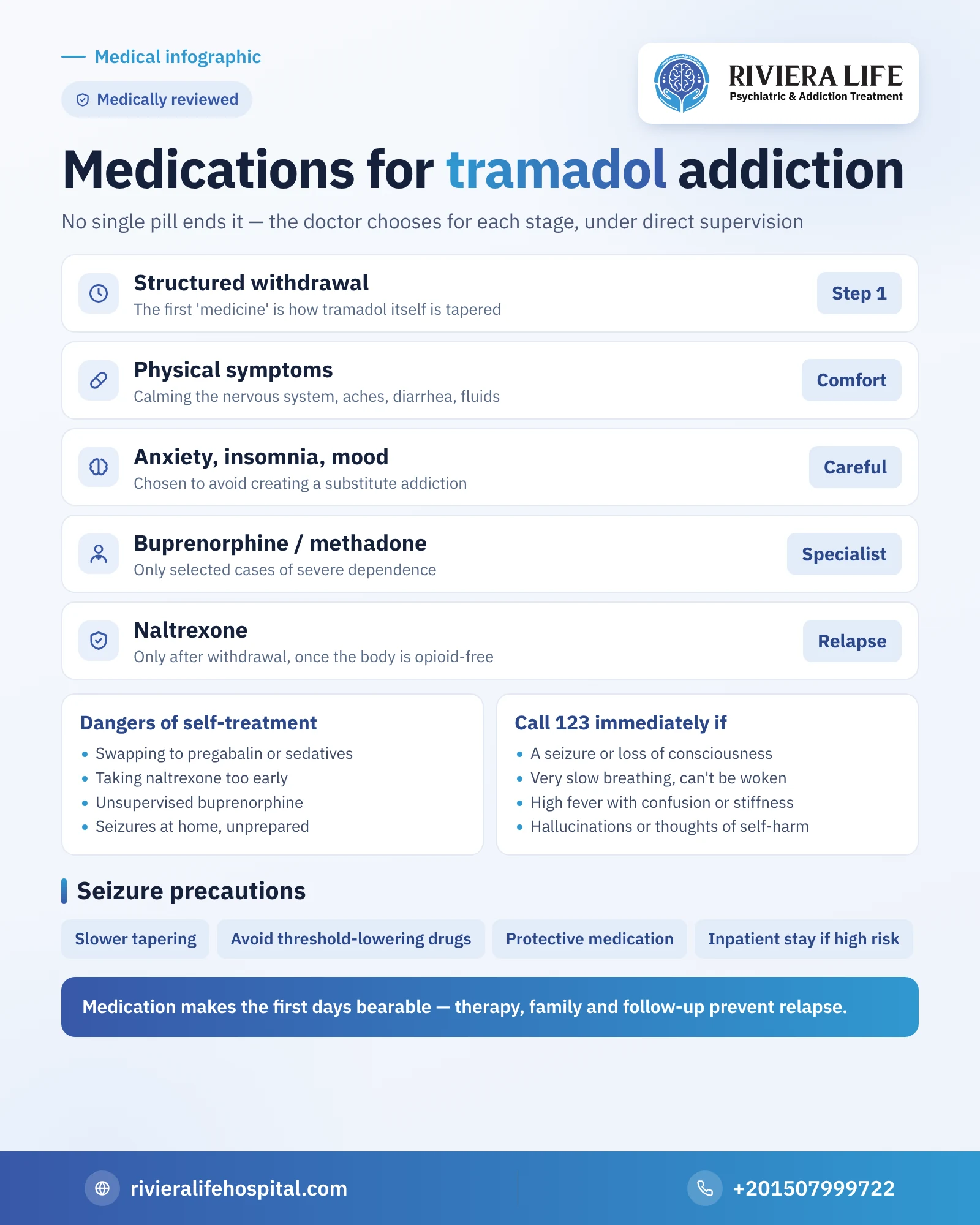
Before talking about any additional medicine, the doctor decides how tramadol itself will be withdrawn. In many cases structured, gradual tapering is easier on the body than a sudden stop; in other cases the doctor replaces tramadol with a longer-acting medicine and then withdraws that slowly. This decision depends on the actual amount, the duration of use and any other substances, and a patient should never set their own tapering schedule at home.
Medicines that ease the physical symptoms of withdrawal
The doctor chooses from several categories according to the symptoms present:
- Medicines that calm an overactive autonomic nervous system, easing sweating, a fast heartbeat and physical tension.
- Non-opioid painkillers for muscle and joint aches.
- Medicines for diarrhea, nausea and cramps.
- Replacing fluids and salts when needed.
These medicines don’t treat the addiction, but they make the first days bearable, which reduces the chance that the patient will drop out of treatment halfway and go back to the tablet.
Anxiety, insomnia and mood swings
This is where the antidepressant-like part of tramadol shows its effect. Many patients describe days of severe anxiety, distress and insomnia that are harder than the physical aches. The doctor deals with this using medicines chosen for sleep and anxiety, preferring ones that do not cause dependence, for a set period. If a patient needs a strong sedative in the first days, it is given under direct supervision with a clear plan for stopping it, because this category in particular can turn into a substitute addiction.
Buprenorphine and methadone: who are they for?
Most tramadol patients don’t need these medicines; a structured withdrawal with symptom treatment is enough. But some cases resemble addiction to strong opioids in their severity: very large amounts for years, repeated failed attempts to stop, or a move to other opioids. In these cases a specialist doctor may decide to use:
- Buprenorphine: a partial opioid that eases withdrawal and craving with a safer effect on breathing, and needs precise timing at the start so that it doesn’t cause sudden withdrawal. Details are in our article on buprenorphine.
- Methadone: a long-acting opioid used in structured programs under strict oversight, with drug interactions that need monitoring. Our article on methadone explains it.
Using either one is a decision taken by a doctor specializing in addiction treatment after a full assessment, and it is only started or stopped on their decision.
Naltrexone after withdrawal is complete
Naltrexone blocks opioid receptors, so someone who takes tramadol or another opioid doesn’t feel the usual effect, which helps some patients stay steady in the first months. But its basic condition is that the body must be completely free of opioids; otherwise it causes sudden, severe withdrawal. That is why it is only started after the withdrawal stage has ended and the doctor has confirmed this. It suits best a patient who is motivated to recover and supported by their family. You will find its details in our article on naltrexone.
Seizure precautions
Tramadol can cause seizures during use, and the likelihood may rise in certain circumstances during withdrawal. So in the first assessment the doctor asks about any previous seizure, the amounts used and any accompanying substances. Based on that, they may:
- Choose a slower withdrawal for someone with a history of seizures or who uses large amounts.
- Avoid medicines known to lower the seizure threshold.
- Add protective medication in selected cases.
- Prefer an inpatient stay under continuous supervision when the risk is high.
Call an ambulance immediately (123 in Egypt) if you see
While tramadol is being used, or during an attempt to stop it.
- A seizure or loss of consciousness
- Very slow breathing, or drowsiness the person can’t be woken from
- A very high temperature with confusion or muscle stiffness
- Hallucinations, severe confusion or thoughts of self-harm
Treating depression after stopping
Some patients started tramadol because it “fixes the mood”, so it was hiding an old depression or anxiety. When they stop, this depression appears clearly, and it can be the strongest reason for relapse. Here the psychiatrist assesses the situation and may prescribe a suitable antidepressant. Timing matters: combining tramadol with certain antidepressants can cause serotonin syndrome, so the doctor arranges to start after withdrawal or within a calculated plan, and a patient should never start an antidepressant on their own while still using.
Why is self-treatment dangerous?
In Egypt, tramadol withdrawal “prescriptions” circulate on social media, and some pharmacies sell ready-made “courses”. The dangers we see as a result keep repeating:
- Replacing tramadol with pregabalin or sedatives, so the addiction becomes double. Our article on pregabalin vs tramadol compares the two substances.
- Taking naltrexone too early, causing violent withdrawal that pushes the patient straight back.
- Getting buprenorphine outside medical supervision and using it at the wrong time.
- Seizures at home with no preparation for them.
- Starting an antidepressant while still taking tramadol, with the risk of an interaction that carries.
Medication is part of the plan, not the whole plan
Even the best medication plan does not prevent relapse on its own. What protects the patient afterwards is psychotherapy, treating any original pain with suitable alternative painkillers as our article on alternatives to tramadol explains, involving the family, and follow-up after discharge. The full program, its stages and its length are the subject of our article on tramadol addiction treatment.
How can you be sure medication treatment for tramadol addiction is managed safely?
The right hospital for tramadol addiction treatment is one with experience in both faces of its withdrawal — opioid and psychological — that can handle the risk of seizures and uses medication with care. Ask before you decide:
- Does the doctor set a written withdrawal plan that fits the actual amount and duration?
- Is there round-the-clock medical supervision to deal with a sudden seizure?
- Does the team have experience with buprenorphine and naltrexone, and with when each one fits?
- Does it treat anxiety and depression after stopping with medicines that don’t cause a substitute addiction?
- Does it deal with people who mix tramadol with pregabalin or sedatives?
- Is there follow-up and a family program after discharge?
And don’t trust a place that promises you a guaranteed cure or complete withdrawal in two or three days.
Why Riviera Life for tramadol addiction treatment?
Here is what Riviera Life offers in this area:
- Official license: a hospital licensed by the Ministry of Health for psychiatry and addiction treatment.
- Specialist consultants: consultants in psychiatry and addiction treatment choose the right medication for each stage.
- 24-hour supervision: continuous medical follow-up during withdrawal to deal with any seizure or complication.
- A calculated medication plan: treating withdrawal symptoms, anxiety and depression without a substitute addiction.
- Long experience: fourteen years in addiction treatment and thousands of people in recovery.
- Mixed-substance cases: organized withdrawal plans for people who combine tramadol with other substances.
- Complete confidentiality: the privacy of the patient and their family is protected at every stage.
- Family and aftercare: a family program and follow-up after discharge to prevent relapse.
The first consultation is free, and you can reach us around the clock on +201507999722. We are based in Sheikh Zayed, Giza.
More from our tramadol guide
- Tramadol: the complete guide
- Tramadol addiction treatment: the stages and relapse prevention
- Tramadol withdrawal symptoms and their stages
- Tramadol and sex
Questions many people ask
No medicine flushes tramadol out or shortens withdrawal to a day. What the doctor does is a structured withdrawal with medications that ease the symptoms, while the body clears the substance on its own.
No. Naltrexone is used after withdrawal is complete and the body is free of opioids; taking it before then can cause sudden, severe withdrawal.
No. Most cases need only a structured withdrawal plan with symptom treatment. Buprenorphine or methadone is used in selected cases of severe dependence, on the decision of a specialist doctor.
Because tramadol raises serotonin and noradrenaline alongside its opioid effect, so its withdrawal brings psychological symptoms similar to stopping some antidepressants suddenly.
An official license, consultants in psychiatry and addiction, and round-the-clock medical supervision to deal with seizures, together with complete confidentiality. Riviera Life in Sheikh Zayed offers all of these, with a free first consultation.