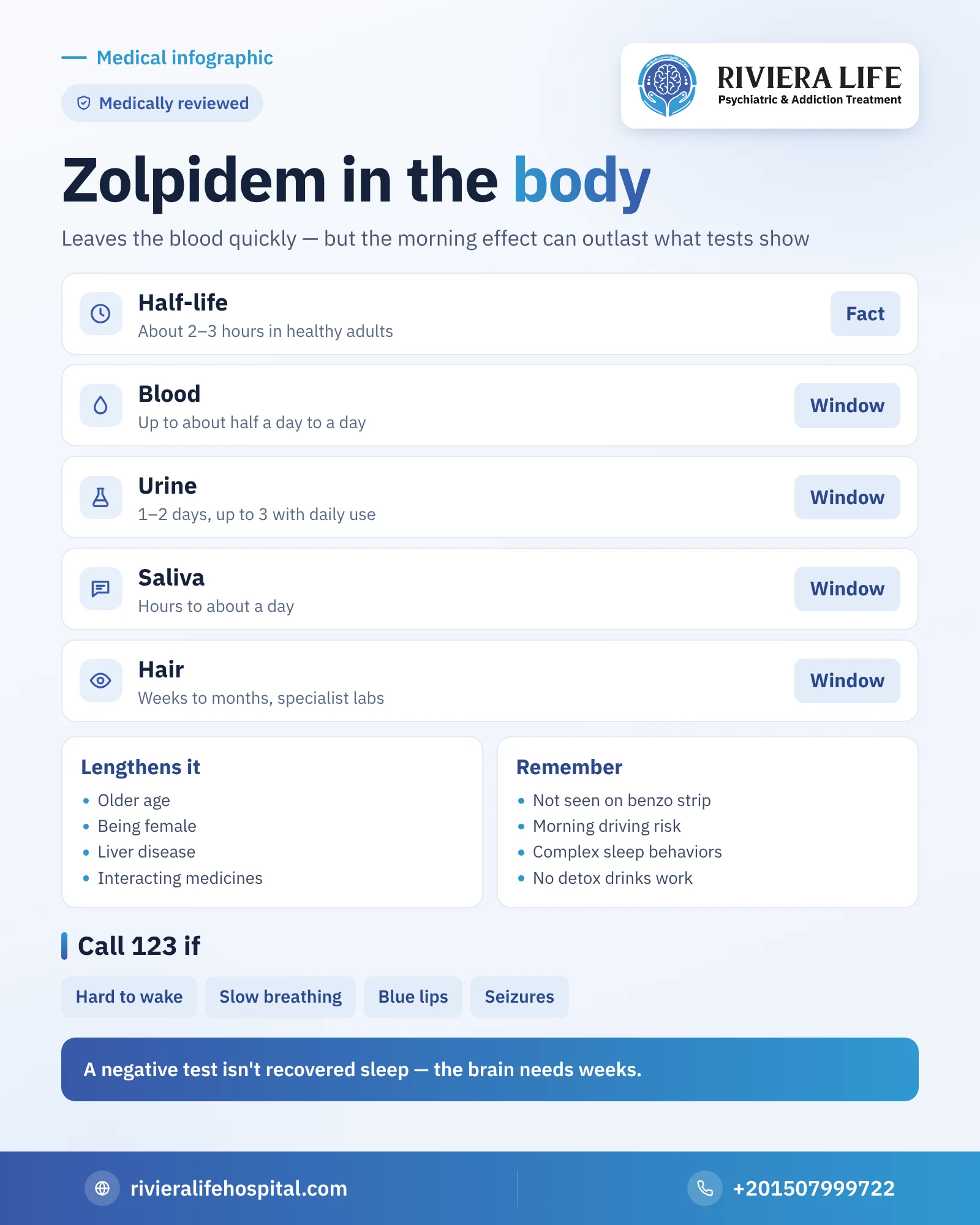
How long zolpidem stays in the body is short compared with most sleeping pills: its blood concentration halves in about two to three hours, most of it disappears from the blood within a day, and its by-products can usually be detected in urine for about one to two days.
But these figures change in older people, liver patients and women, and the lingering effect on driving and concentration the next morning lasts longer than the drug’s clear presence in tests. It doesn’t show up in the routine benzodiazepine test despite acting on the same receptors. This article explains how the body processes the drug, the detection windows by sample type, and everything that lengthens or shortens them.
How does the body deal with zolpidem?
Zolpidem is absorbed quickly from the intestine and peaks in the blood within about an hour, which is why the person falls asleep shortly after taking it. Then the liver breaks it down, with most of the work done by an enzyme called CYP3A4 helped by other enzymes, converting it into pharmacologically inactive by-products. These by-products then leave mostly in the urine and to a lesser degree in the stool. Since the by-products are usually what is looked for in samples, the test detects not only the drug itself but what it left behind in the body.
This speed is both a blessing and a trap. A blessing because the drug wears off quickly and doesn’t stay with the person through a long day when taken as prescribed. A trap because its effect wearing off in the morning wakes the insomnia and tempts the user to take it night after night, or to take an extra tablet if they wake in the middle of the night. The details of what happens on stopping are gathered in the article on Night Calm withdrawal symptoms.
The half-life and what it means in practice
The half-life is the time it takes for the drug’s blood concentration to fall to half. For zolpidem it is around two to three hours in healthy adults, according to pharmacological sources, and the general rule says most of the drug is gone after about five times this period, i.e. about half a day to a day. Extended-release tablets are designed to keep drug levels up for longer at night, but the final half-life doesn’t change much. These figures are approximate, and vary genuinely between individuals.
The detection window by sample type
The figures are approximate for an adult with a healthy liver and kidneys, and apply to ordinary, not heavy, use:
Blood
Reflects the last few hours, and can usually be detected for up to about half a day to a day. It is used in emergencies, road accidents and medical investigations to estimate the drug’s effect at the moment of the incident.
Urine
The drug and its by-products usually appear in it for one to two days after the last tablet, and this may extend to three days with sensitive equipment and with long-term daily use. It is the most commonly used sample in follow-up.
Saliva
Data are fewer, and it is expected to detect recent use within hours to about a day; it is sometimes used in roadside testing.
Hair
Traces may be detected in hair for weeks to months in specialized laboratories; this is rarely requested, in special cases, and doesn’t determine the time or amount of use precisely.
Does zolpidem show up in a benzodiazepine test?
Usually not. Zolpidem isn’t a benzodiazepine in its chemical structure, even though it acts on the same “GABA” receptors. And because rapid screening tests rely on catching the chemical shape of benzodiazepines, their result is usually negative despite zolpidem having been taken. It is detected only by a specific test requested by name and carried out with chromatography and mass spectrometry, and some extended laboratory panels include it. For comparison with the older class of medicines, see how long benzodiazepines stay in the body.
Why does the effect outlast its disappearance from the blood?
This is the point that matters to drivers and older people more than any test. The blood concentration may have fallen a lot by the morning, but in some people it is still enough to slow reactions and weaken attention, especially if they took the drug late at night or didn’t get eight hours of sleep. That is why drug authorities have strengthened warnings about driving and alertness activities the next day, a warning stronger for women because their bodies clear the drug more slowly on average. So don’t measure your alertness by how you feel, and don’t drive unless you feel completely clear.
Older people: a special case
Ageing slows the liver and increases the brain’s sensitivity to sedatives at the same time. So the drug stays longer and its effect is stronger, and the risks of dizziness, falls and night-time confusion multiply, with a hip fracture an example of the outcome. That is why zolpidem is prescribed to older people with great caution and for the shortest possible time, and if a family notices a parent stumbling at night or seeming confused in the morning after the sleeping pill, it deserves a review of the medicine with the doctor, not putting up with it.
Factors that change the duration
- Age: the liver slows with age, so the drug stays longer.
- Sex: women show higher morning concentrations on average.
- Liver function: in liver disease the half-life may lengthen several times, and the doctor needs to adjust the plan.
- Accompanying medicines: some slow the drug’s breakdown so its concentration rises, such as some antibiotics and antifungals; the doctor assesses this.
- Alcohol: doesn’t change the duration so much as multiply the sedative effect.
- Repeated use: lengthens the detection window compared with a single tablet.
When does the doctor order the test?
It isn’t ordered without a reason. Doctors order it in emergencies for severe drowsiness or unexplained confusion, when complex behavior during sleep is suspected, such as walking, driving or eating without awareness, and in following up people treated for sleeping pill dependence. Anyone taking the drug on prescription should tell the doctor and the laboratory before any test so the result is read in context.
Complex sleep behaviors: what tests don’t show
One reason for health authorities’ warnings is that some people get up from sleep and carry out complex acts without awareness and without remembering them: walking, eating, making calls or even driving. This doesn’t necessarily result from a particular amount, and increases when combined with alcohol or other sleeping pills. The family may discover it before the person does. If something like this happens, don’t wait for a test; tell the doctor the same day.
No mixtures to cleanse the body
There is no drink, herb or amount of water that speeds up zolpidem’s breakdown in the liver. And some of these recipes strain the liver and kidneys themselves. The only solution for those who want to get away from the drug is a plan with the doctor, because stopping it suddenly after long use may bring insomnia back worse, and other symptoms may appear. You will find the stages of stopping safely in zolpidem addiction treatment.
The drug leaving the body isn’t sleep recovering
The result may come back negative after two days, while the brain needs weeks to regain its natural sleep without the drug. For effective non-drug ways of dealing with insomnia see the insomnia guide; to understand how dependence on sleeping pills begins, read sleeping pill addiction; and the overall picture is in the zolpidem guide.
Signs that call for an ambulance
Call an ambulance on 123 immediately if you see
Especially when combined with alcohol, opioids, benzodiazepines or other sleeping pills.
- Difficulty waking the person, or fainting
- Slow, shallow or irregular breathing
- Blue lips or fingers
- Seizures or severe confusion after stopping suddenly
- Severe dizziness with fainting or falling
More from the zolpidem guide
- Zolpidem: the complete guide
- Zolpidem addiction treatment
- Night Calm withdrawal symptoms
- Sleeping pill addiction
Questions many people ask
Usually one to two days after the last tablet, and it may extend to three days with sensitive equipment or long daily use.
Usually not, because it isn't chemically a benzodiazepine, and a specific test requested by name is needed.
About two to three hours in healthy adults, and longer in older people and liver patients.
Yes, its effect on attention and reaction may remain even though its blood level has fallen, more clearly in women and when taken late at night.
No drink or herb has proven effective, and stopping suddenly after long use may bring insomnia back worse, so stopping is done with a plan with the doctor.